Every Type of Plastic Used By LEGO: 2026 Edition
/Today’s guest article comes from Rylie Howerter, one of the LEGO fan community’s foremost color and materials enthusiasts. Her color guide is one of our go-to LEGO references here at BrickNerd, and you can follow her on Flickr, Instagram and Patreon.
A Plethora of Plastics
Back in 2022, I wrote an overview of the materials that LEGO uses in their products. Though I’m not a materials expert by any means, I do enjoy researching and discussing LEGO minutiae, and in the years since that article was published, I have found a few more historic sources for materials used, made some corrections, and been pointed towards other resources by like-minded fans.
What follows is an expanded/revised version of that original article, with additional materials and the same disclaimers: this will never be an all-encompassing list; it is simplified; and I’m sure there are still things I’ve gotten wrong. But like my color resources, I hope it can at least be a jumping-off point for further discussion.
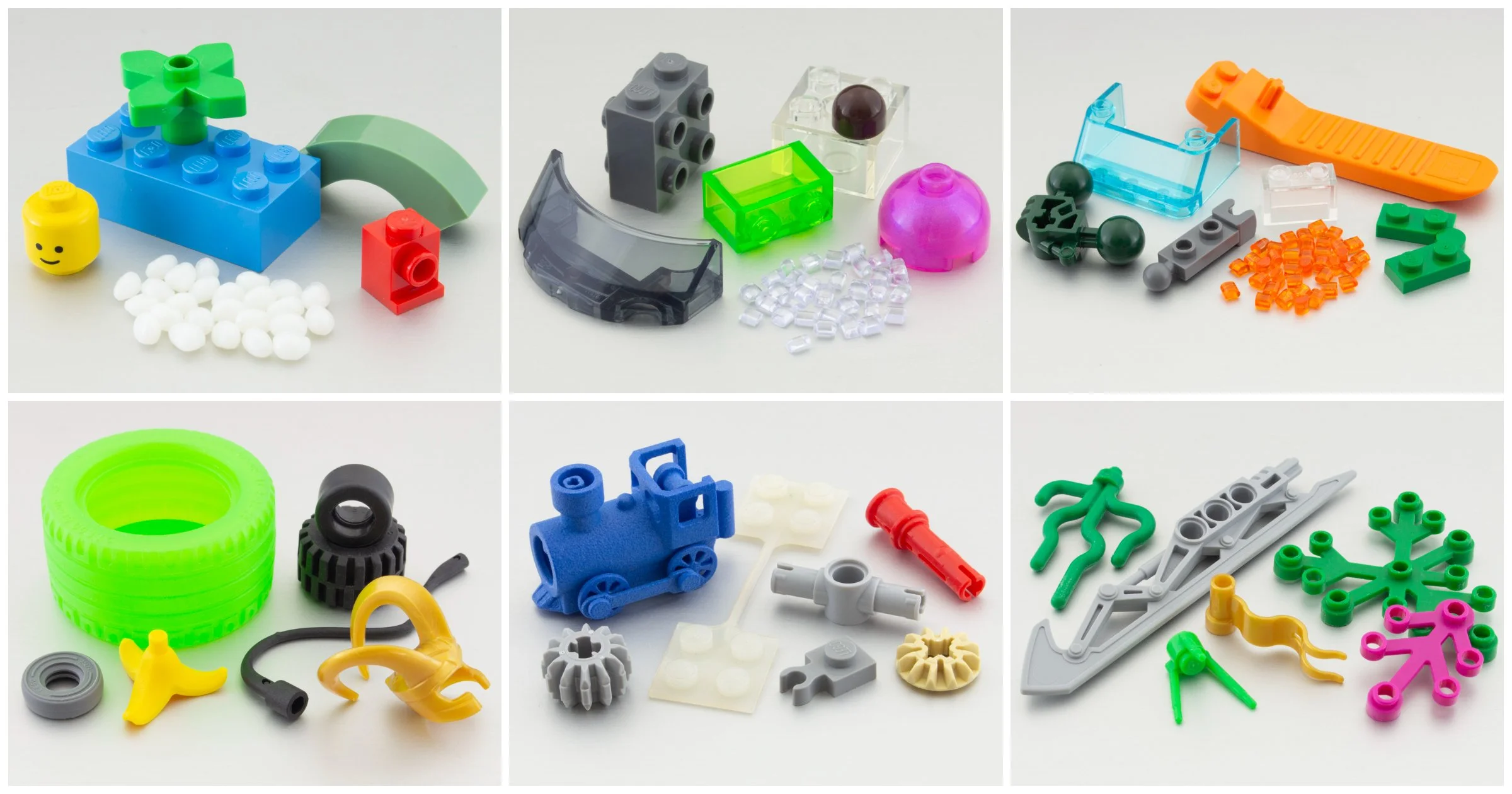
It’s commonly known that most LEGO bricks are made of ABS, but that’s not the only plastic that LEGO uses! Historically and currently, LEGO bricks are made with a variety of materials depending on the use case. This article explores many of them, with a brief overview of the properties of each and when/how they have been used.
Keep in mind that a lot of this is oversimplified: in reality, parts may contain additives and colorants that can further affect how they perform. Often parts will be a blend of multiple plastic types to achieve the desired properties. Most of the plastics I’ll list are really names for families of hundreds of subtly different plastics. LEGO’s exact plastic formulations are trade secrets, and for good reason.
Much of this article was informed by The LEGO Group’s own materials webpage as well as hobbyist researchers such as Gary Istok, Bailey Fullarton, Wouter van Iersel, Wilmer Kardell, and others. All images are my own unless noted otherwise.
ABS (Acrylonitrile Butadiene Styrene)

Fitting that our first material alphabetically is the one that makes up 80% of all LEGO parts. ABS is a strong, stable, scratch-resistant thermoplastic, and has been used by LEGO since 1963. It is a translucent-milky color when uncolored, so it cannot be used for transparent parts. LEGO used to receive their raw ABS granules from Bayer (Novodur), BASF (Luran S), DSM (Ronfalin), and Borg-Warner/Marbon (Cycolac), all of which have long histories of testing 2x4 bricks for LEGO in unusual colors and molds. In 2004, Bayer’s ABS division became Lanxess AG, which now provides LEGO with ABS under the brand name Novodur (colored with Lanxess’s Macrolex dyes).
According to Fabian BL, Svein Strømberg (head of A/S Norske Legio) “brought with him a bag of Cycolac ABS from Borg Warner after a business trip to the US which he gave to Godtfred. In Svein’s funeral Godtfred especially thanked him for his involvement in the change to ABS and success of LEGO.”
At first, red and yellow were difficult colors to produce, so LEGO used the heavy metal cadmium as an additive, resulting in a darker color. Although the amounts used were supposedly well within acceptable limits for toxicity to children, LEGO discontinued using Cadmium in 1973 due to environmental concerns, after Bayer developed a more stable formulation of red and yellow without Cadmium.
ABS/PA
LEGO uses a lot of blends, but this one in particular is of note for appearing in a variety of common parts. The addition of nylon to ABS increases its stress tolerance, making it useful for thin parts that need to flex slightly without breaking.
CA (Cellulose Acetate)

CA is a moderately hard thermoplastic (a plastic that softens when heated and hardens when cooled). It can have very glossy, vibrant coloration and good transparency, but it doesn’t retain its color over time as well as other plastics. Most of the CA LEGO used was Bayer’s Cellidor.
The very first LEGO bricks in 1949 were made from CA, and this use continued through the Town Plan and Samsonite eras. However, CA has a tendency to warp over time, often severely. Many of these bricks are now incompatible with modern bricks due to this deformation. LEGO switched to ABS around 1963 and fully phased out CA by 1970, with Samsonite in the USA as the last holdout.
MABS (Methyl Methacrylate-Acrylonitrile-Butadiene-Styrene)

This newer thermoplastic offers high strength and impact resistance, though it is not quite as strong as standard ABS. However, MABS offers high transparency and can display very bright transparent colors and glitter effects. Since around 2018, LEGO has switched to using MABS for most transparent parts instead of PC. The first MABS parts looked a bit milkier than older transparent parts, but I believe this has improved as LEGO continues to refine the material (read more about the transition in this BrickNerd article). And since 2024, LEGO’s new “arMABS” contains 20% recycled materials from artificial marble kitchen counters.
MABS can also be used for certain opaque colors. Different materials flow and cool in different ways, so traditionally a part made in both opaque colors and transparent colors would need separate moulds to be formed to the same tolerances. Using MABS for both reduces the need for tooling/storage/maintenance for an extra mould. However, not all opaque colors can be made in MABS.
MTPO (Metallocene Thermoplastic Polyolefin)

MTPO (also known as MPO?) is a very soft material that LEGO uses for parts that need to bend sharply without being damaged. I wasn’t able to find much information on this material, but it seems it’s a variant of TPO, a category of thermoplastics blended with elastomers.
PA (Polyamide)

Polyamide, or nylon, is a very strong plastic that holds up against high impact, making it ideal for connectors and gears (even in non-LEGO machinery) where durability is more important than perfect coloration. LEGO used nylon as far back as the 1960s for flexible vehicle couplings and box trays, although today most of these have hardened and are very brittle. Modern Technic bricks with pins, such as 42929, are dual-molded so the brick part is ABS and the pin is PA (this is why they are often listed as “multicombination” even though it’s the same color throughout). I’m not certain about the 3D-printed parts like the train here, but others have suggested that they are SLS-produced Nylon 12, colored by DyeMansion.
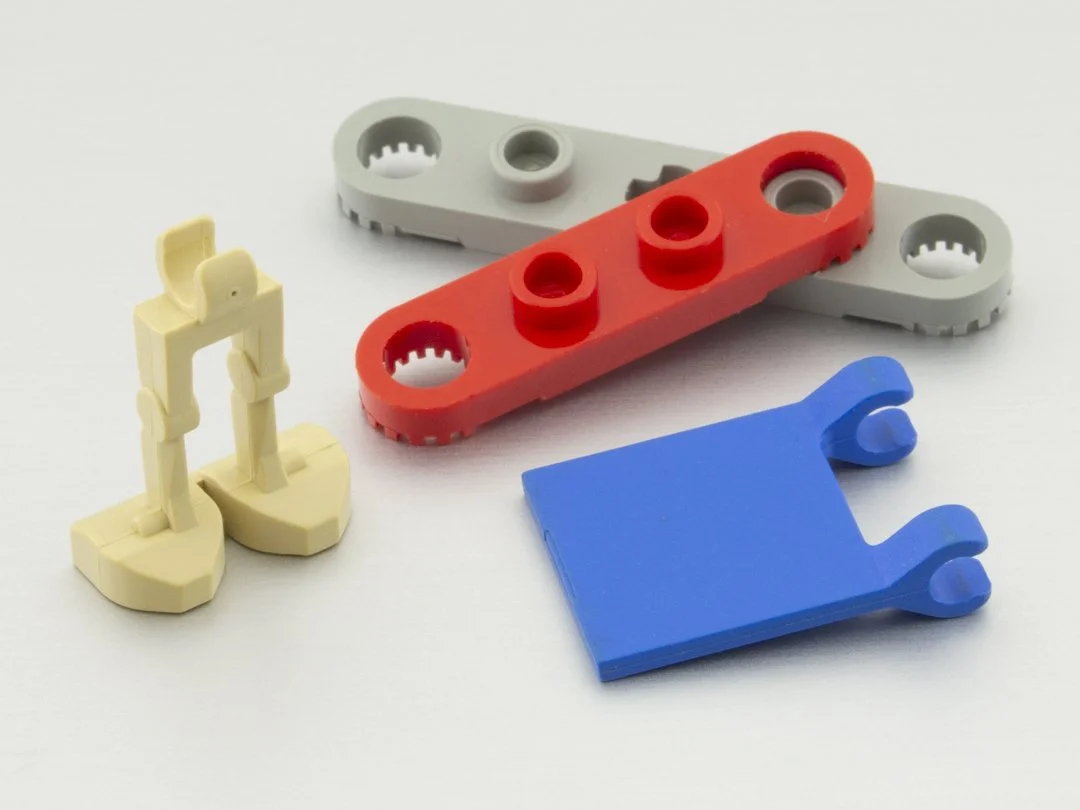
As for the clip plate, only the earliest ones (from Classic Space sets) are made of this material. I would guess that modern ones use PC.
PBT (Polybutylene Terephthalate)
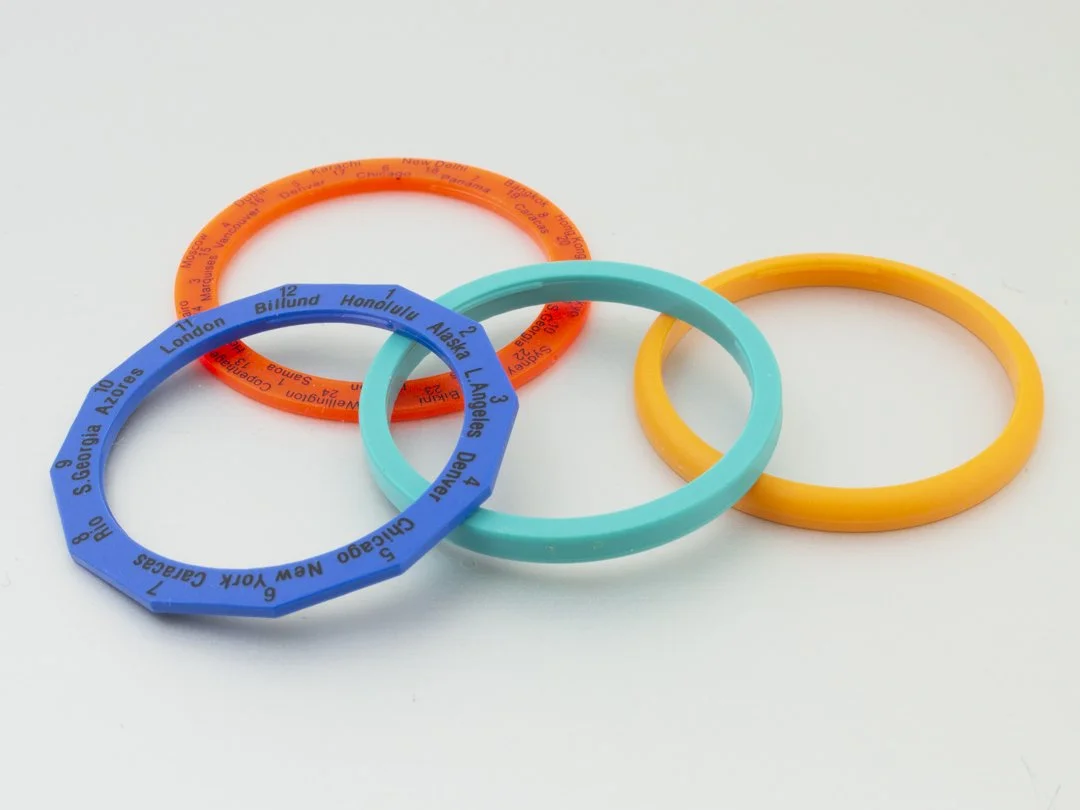
PBT is a thermoplastic that is both strong and stiff, with excellent heat resistance, mostly used in electrical components as an insulator. LEGO used DuPont’s Crastin for early watch rings. (My only source for these watch plastics is Miniland.nl.)
PC (Polycarbonate)

Polycarbonate is a strong material that can be very clear. PC replaced CA for most transparent parts around 1963 (the same time that ABS replaced opaque CA). The vast majority of transparent parts in LEGO’s history are made of PC — but around 2018, LEGO switched to MABS (possibly because PC uses BPA, which is increasingly regulated by the EU), so PC is now only used for opaque parts like hinges and joints that need extra durability.
Transparent PC tends to bond to itself when connected tightly, which is why it’s so difficult to remove a transparent cone from a 4L bar, and PC minifigures only exist as rare, delicate prototypes. The PC LEGO uses is Lanxess’s Makrolon.
PE (Polyethylene)

Polyethylene is a very common thermoplastic with low strength and rigidity, and a low melting point. Its relative flexibility makes it perfect for large, thin parts like leaves and stems, as well as long Bionicle weapons. This photo contains both parts in high-density polyethylene (HDPE) and low-density polyethylene (LDPE): the lower the density, the softer it is.
PE is a very versatile plastic — the thin plastic in LEGO store shopping bags is LDPE, and some carry cases that have a living hinge use HDPE. In 2018, LEGO started sourcing their bio-PE from 98% sugarcane (the small leaf pictured), as part of their long-term sustainability plan. Although the source is different, the end product is (in theory) identical.
PEBA (Polyether Block Amide)

PEBA is a thermoplastic elastomer (TPE) with great flexibility and fatigue resistance. Here, LEGO uses it (most likely blended with other plastics) for a part that may repeatedly experience impact force: the button/shaft on a pneumatic pump.
PET (Polyethylene Terephthalate)

PET, a type of polyester, is a versatile plastic used for water bottles (among a myriad of other items, including fabrics and electronics). LEGO currently uses PET for vacuum-formed clamshell packages such as Build-a-Minifig packages and older set display trays, and has used it for some set containers as well. LEGO had been prototyping actual bricks in this plastic, due to its readily recyclable nature (when not thermoformed), but we will likely never see these in sets (see appendix).
Foamed PLC (Pale Latex Crepe)

PLC is made from natural rubber and used for the large, solid Technic tires from the late 70s. It is very satisfyingly squishy and seems to have held up well over time. The surface texture is a bit uneven (especially around the injection point), and though moulded latex is unlikely to cause an allergic reaction, I can understand LEGO wanting to stop using it entirely.
POM (Polyoxymethylene)

Also known as acetal resin, POM offers high stability and low friction, like PA. POM is more pliable, making it suitable for long axles (and hands!) that need to be able to flex a little without breaking. LEGO used DuPont’s Delrin plastic for at least the watch links, but DuPont isn’t listed in their most recent suppliers list, so I assume they use something else now. LEGO plans to start using a more sustainably-sourced ePOM in 2026.
PP (Polypropylene)

Polypropylene is a tough, flexible plastic used widely for certain Bionicle parts and minifigure parts that might break easily if they were a more rigid plastic. The plastic’s flexibility allows for it to be used as a “living hinge” as in the suitcase pictured here. Because it cannot be fully transparent, colors like 48 Transparent Green (pictured) look nearly opaque in PP, sometimes being mistaken for their solid counterpart color.
Like PE, PP tends to turn whitish along the edges as it wears. It is used for a wide variety of applications outside standard parts, such as large buckets and pick-a-brick cups, and even the polybags that parts and small sets come in.
PPO (Polyphenylene Oxide)

PPO, commonly used as NORYL™, is a high-temperature thermoplastic that is often blended with other materials due to its difficulty in processing and low fatigue resistance. It was used by LEGO in parts where high strength and stability are needed, but has largely been supplanted by ABS.
HIPS (High Impact Polystyrene)

Polystyrene is a very durable plastic, used for early waffle plates and modern baseplates. Despite its impact resistance, it can be brittle and has a tendency to turn white along the edges as it wears (see the factory-cut edge of the baseplate pictured and some play-worn Minitalia bricks). Older polystyrene bricks have a very high-pitched, glassy sound when dropped. I believe LEGO now adds a rubber additive to HIPS to increase its strength and flexibility and reduce the whitening effect.
PVC (Polyvinyl Chloride)

PVC is an extremely common synthetic polymer, third only to PE and PP. It was used for vacuum-formed packaging parts, such as the Classic Space insert here, until it was replaced by PET in 1990, which allowed for a reduced material thickness.
Soft PVC (Polyvinyl Chloride)

…And, judging by a demonstration board put together for a manufacturing school in collaboration with LEGO, PVC (softened with plasticizers) was also used for many LEGO tires in the 70s. It had a tendency to harden and even break with age, so my assumption is that it was later supplanted with SBS and then SEBS.
SAN (Styrene-Acrylonitrile Resin)
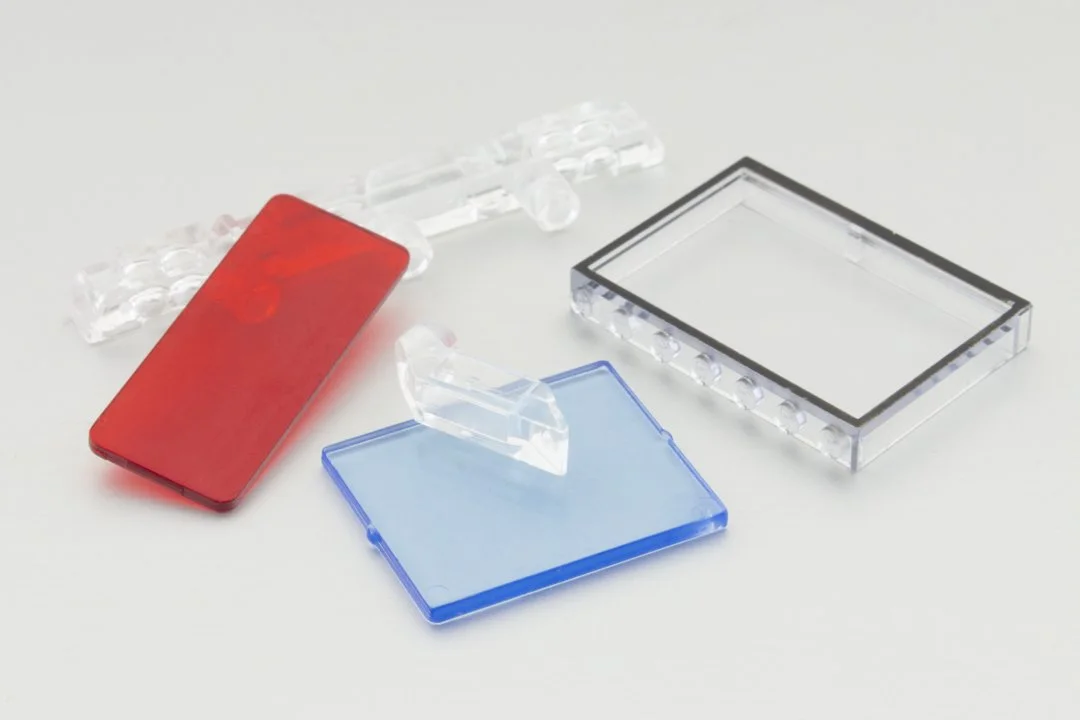
SAN is a very clear, glassy plastic often used for inexpensive drinkware. It is rigid and strong, but can turn yellow over time. Its clarity makes it great for prisms, and I believe LEGO also used it for windscreens and window panes from the 70s to early 90s — these can be identified by a very high-pitched, glassy sound when dropped on a hard surface.
SBS (Styrene-Butadiene Styrene)

SBS is a rubber-like thermoplastic, stronger than SEBS but less stable and less heat-resistant. LEGO used to use this for solid tires (as opposed to larger hollow tires), I’m guessing from the late 70s to the late 2000s.
SEBS (Styrene-Ethylene-Butylene-Styrene)
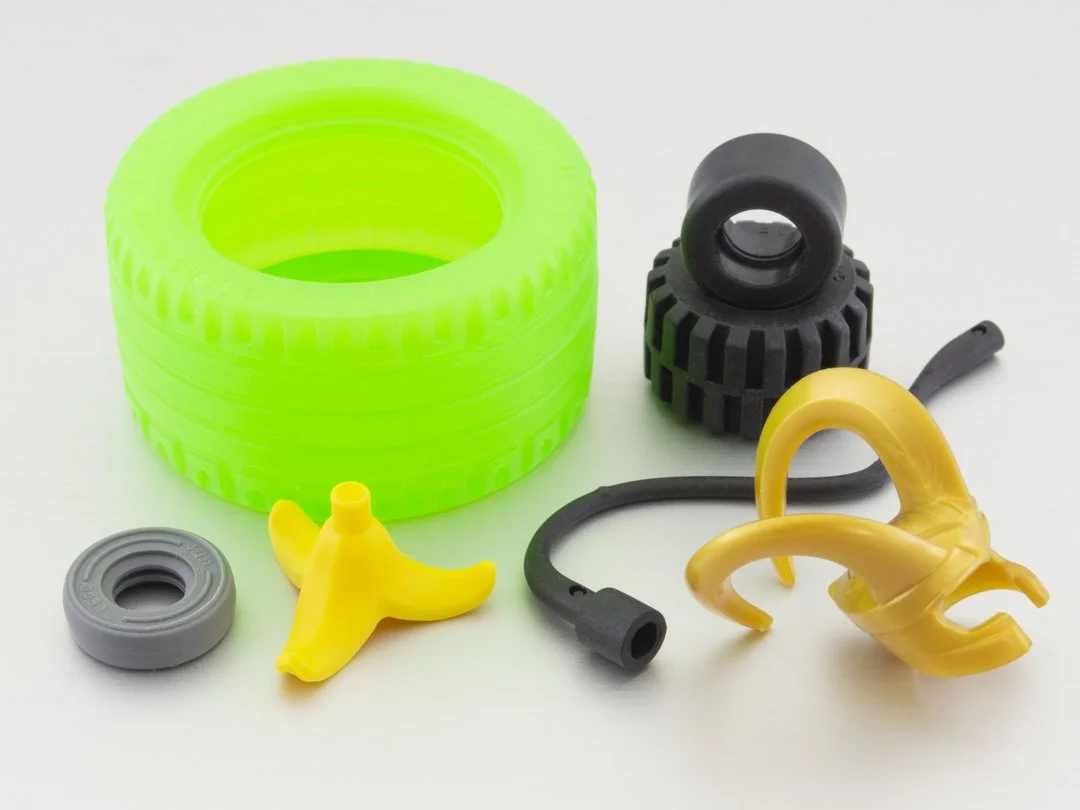
SEBS is a thermoplastic that behaves like rubber, without needing vulcanization. LEGO uses this for tires — and, famously, LEGO makes most of the tires in the world, by number if not by mass! Until the late 2000s, I believe LEGO used SEBS primarily for larger/hollow tires and SBS for solid tires.
TP (Thermoplastic Polyester)

TP is a broad category of materials, including PET, that are strong and can be very transparent. In LEGO, it is both tougher than PC (so the thin fire element doesn’t snap) and softer than ABS (so the brick separator is less likely to damage other bricks).
The brick separator is clearly different from the earlier PC brick separators of the same shape — if you drop it on a hard surface, TP sounds much duller. The flame here came from Pick-a-Brick in 2022 and definitely feels softer than older versions.
TPEE (Thermoplastic Polyester Elastomer)
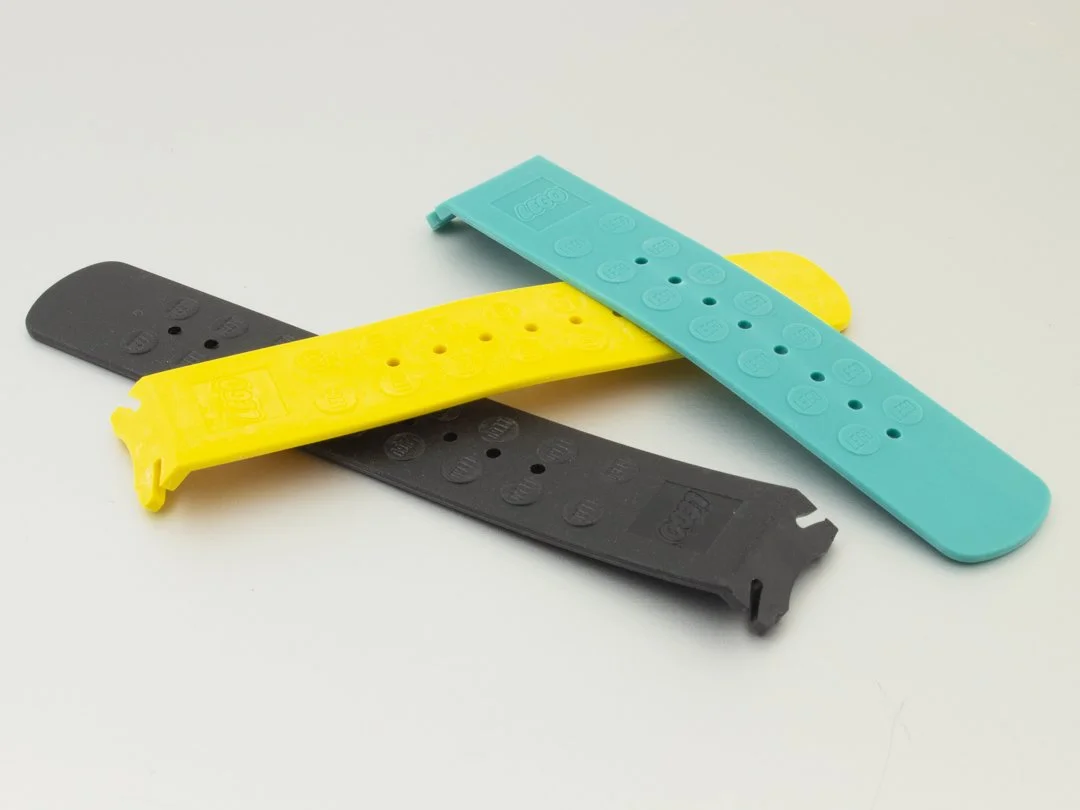
Also known as TPC-ET, TPEE is a rubber-like thermoplastic that has great toughness while also being flexible, often used in automotive parts such as hoses and bearings for its shock absorption and chemical resistance. LEGO used DuPont’s Hytrel for the early watch bands, similarly to how TPU is used today. These bands do seem to hold up over time — they sometimes develop a whitish coating that can be washed off, but I’ve never seen one cracked or broken.
TPU (Thermoplastic Polyurethane)

TPU is a very strong but elastic thermoplastic, perfect for uses where repeated flexing might wear out a weaker material. LEGO uses this for Dots and Vidiyo straps, as well as other semiflexible parts like Duplo dog ears. TPU is harder and stronger than MTPO.
TPV (Thermoplastic Vulcanizate)

TPV is a high-performance elastomer that undergoes vulcanization, a hardening process. Here, LEGO uses it for the diaphragm in a pneumatic pump, as well as a common O-ring tire, which due to its proportions, may have needed something more durable than SEBS.
Bakelite? Catalin? Lucite?

These bricks were produced for LEGO by the Swedish company Geas Konstharts from 1950 to 1953. They are commonly assumed to be Bakelite, and there is some evidence for that. But from my limited readings, it seems they may likely be something else, given the consistent bright colors, lack of strong odor, and slight translucency.
The waters are muddied further by vintage toy collectors often using “Bakelite” and “Plaskon” as umbrella terms for other vintage plastics. I have used Bakelite test pads on my Geas bricks, and they didn’t turn yellow at all, implying that there is, in fact, no formaldehyde present. (I used a speckled Kiddicraft brick as a control, and it did clearly turn the pad yellow, which aligns with it being urea-formaldehyde.)
Then there’s Lucite, an odorless acrylic resin (and another thermoset) created by DuPont in 1937. Although typically transparent, it could be colored brightly and even made opaque, and was used frequently when these bricks were made. Could they be Lucite? Or yet another plastic?
Squishy Bionicle Ammo?

These parts seem uniquely squishy even when compared to MTPO, but I don’t know exactly what the material is. Bionicle squid ammo, thornax balls, and shadow leeches all share this property. Let me know if you have any insight as to what these might be composed of!
Other Materials

The Future of Plastics
That’s all the plastics LEGO has used that I’m aware of. I’m certain I haven’t caught all of them!
In 2015, LEGO announced plans to invest 1 billion DKK (~$150k USD) in developing new sustainable materials for their products over the following 15 years, kicking off with the 2016 opening of their LEGO Sustainable Materials Centre in Billund. In 2018, the first plant-sourced polyethylene parts started appearing in sets. By 2020, plastic shopping bags were being phased out in LEGO stores. And in late 2020, LEGO announced that they were massively reinforcing their sustainability plan, investing $400k USD to replace all packaging with sustainable materials (as well as other “social responsibility initiatives”). Paper bags (well, >95% paper with a lining made of a-still-recyclable-amount-of PE) have been replacing plastic in some regions for a couple of years now, and are just starting to show up in the US.
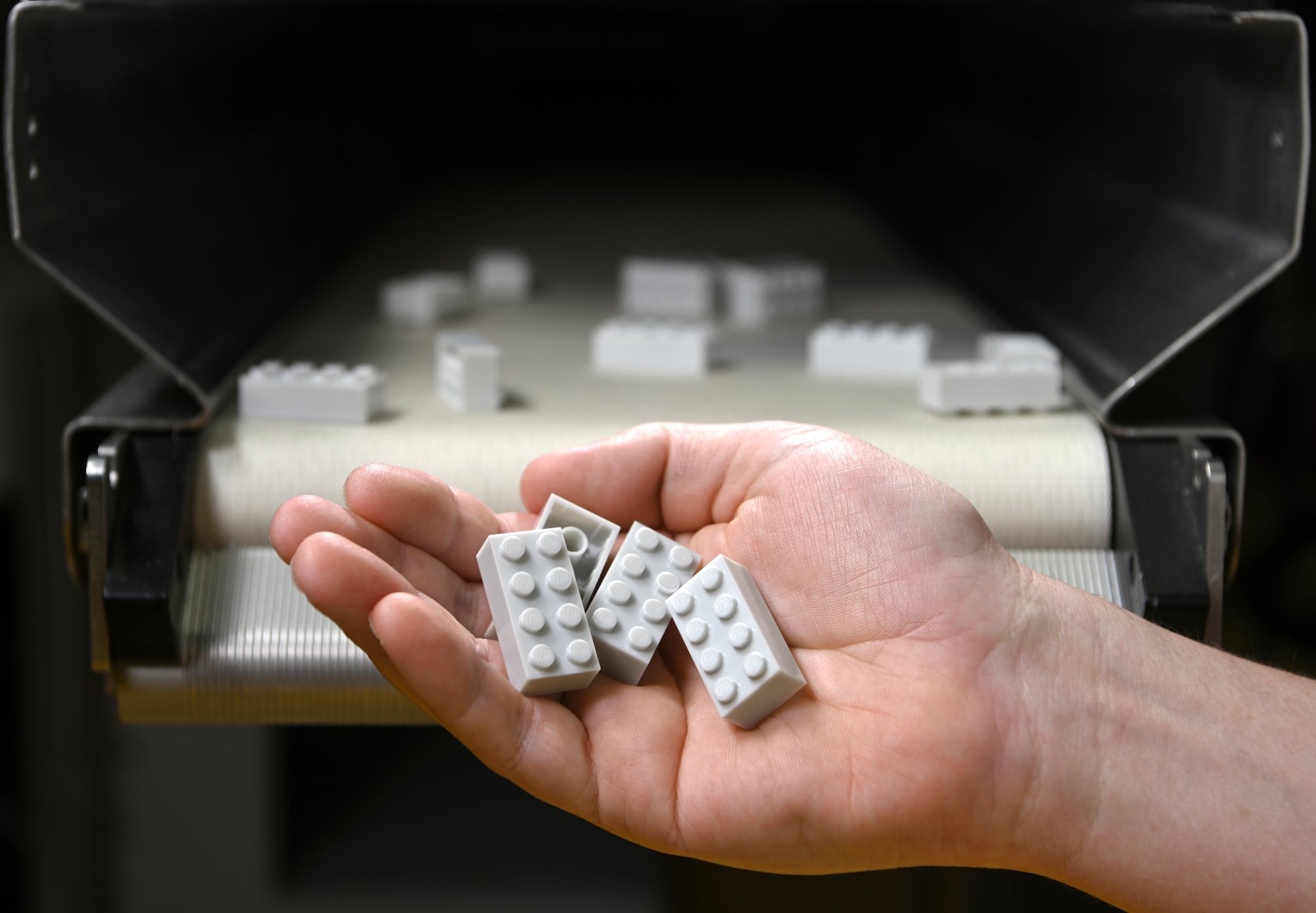
Recycled PET Test Bricks, Image via LEGO
So what becomes of ABS, the plastic that accounts for around 80% of LEGO’s production? LEGO has tested “over 250 variations of PET” (Polyethylene Terephthalate) as well as many hundreds of other plastics — a New Elementary article mentions test bricks made from corn, algae, and wheat! Fantastic Brick on Flickr has shown some PLA (Polylactic Acid) bricks from spruce wood sugar that LEGO tested in 2015.
Unfortunately, in 2023, LEGO announced that they were abandoning their effort to make recycled PET work as an ABS replacement. They stated that they would triple their sustainability spending to $3 billion DKK per year by 2025 and would at least continue to find ways to make each individual ingredient of ABS as sustainable as possible.
A Palatable Postscript
Just for fun, what are some materials that LEGO hasn’t used for building bricks? We’ve seen wooden bricks in Eco-Bricks and Mokulock, and even as early as Halsam’s American Bricks in 1939. Various brands have made a variety of metal bricks as desk toys for adults. Minibrix and Bild-O-Brik, arguably the very first building toys with a stud-and-tube concept, used hard rubber bricks in the mid-1930s.

Image via Candy Blox
Batima, a brand from 1930s Belgium, made bricks from Galalith, which comes from casein (milk protein) — not edible, unlike Candy Blox, which are made from compressed dextrose! Hilary Page’s Kiddicraft used urea formaldehyde along with Bakelite for their toys. Bio-On has tested sustainable bricks made from PHA. JELU has produced bioplastic bricks in WPC (wood-plastic composite).
As for plastic additives that didn’t end up making it to production, LEGO tested bricks in the mid-80s that would change color when heated (by hand or hot water), according to Daniel Konstanski’s The Secret Life of LEGO Bricks. This thermochromic property was never used in bricks, but did show up in a stickered part some years later.
I was listening to my favorite trivia podcast when they had a question about a plan by LEGO to use barium sulfate in order to [podcast spoiler] make bricks show up on an X-ray in case of swallowing — they abandoned it due to the additive affecting the brick’s durability and non-toxicity. I had never heard of this before, and after some digging, it seems to have originated in a letter to the editor LEGO wrote in 1996 in response to a medical article about LEGO inhalation.
Do you know of any other LEGO plastics that we missed? Let us know in the comments below!
Do you want to help BrickNerd continue publishing articles like this one? Become a top patron like Paige Mueller, Rob Klingberg from Brickstuff, John & Joshua Hanlon from Beyond the Brick, Megan Lum, Andy Price, Lukas Kurth from StoneWars, Wayne Tyler, Dan Church, and Roxanne Baxter to show your support, get early access, exclusive swag and more.