Once Upon a VHS: The Fairy Tale Behind LEGO Shrek
/When the new LEGO 72423 Shrek, Donkey & Puss in Boots was announced, my heart and mind immediately drifted back to childhood.
An almost repressed memory of an old VHS tape suddenly resurfaced, tied to Christmas, family gatherings, and the warmth of being together at home. The strongest memory, however, is the one connected to my grandparents. I found myself wondering what linked those distant moments to this new LEGO set. Perhaps it was that carefree childhood feeling and the endless hours spent in front of the television, consuming meters and meters of VHS tape in the binge-watching habits of times gone by.
Today, jumping between streaming services is an everyday occurrence. But in a very different time—and saying that makes me feel like a wise old man—waiting for a new film to arrive on VHS was often the only way to revisit your favorite movie. Thanks to Blockbuster, small local rental stores, and homemade recordings, we could slowly expand our viewing choices. I grew up with old VHS tapes in hard yellow cases that I still guard jealously today, including the original Star Wars trilogy and even the rare Caravan of Courage: An Ewok Adventure, which my father recorded at home with his old VCR.
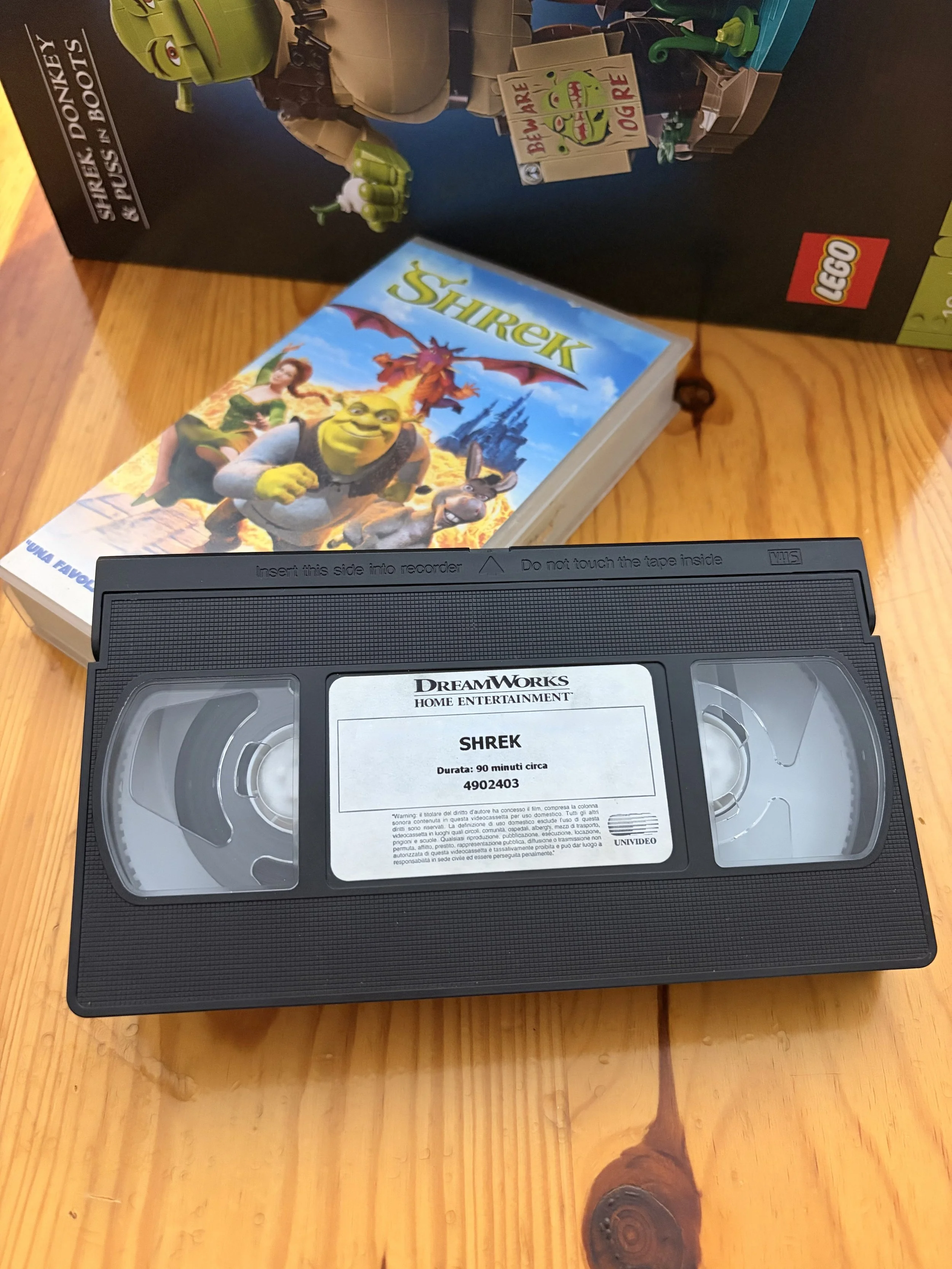
Certainly, the arrival of DVDs and later Blu-ray discs completely changed the experience of home movie watching, but there was something almost mystical about VHS tapes. The holidays were the perfect excuse to spend a little extra time watching a favorite film, and among the many tapes that filled those shelves, Shrek is still one that fills my memories with a particular warmth.
Rewinding to Childhood
Back in 2001, no one could have imagined that DreamWorks Animation would create one of the most successful franchises in the history of computer animation. Christmas 2001 introduced audiences to that “ugly” ogre, a creature originally meant to represent fear, ugliness, and brute force, transforming him instead into a true pop culture star.
Thinking back to that moment, I hadn’t yet fully realized that my future would somehow become linked to the world of LEGO. Yet even then, something was already beginning to stir in me through my fascination with art, drawing, and creativity, passions that still remain among my favorite hobbies today. That quiet awareness has followed me ever since, eventually bringing me countless satisfactions through LEGO itself. And honestly, I sometimes wonder if I also owe a small part of that journey to that now dusty VHS copy of Shrek.
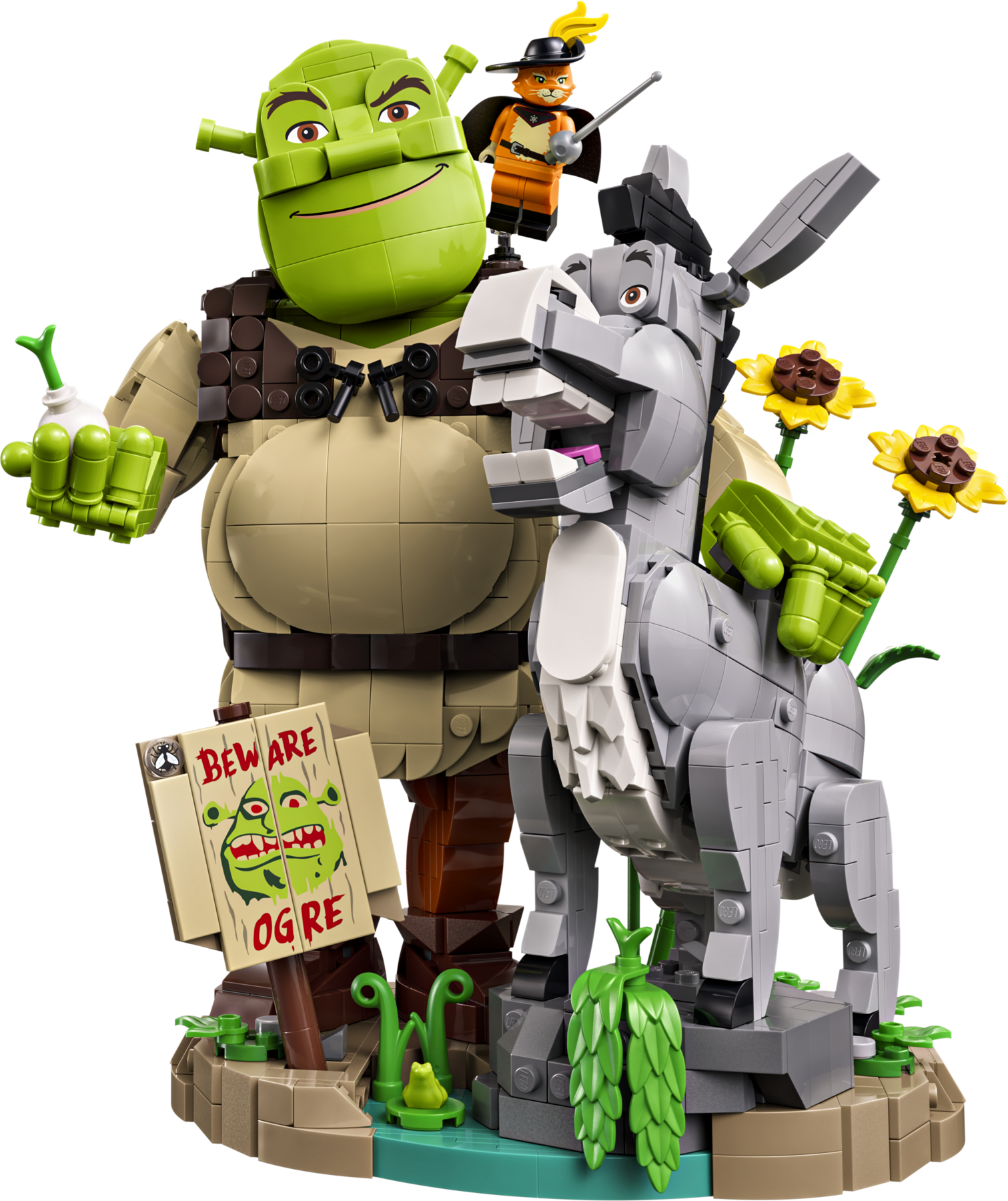
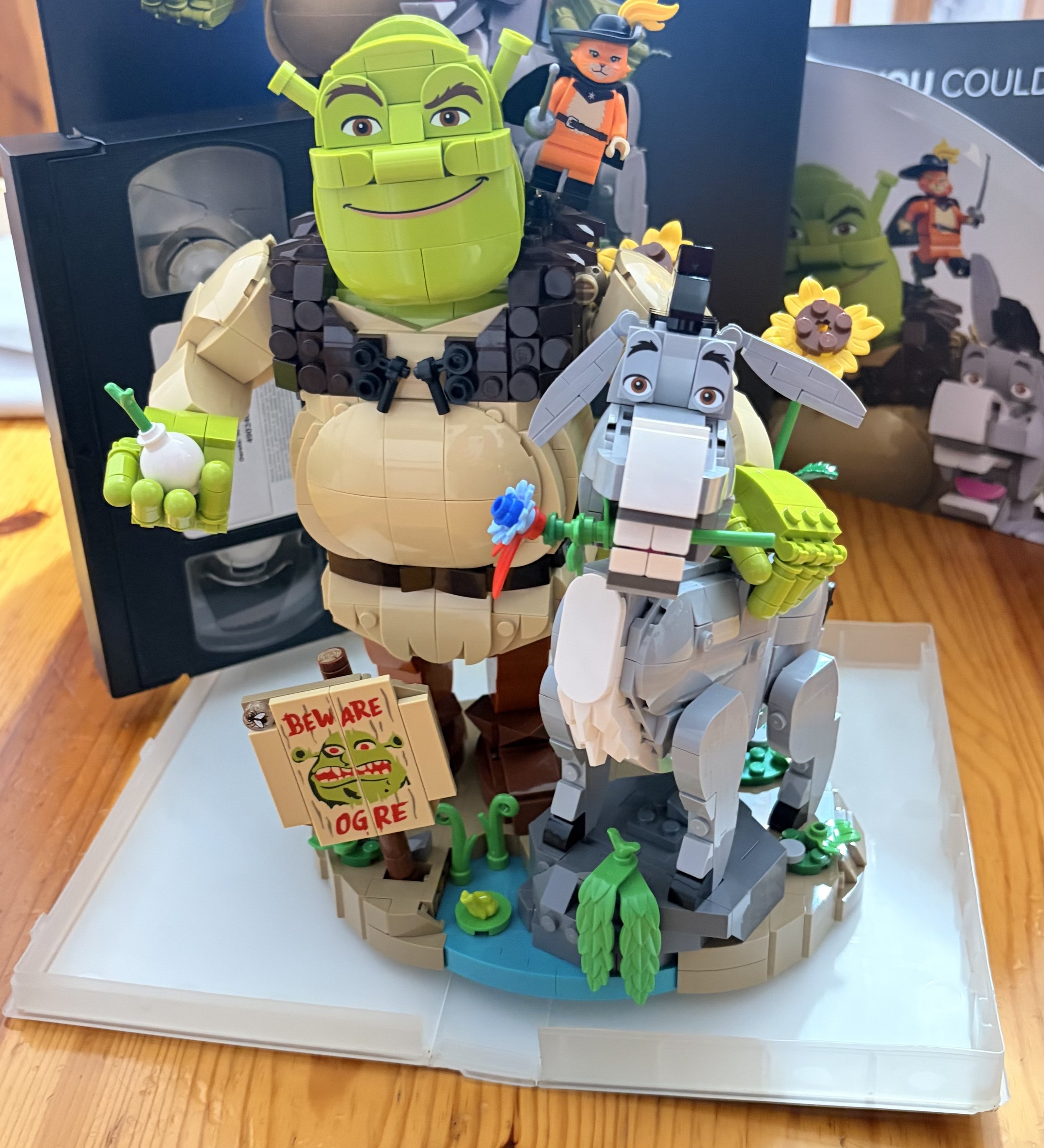
So imagine what it felt like to finally hold LEGO set 72423 Shrek, Donkey & Puss in Boots in my hands…
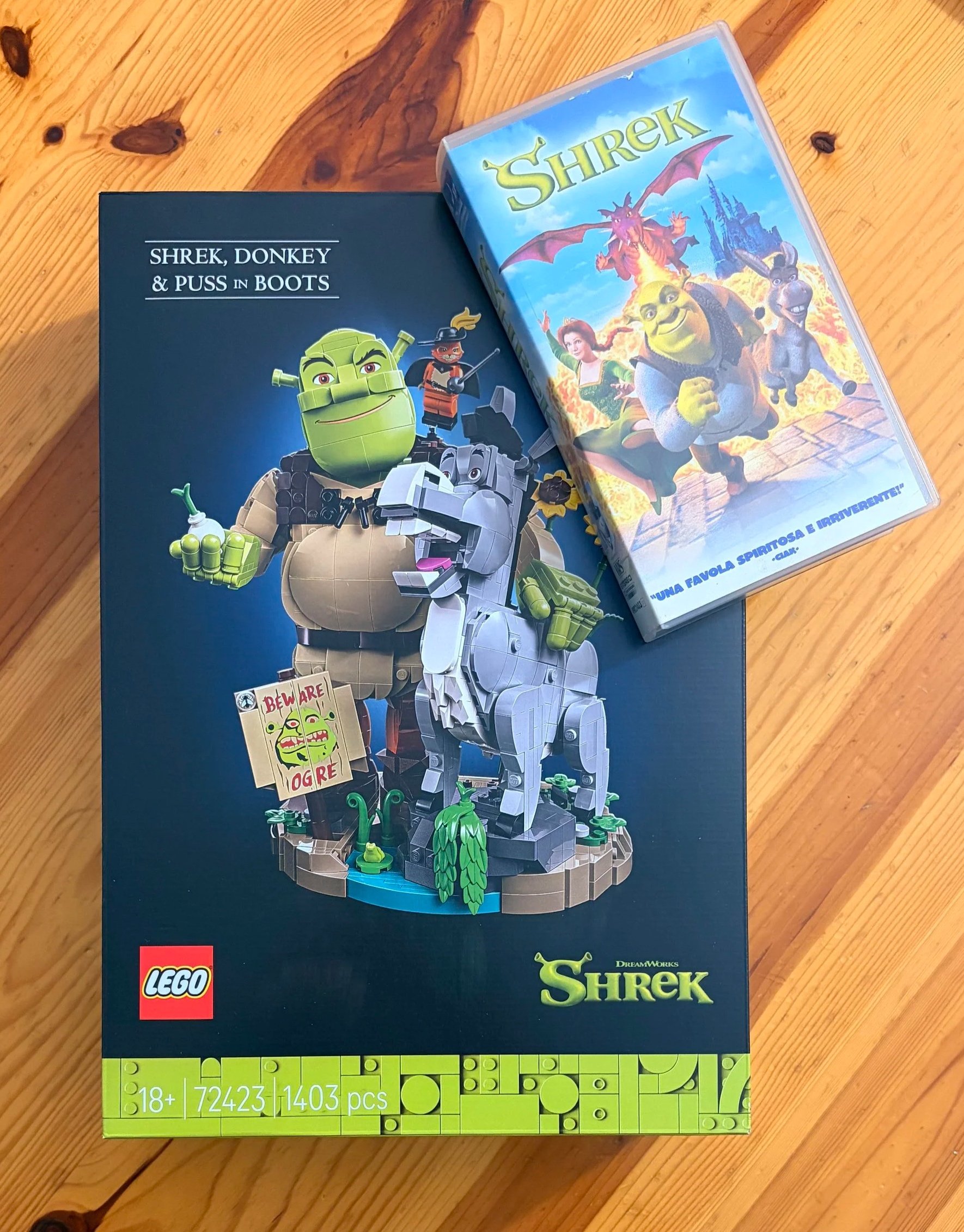
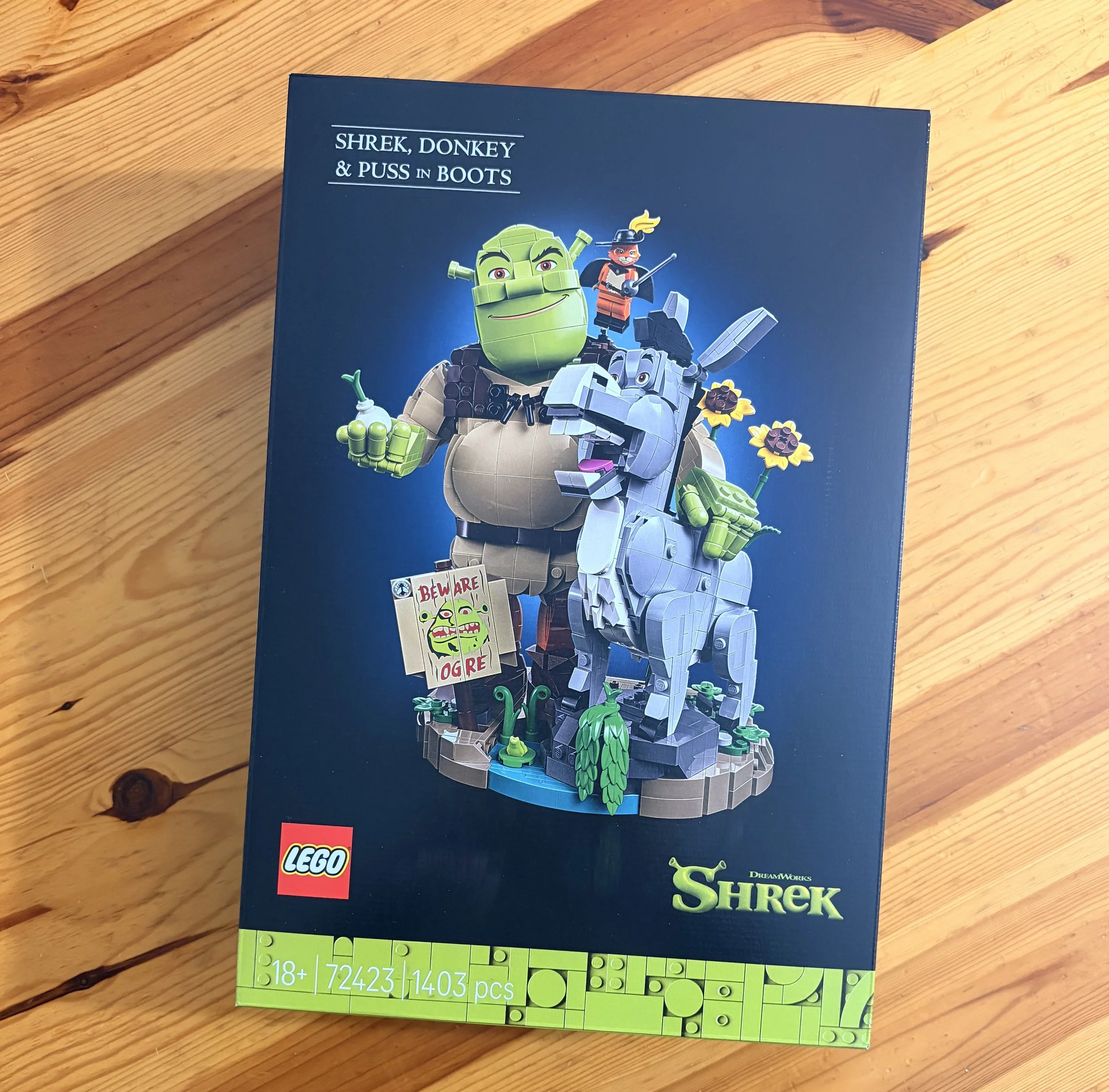
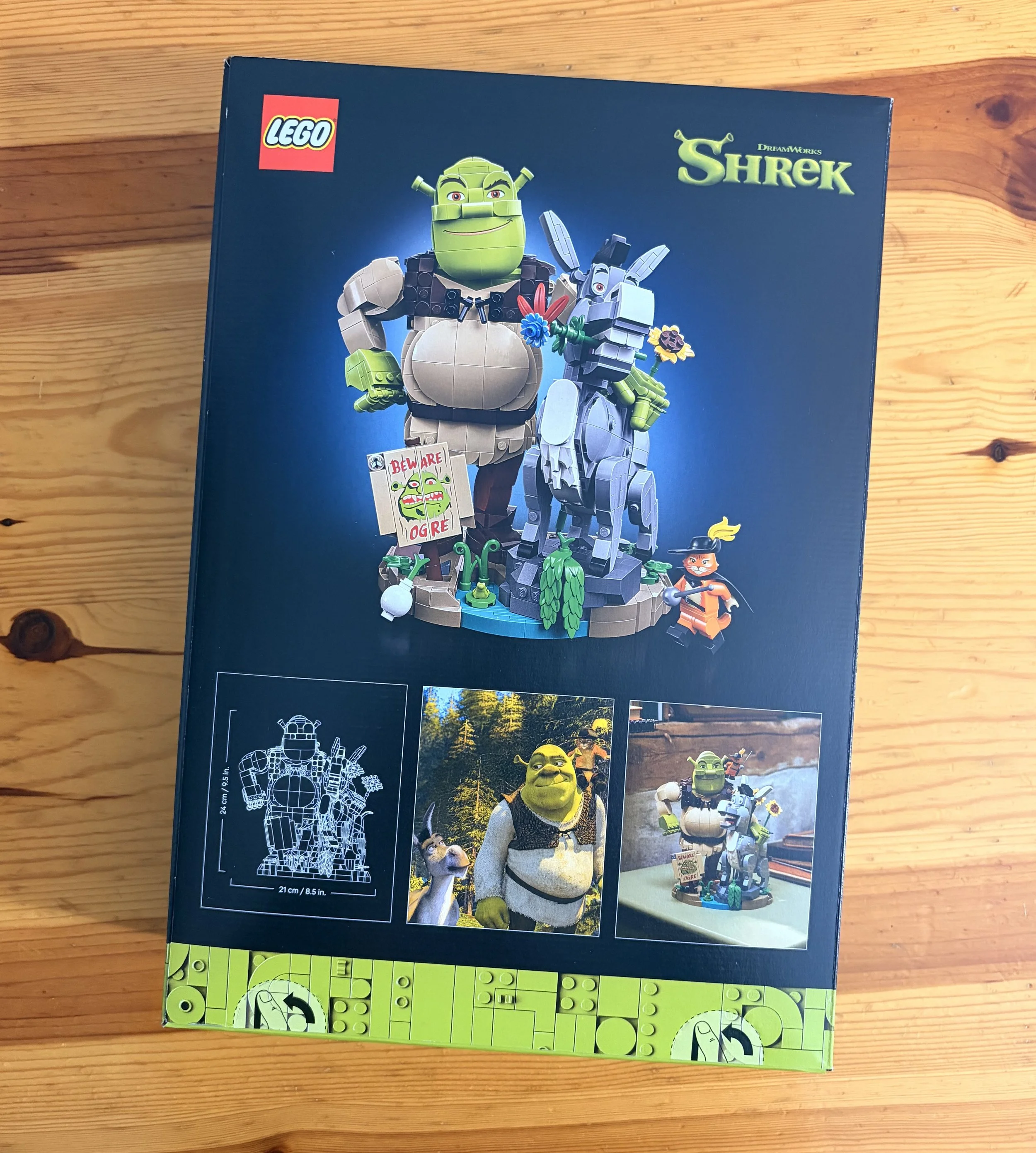
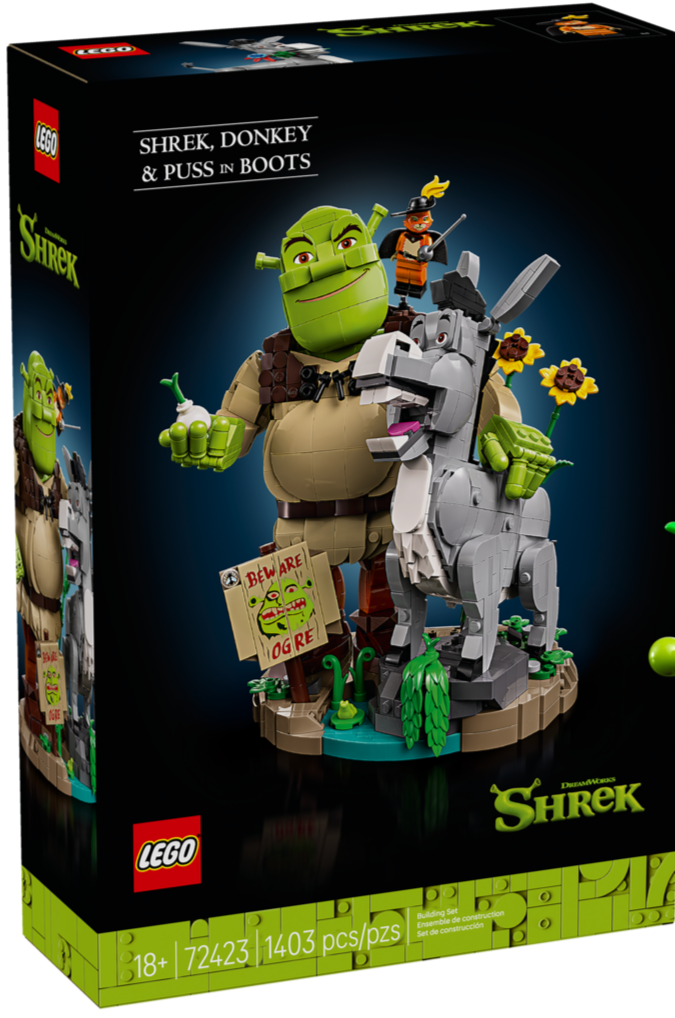
As we’ve come to expect from Denmark, the box art is fairly minimal. We see the set and only a few additional details. Yet despite its simplicity, opening the box gave me a strangely familiar feeling, almost like opening an old VHS case and pulling out its priceless “treasure” with that same sense of anticipation and discovery. Maybe it was the LEGO logo. Maybe it was nostalgia.
Certainly, a VHS cassette has nothing to do with the construction phase of a LEGO set, but its history is almost as fascinating as that of the LEGO Group itself. I can already imagine some younger readers asking, “But what exactly is a VHS?” and “What does it have to do with LEGO?”
The Video Home System, better known as VHS, emerged during the 1970s thanks to the Japanese company Matsushita Kotobuki Electronic Industries and the development of the Video Cassette Recorder system, or VCR. Originally known as the Vertical Helical Scan system, VHS was officially launched by JVC in 1976. At the time, nobody could have imagined that this new tape-based video format would completely revolutionize the home entertainment market.
BASF Test Brick - Photo via Flickr/Maxx 3001
And revolutionize it did. Soon, other companies entered the competition with their own systems, including Sony’s famous Betamax and the Philips Video 2000 format.
Interestingly, if we wanted to find a small point of contact between the history of VHS and that of the LEGO Group, we could trace it back to the chemical company BASF. Among many other things, BASF produced some of the first magnetic recording tapes for audio systems in the 1930s, but the company also played a role in the development of plastics connected to the LEGO brick following the 1958 patent.
It’s a tiny historical detail, but somehow it makes the creation of this set feel even more fascinating. (Read more about the different types of plastic that LEGO uses here.)
From Fairy Tale to Reality
Back to the Shrek set, what immediately caught my attention wasn’t so much the number of building steps, but the complete lack of stickers. Even the instruction booklet surprised me. Rather than feeling like a standard LEGO manual, it resembles a small storybook pulled directly from the world of Shrek, complete with references and iconic lines from the film itself.
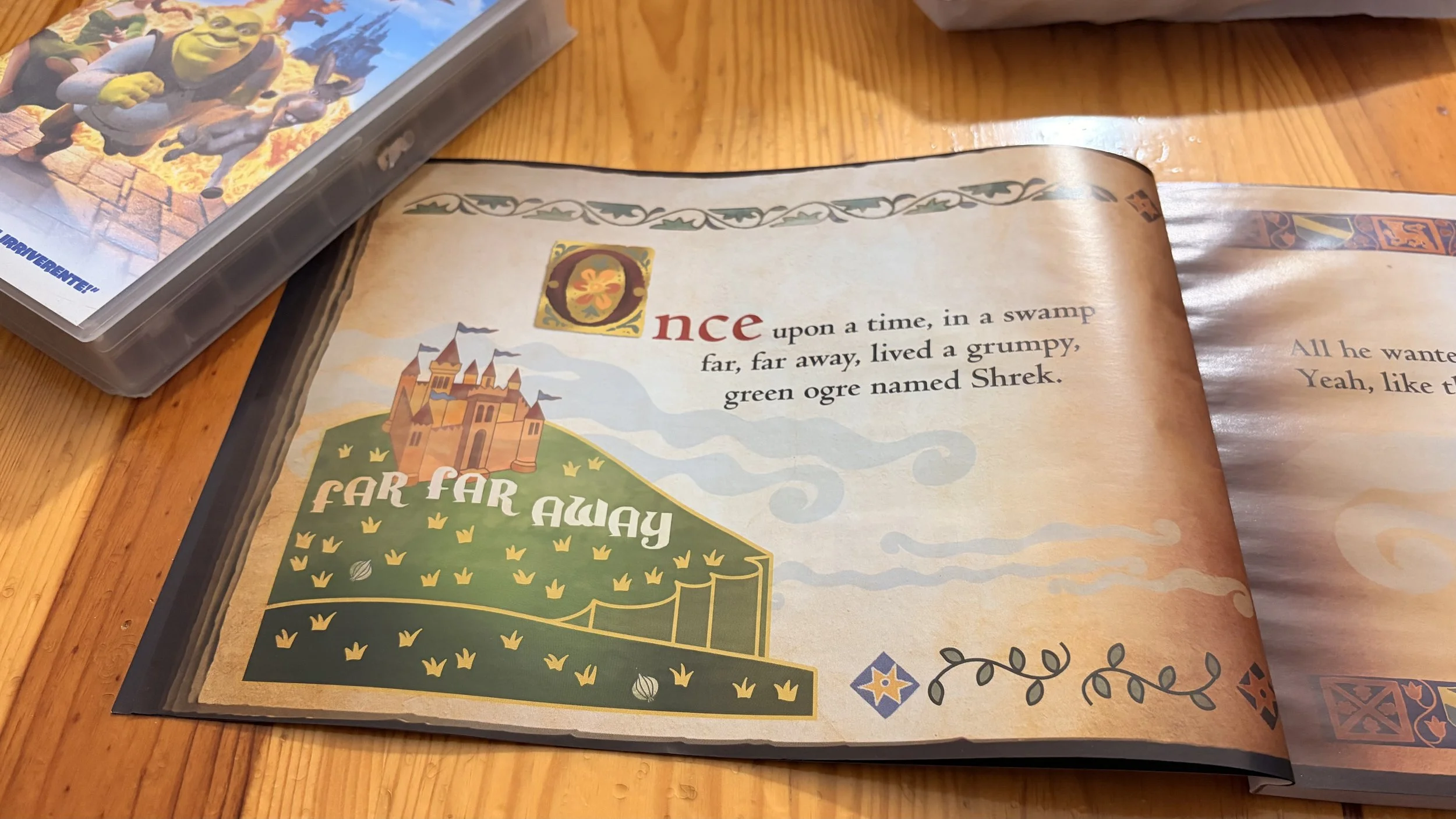
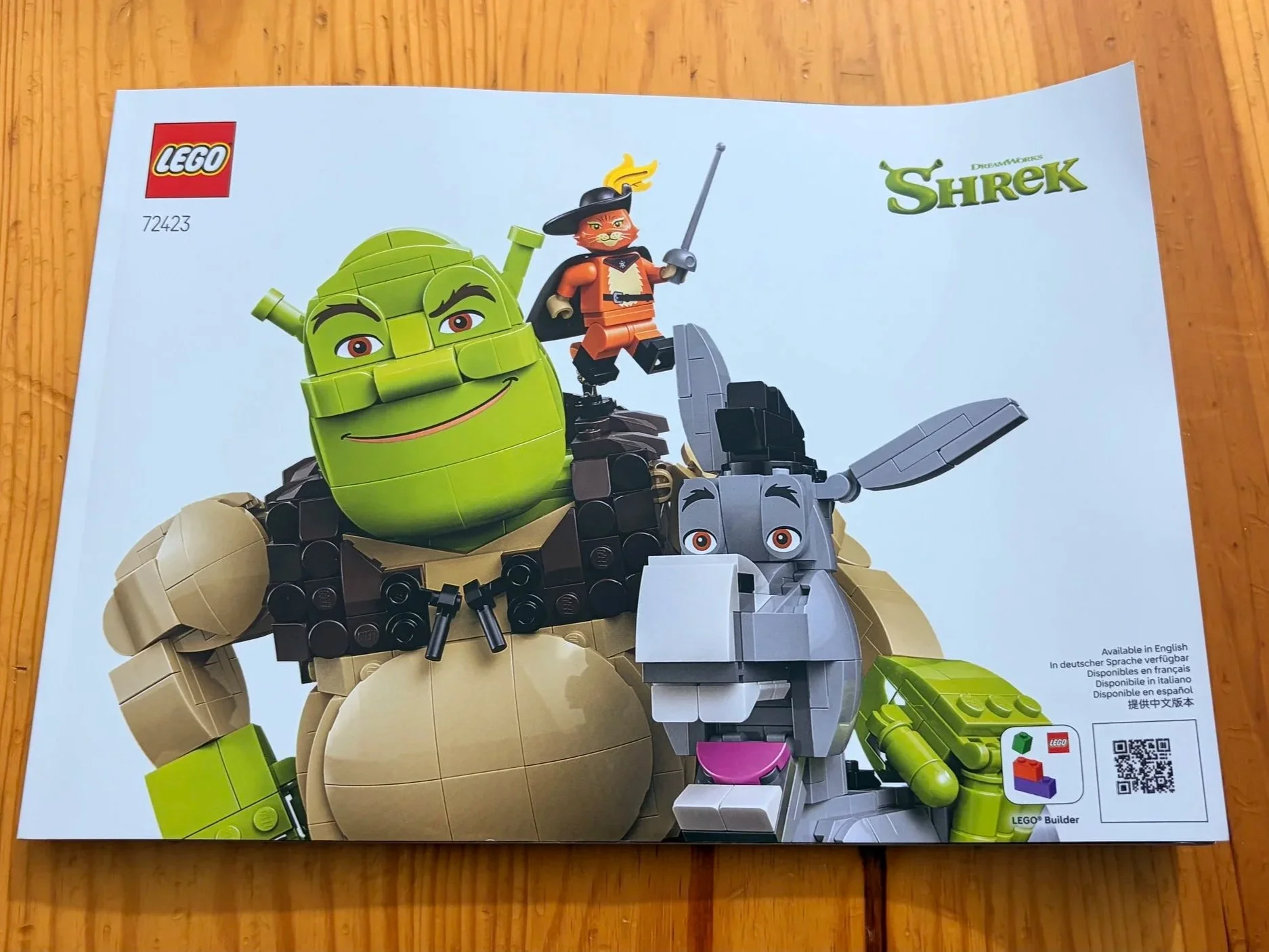
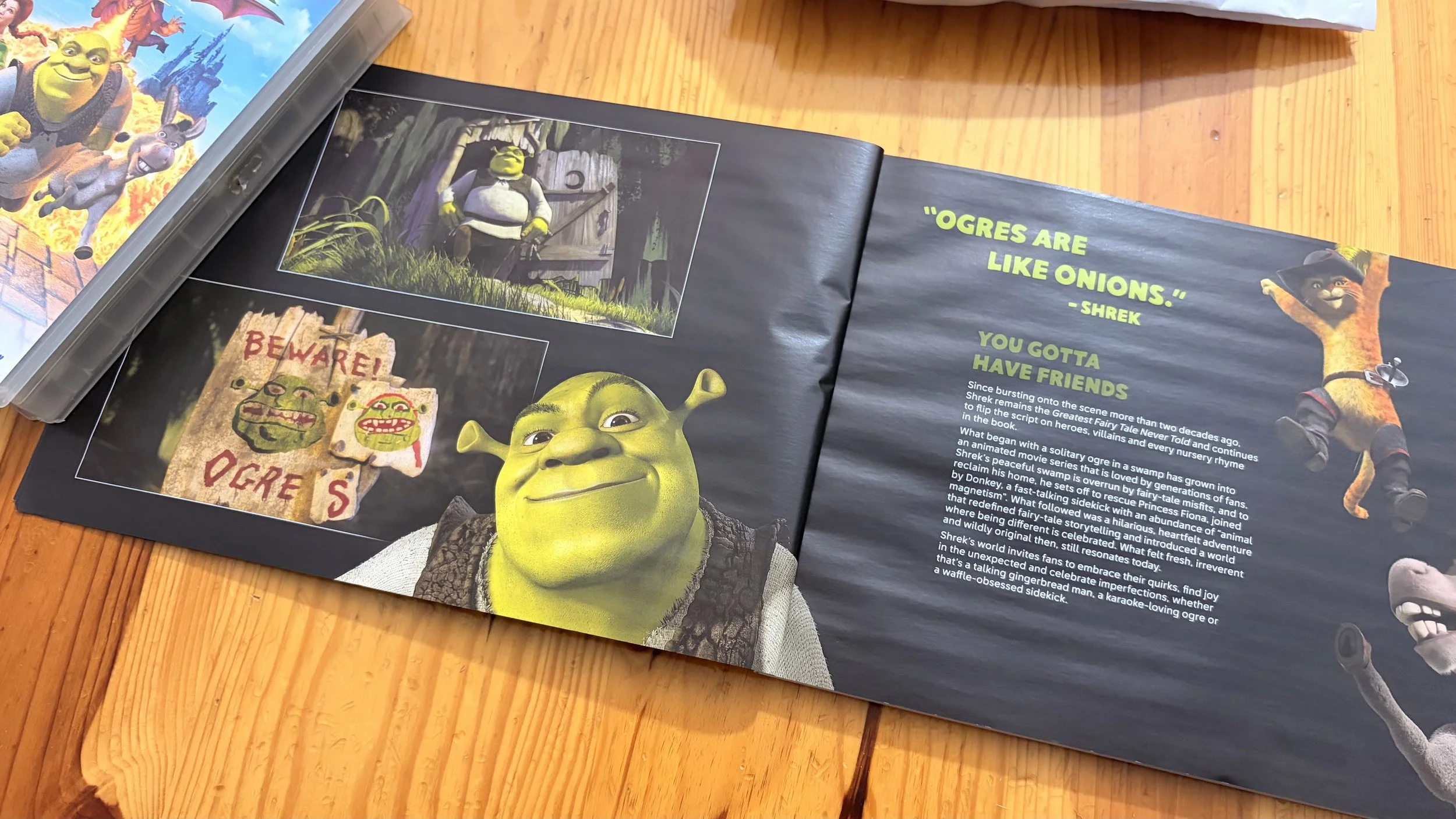
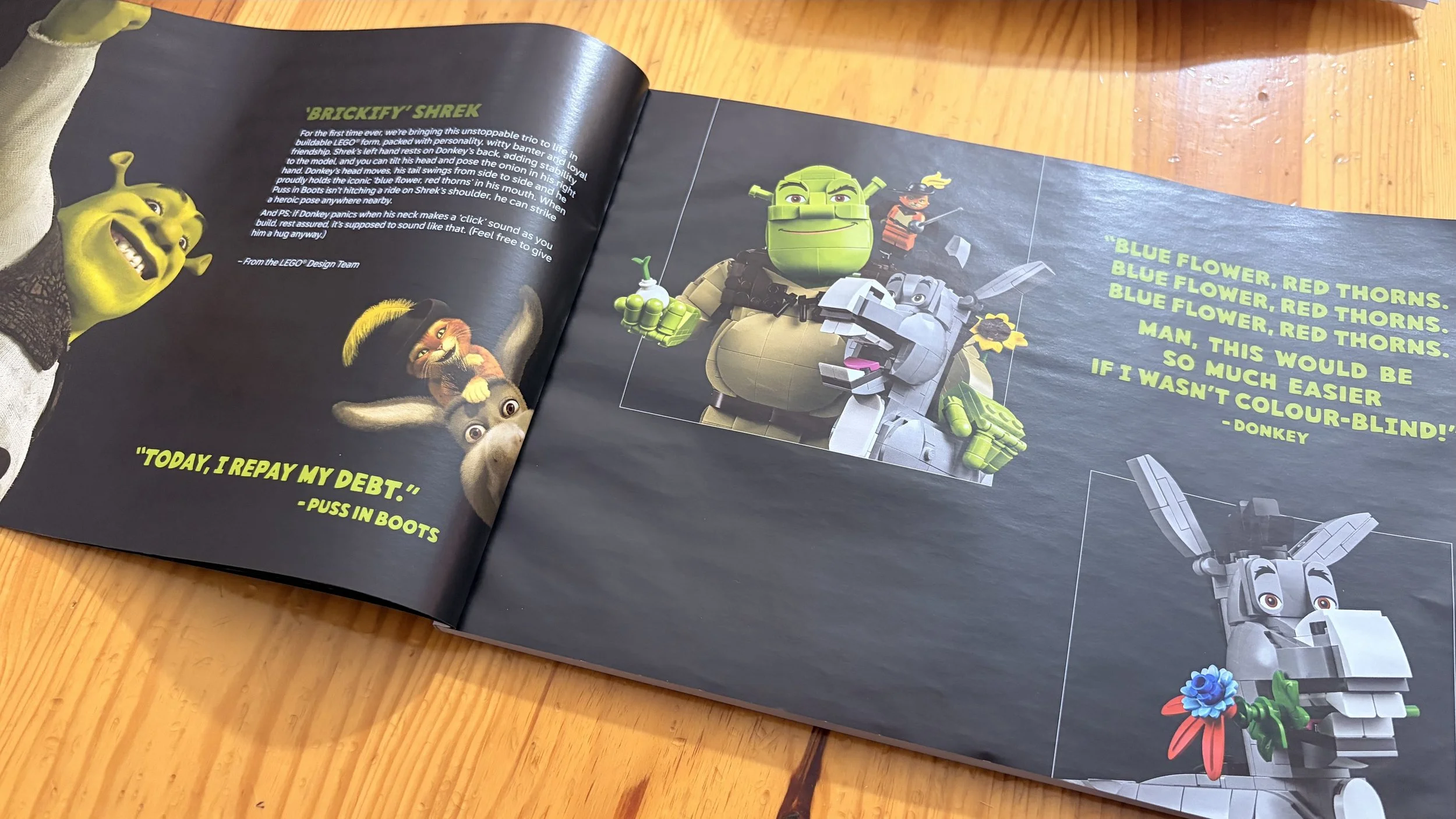
Perhaps this too is part of the nostalgia behind the set, something that will resonate with many people who add it to their collection. Friendship, even the strangest kind imaginable, sits at the heart of this Shrek set. After all, what could be more bizarre than an ogre, a talking donkey, and a sword-fighting cat? Yet that unlikely combination became the soul of the Shrek saga’s success.
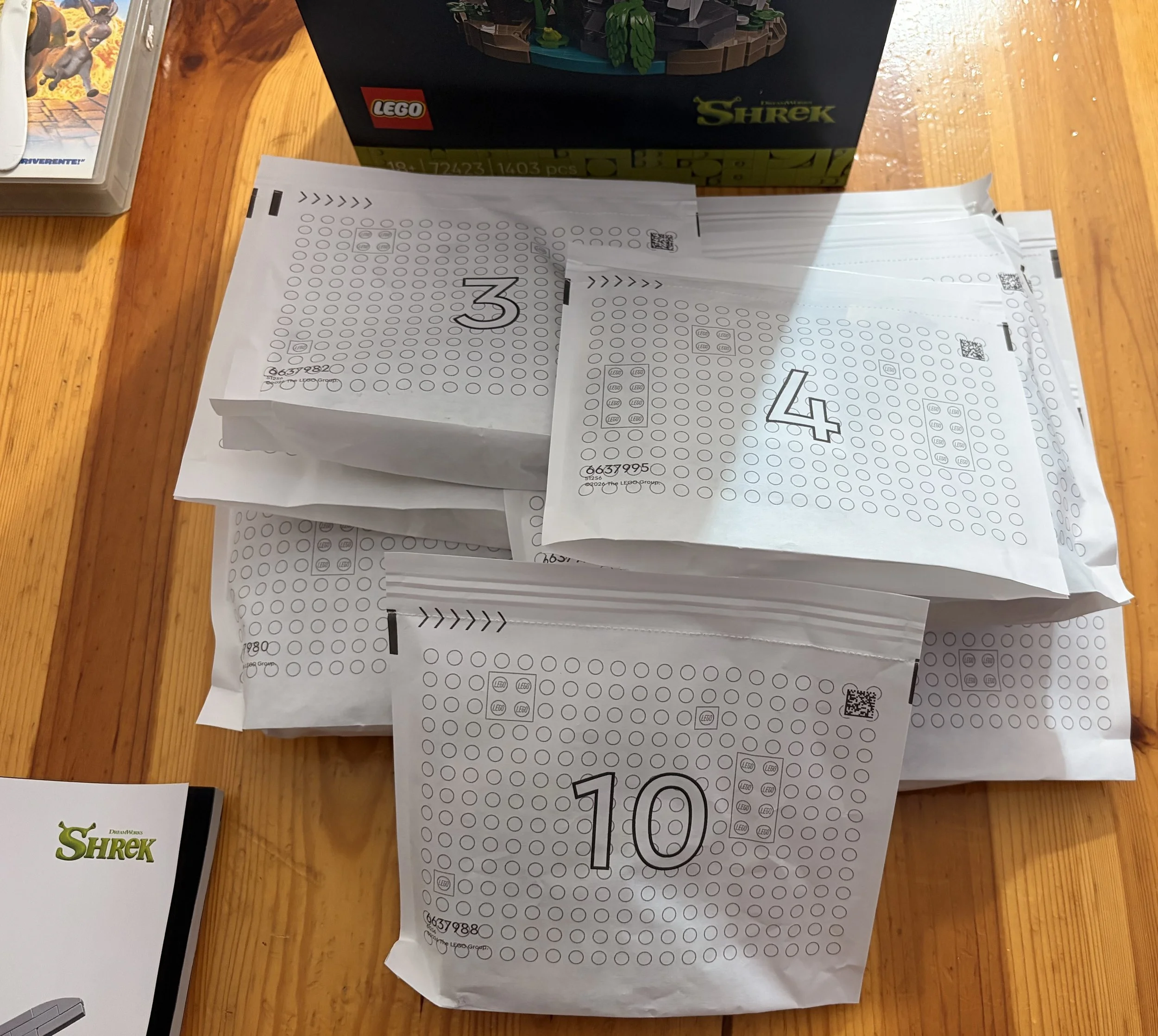
Fittingly, Puss in Boots is the first character to emerge from the bags and the only traditional minifigure included in the set.
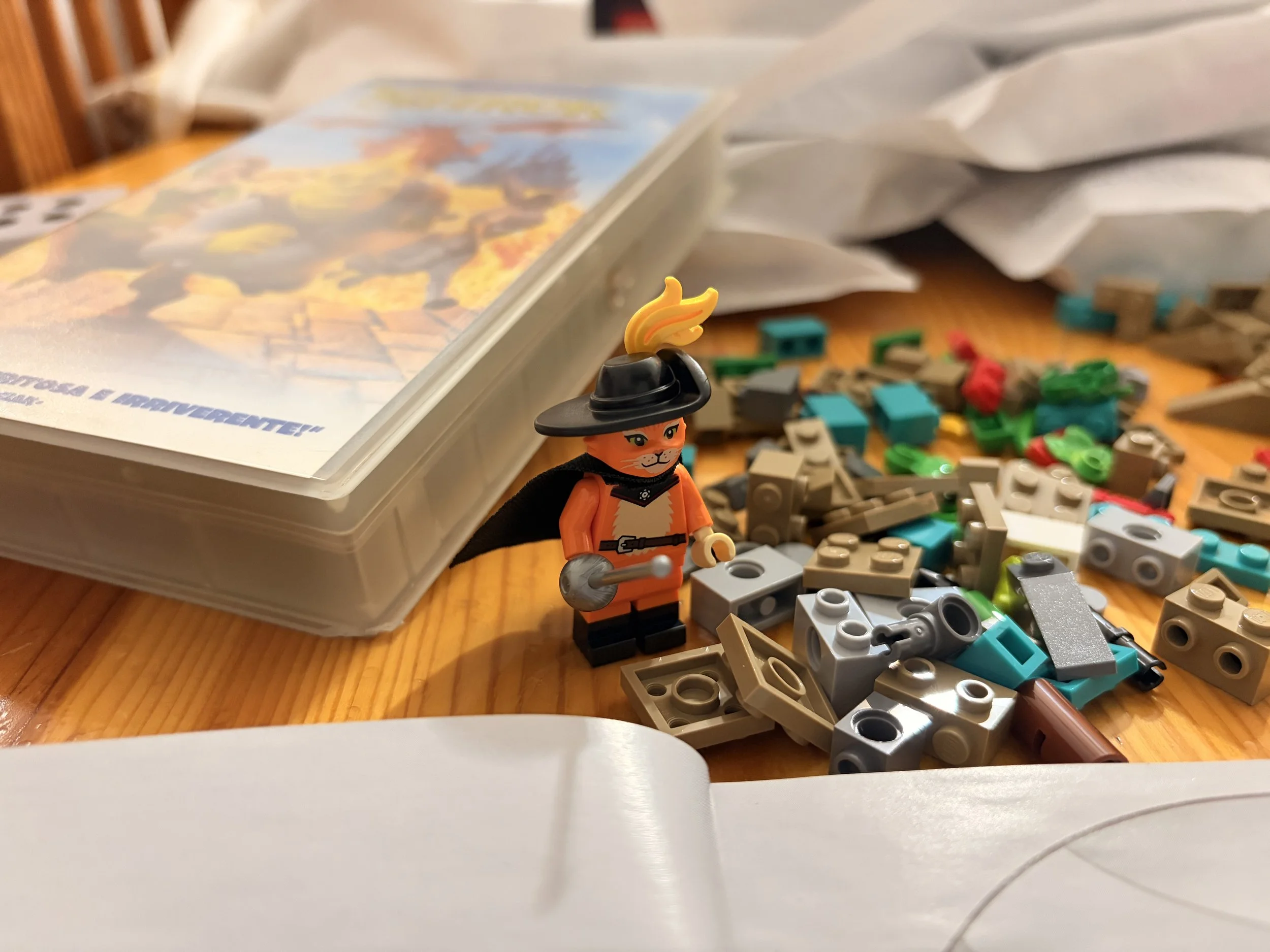
While building, I found myself reflecting on how almost all of the Shrek characters have surprisingly deep roots in European literary and fairy tale traditions. These characters did not appear out of nowhere. In many ways, the entire structure of Shrek comes from William Steig’s 1990 illustrated book.
One of many versions of Steig's book cover. Via: AbeBooks.it
Steig, best known as a cartoonist for The New Yorker, created a version of Shrek that is dramatically different from the lovable cinematic antihero audiences eventually embraced. In the original story, Shrek does not isolate himself in the swamp by choice. During his journey, he encounters a witch who predicts that he will marry a princess even uglier than himself in exchange for some rare lice. The princess is not cursed; she is simply an ogress.
Steig’s Shrek is described as “the ugliest of them both put together,” a horrifying creature covered in pustules, breathing fire, and even releasing smoke from his ears. He delights in anything foul and disgusting, terrorizes everyone he encounters, and is even capable of eating lightning during thunderstorms. Even Donkey differs greatly from the comedic companion seen in the film.
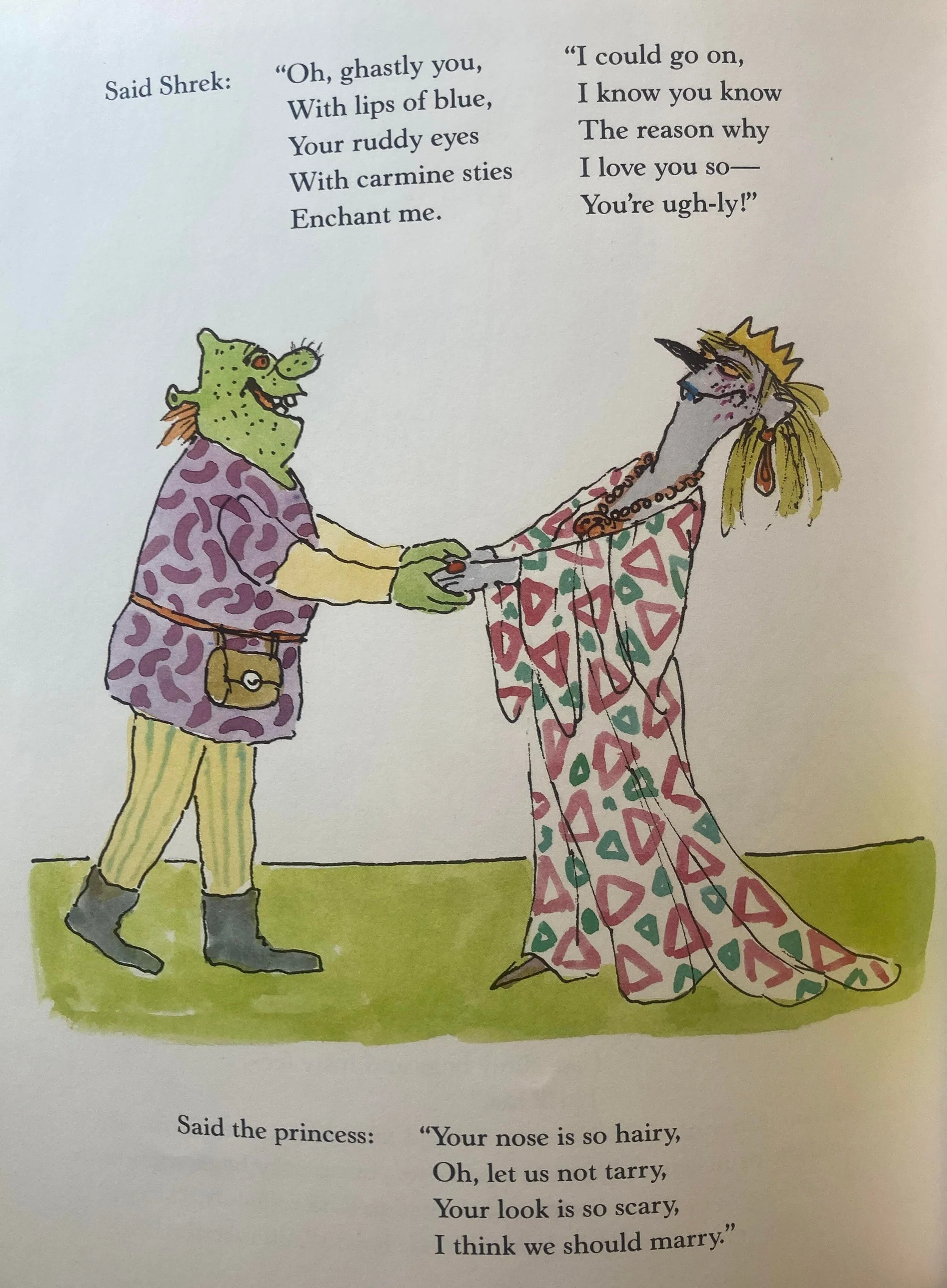
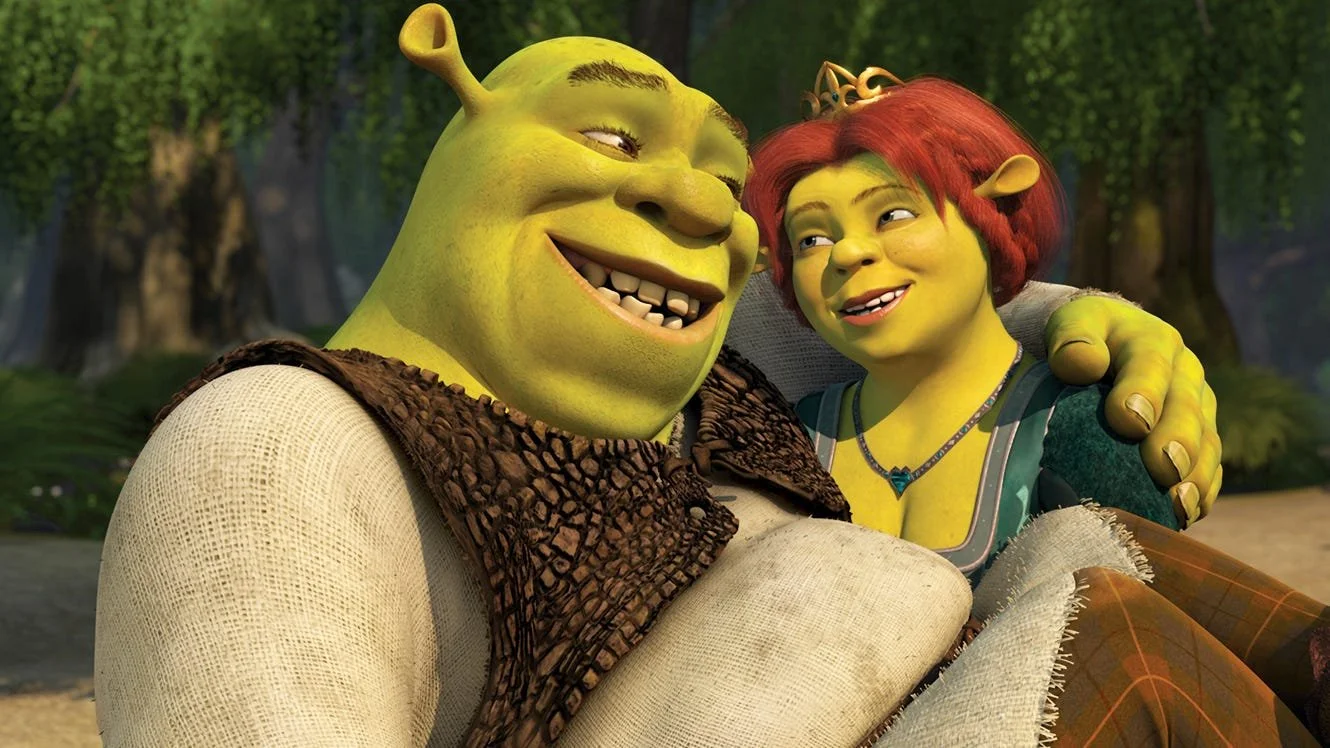
It is no coincidence that the name “Shrek” derives from the German word Schreck, or the Yiddish shreck, both meaning “fear” or “terror.” And as you can imagine, this version of the character is worlds apart from the Shrek eventually brought to theaters by DreamWorks.
Interestingly, early cinematic drafts of Shrek were reportedly much closer to Steig’s darker interpretation before the production pivoted toward the more comedic and emotionally grounded version that became such a massive success. Despite all those changes, however, the adventurous journey toward the princess remained one of the strongest connections between the film and the original fairy tale.
While thinking about all of this history, the set itself continued to come together in my hands, and I have to admit that building the rocky base is genuinely enjoyable.
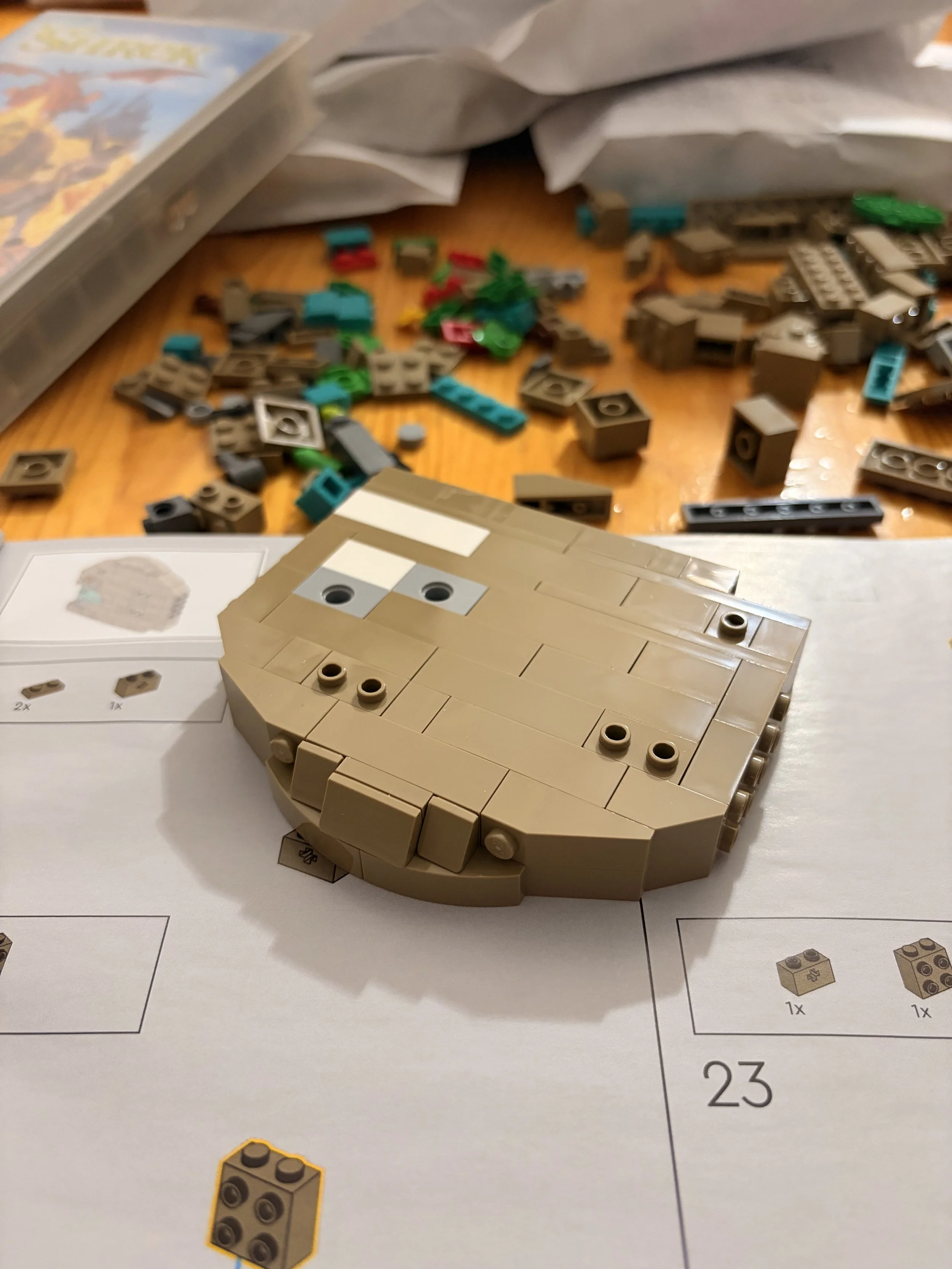
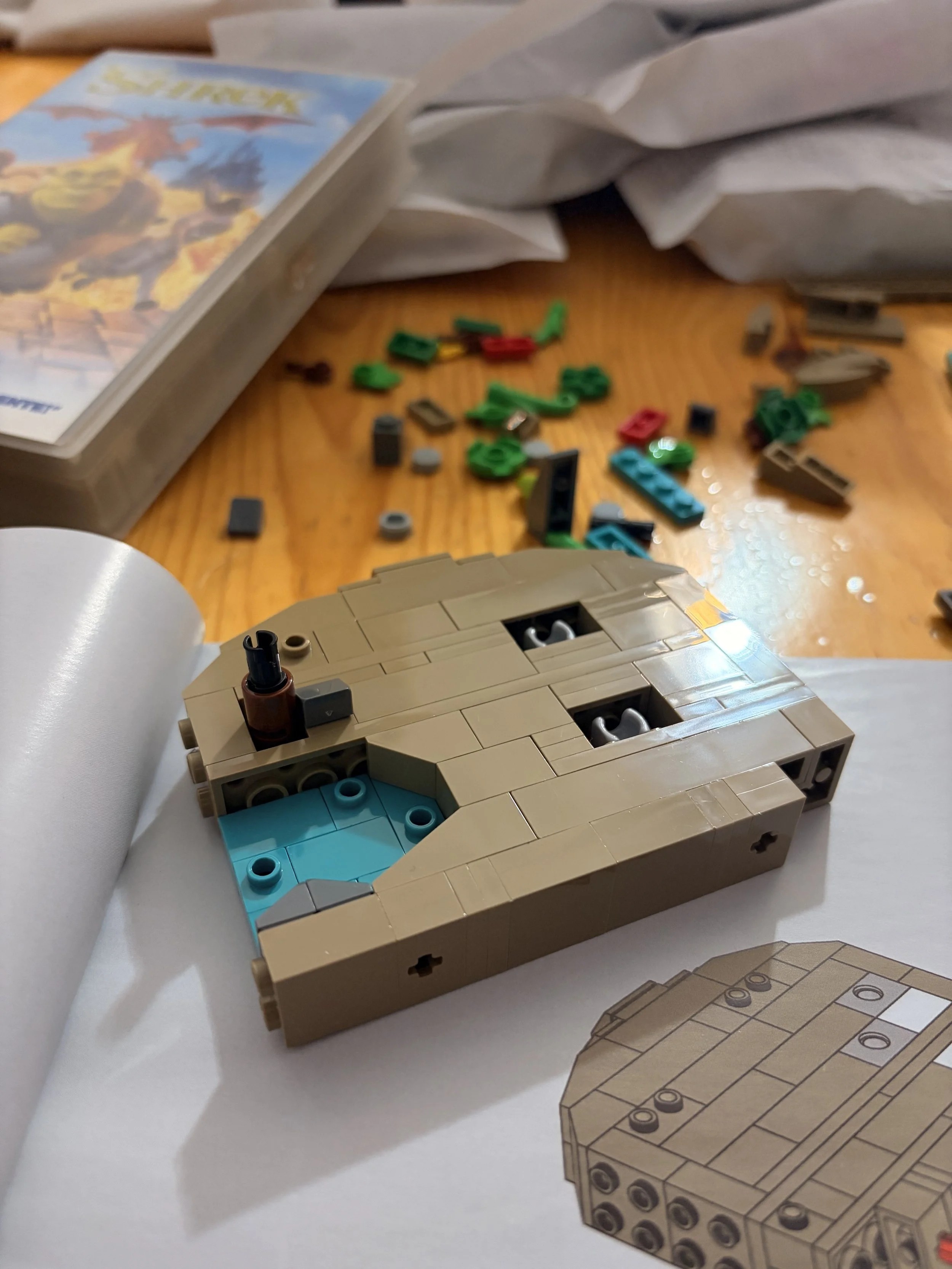
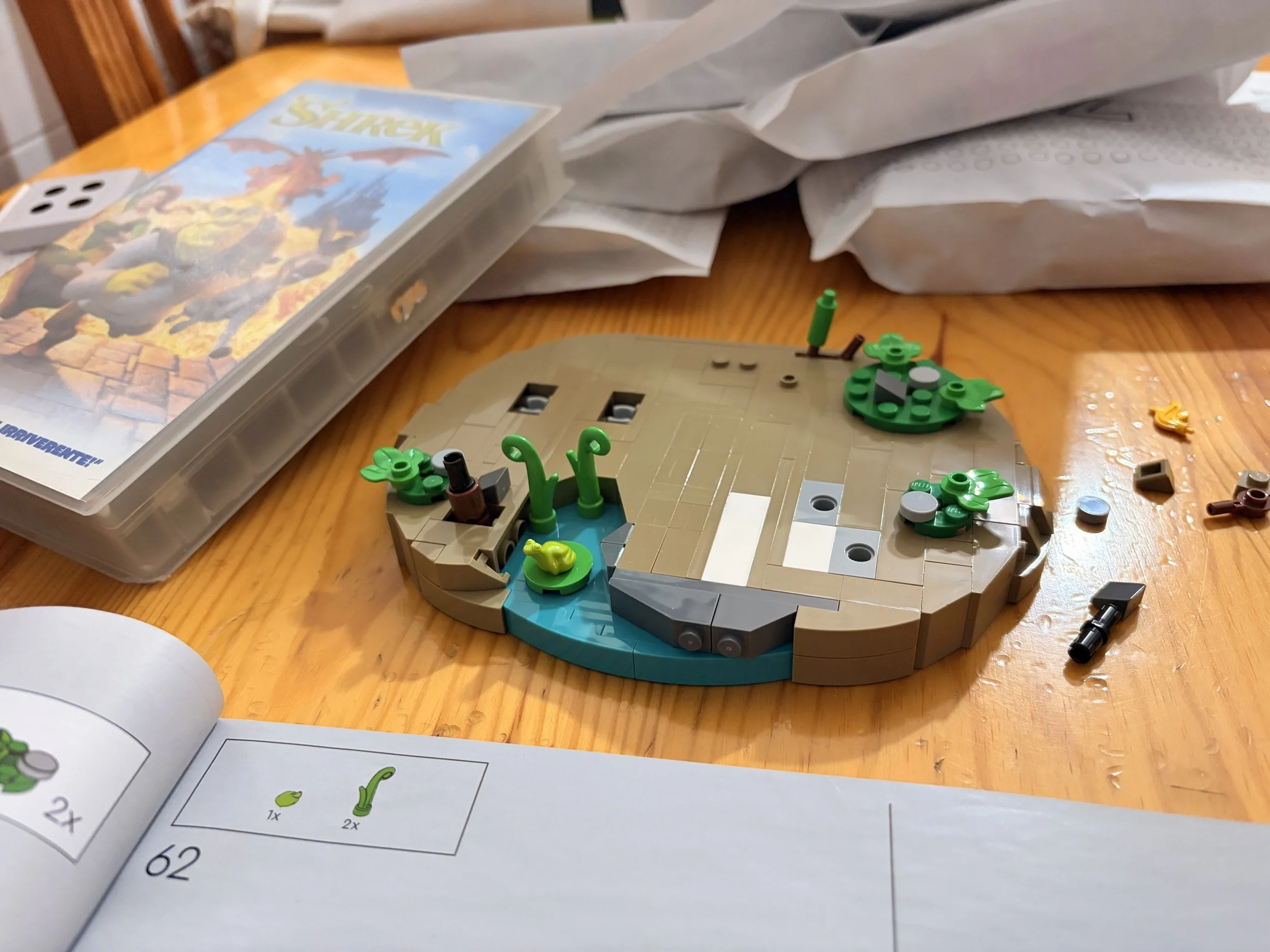
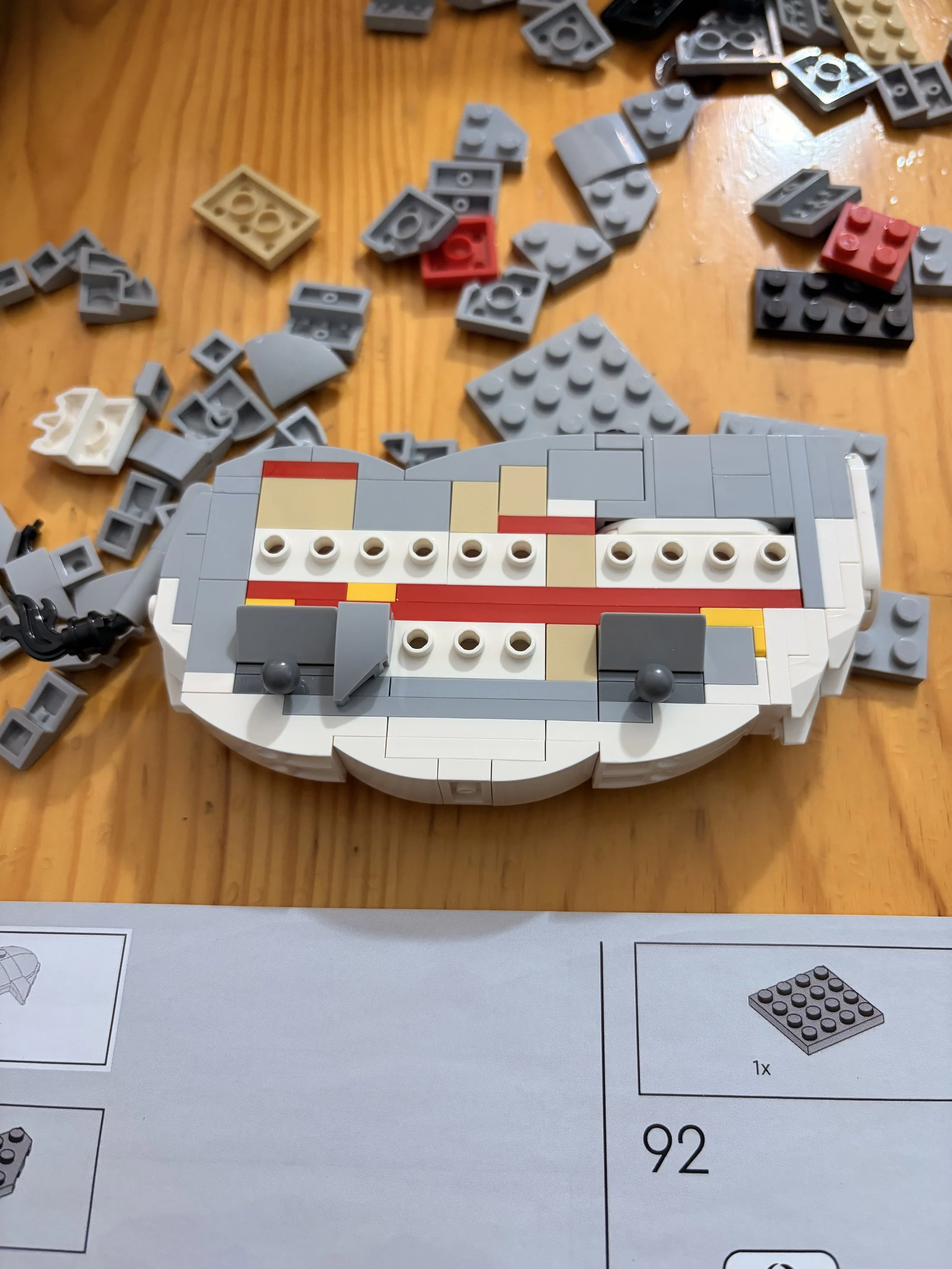
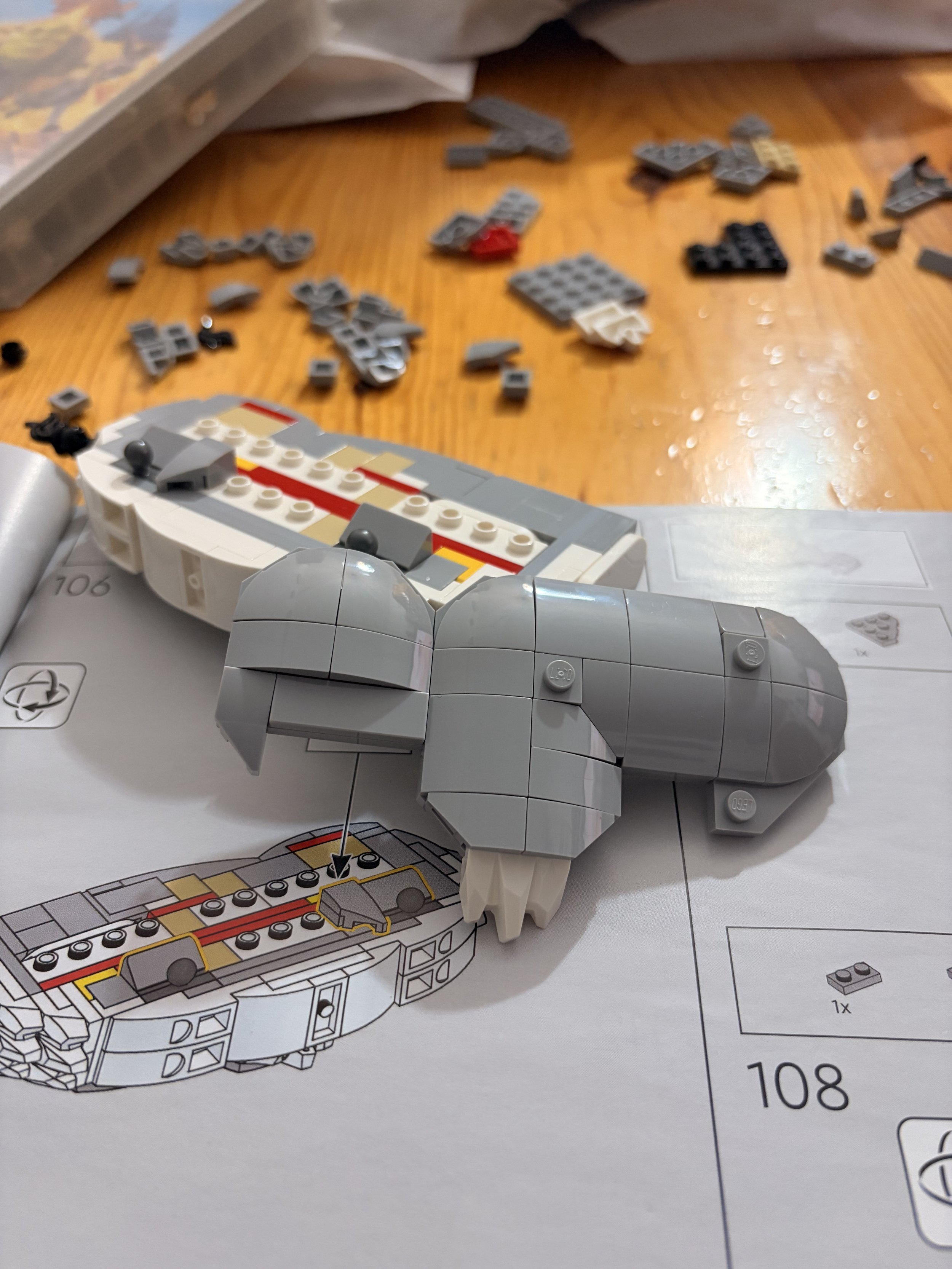
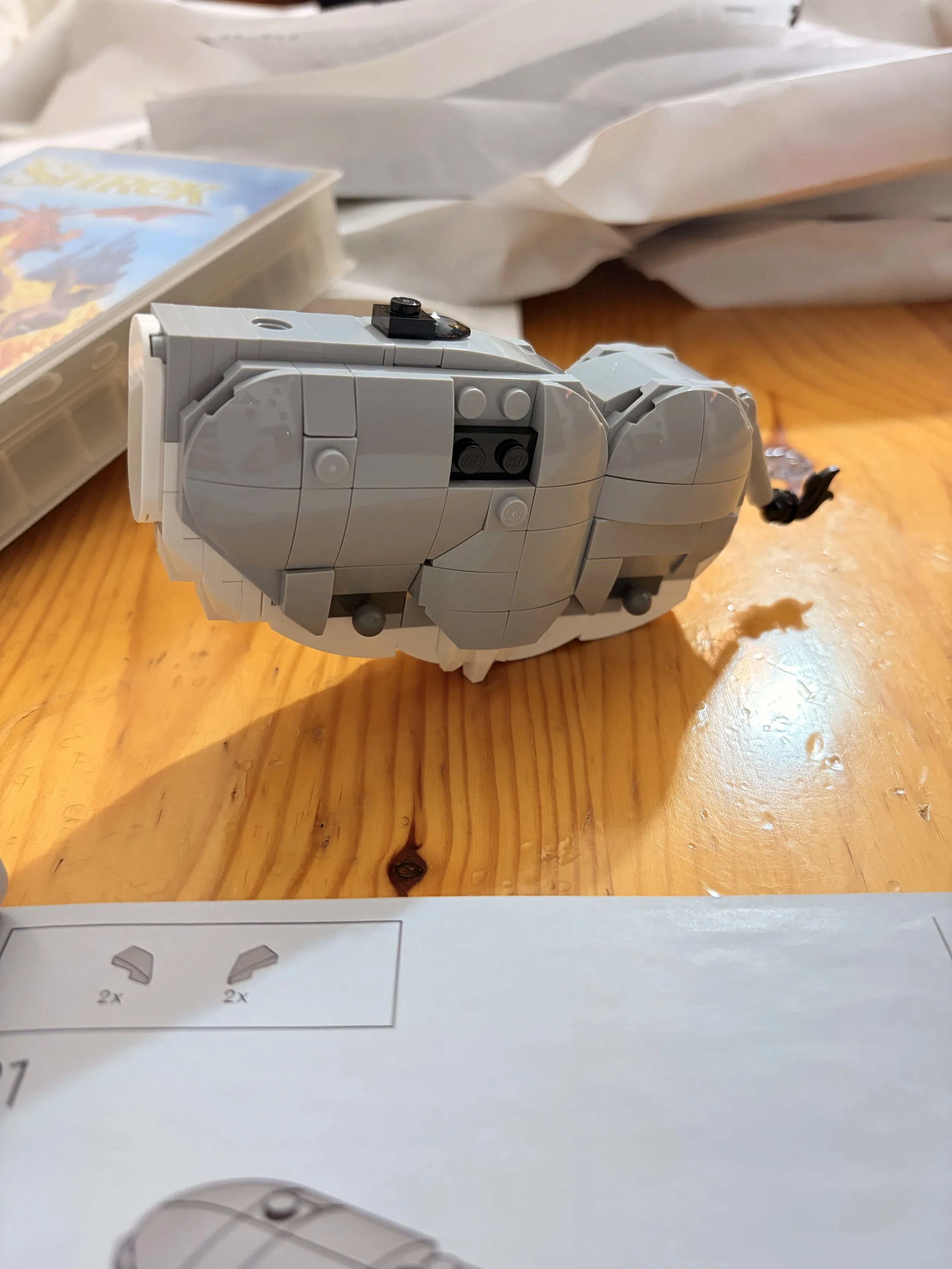
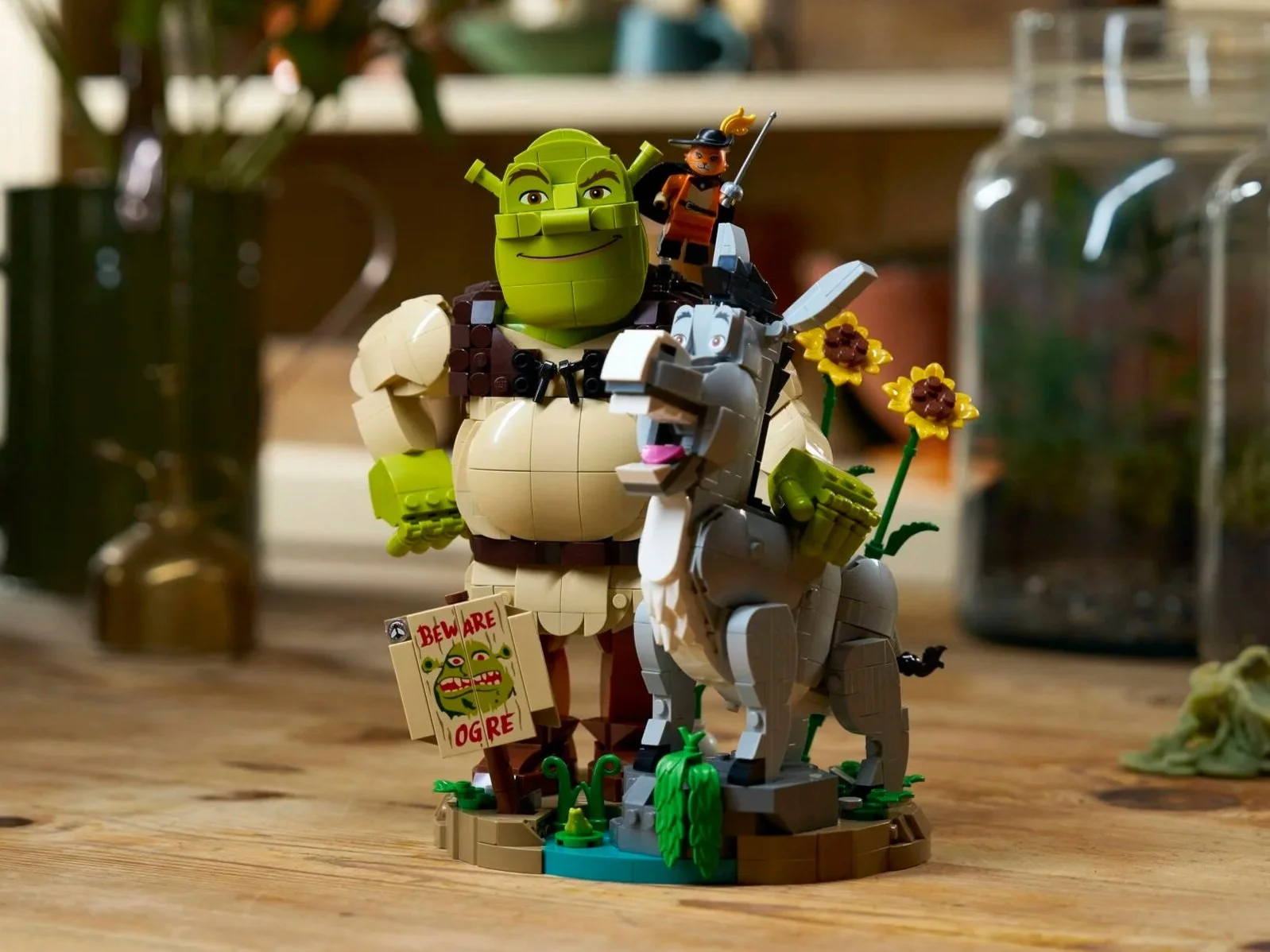
Building Donkey requires several distinct phases. The body is assembled primarily through SNOT techniques before moving on to the rock he is perched on and his legs. One particularly clever design choice is the way Donkey’s legs connect directly into the base itself, helping stabilize the entire structure and making the finished model feel like a single solid sculptural piece. The result pushes the set firmly into display-model territory rather than playability, but visually the effect works wonderfully.
PUSS IN BOOTS, ILLUSTRATION FROM 1903. Via: WEB research
At that point, my attention shifted to Puss in Boots himself. Did you know the character originates from an ancient European fairy tale? One of the oldest written versions appears in Giovanni Francesco Straparola’s Le piacevoli notti, published beginning in 1550 under the title Costantino Fortunato. Scholars still debate whether Straparola invented the story himself or simply transcribed a tale already circulating through oral tradition.
From there, the story evolved through centuries of reinterpretations before eventually finding its way into Shrek, where it became popular enough to inspire its own DreamWorks spin-off. And Puss in Boots is hardly alone. The Gingerbread Man, Pinocchio (created by Italian writer Collodi), the Three Little Pigs, the Big Bad Wolf, and many other Shrek characters all originate from classic folk tales and children’s stories passed down through generations.
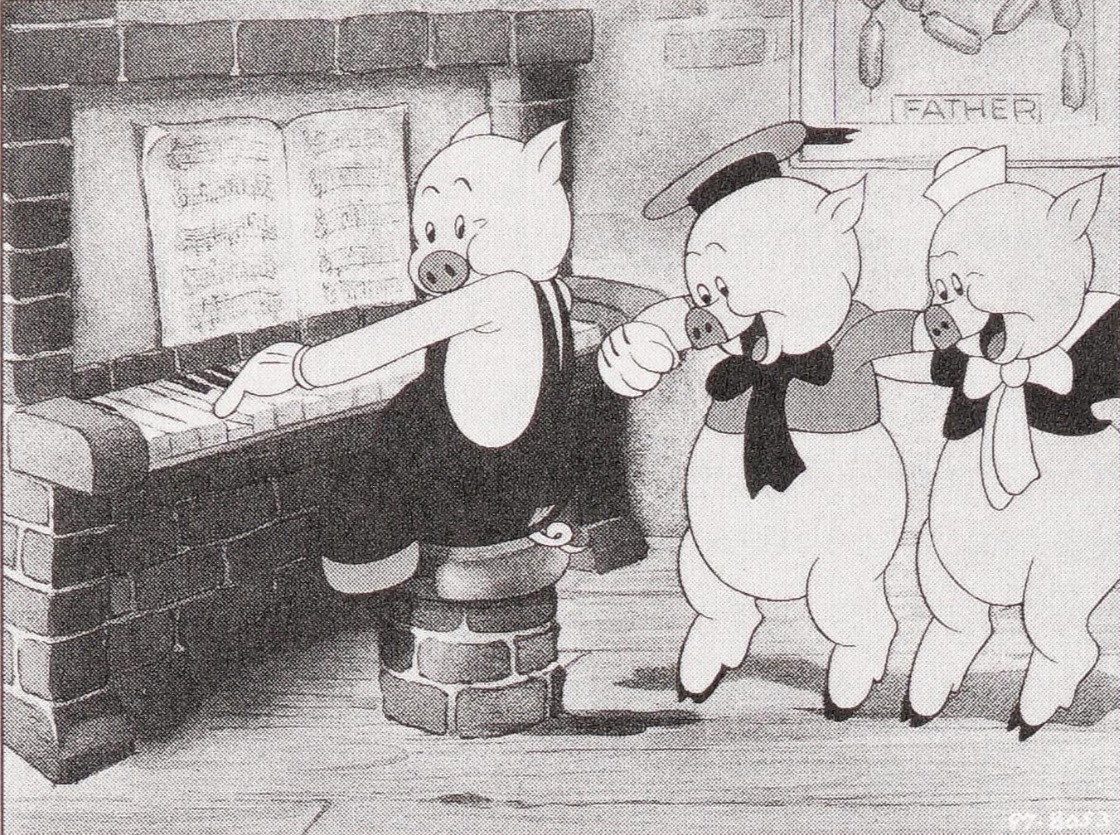
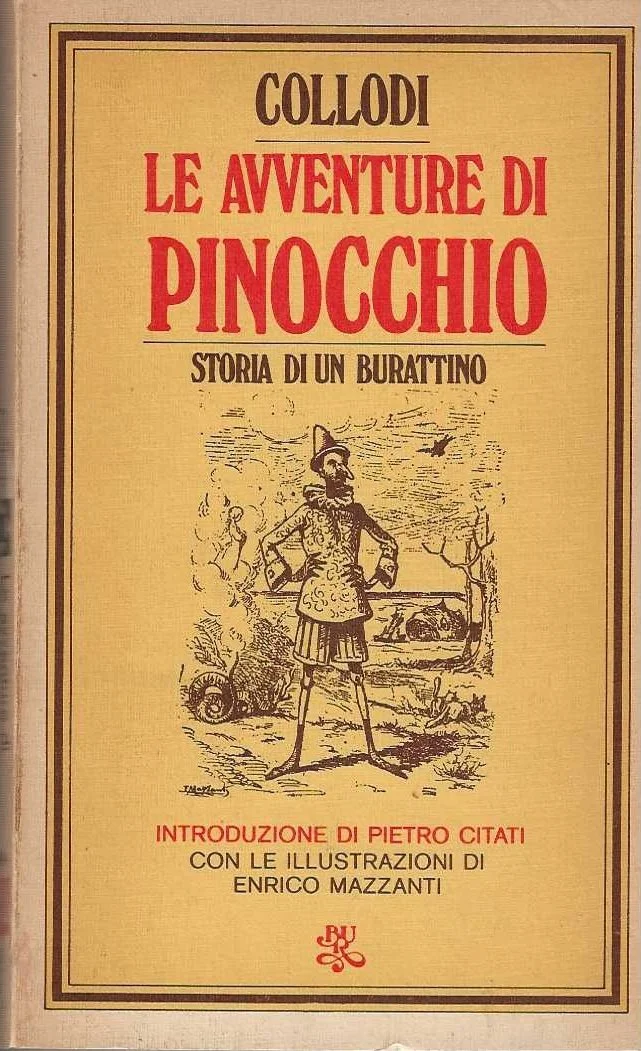
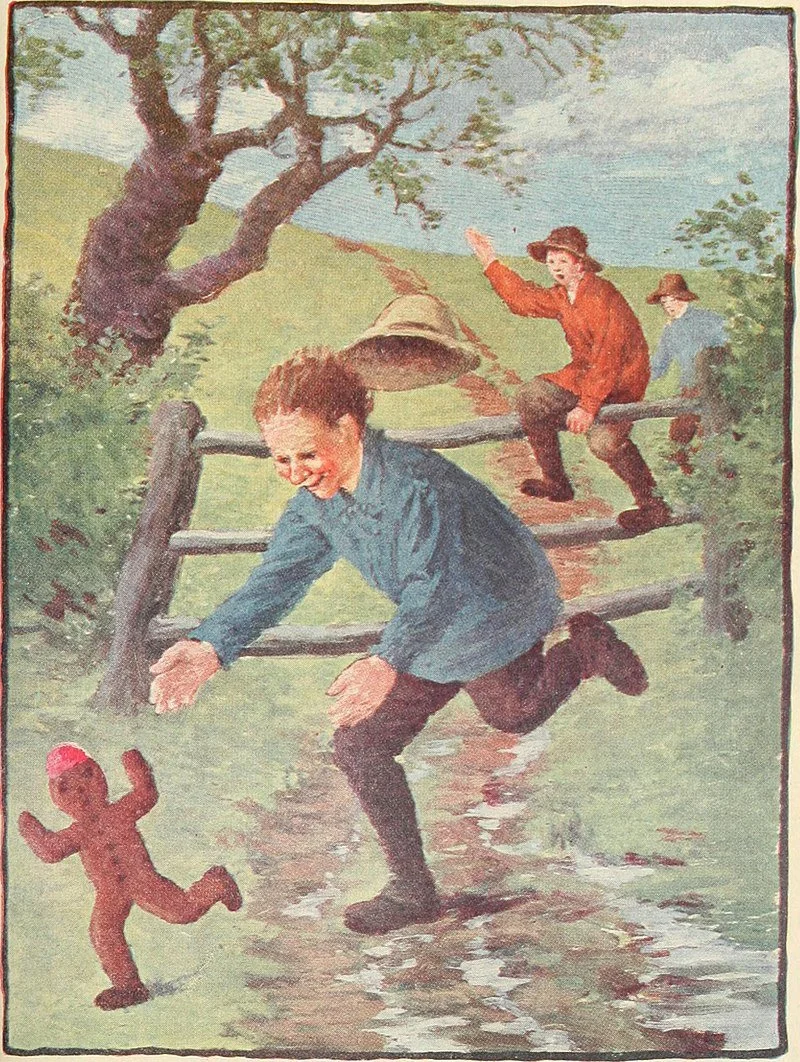
(Above: The Three Little Pigs, Disney Version - Via: Web Research. The Adventure of Pinocchio, Italian Version - Via: AbeBooks.it. The Gingerbread Man, Illustration From 1918 - Via: Wikimedia Commons)
A Dream… Works!
Let’s continue with the set. Honestly, being the LEGO Designer behind a project like this must feel like a dream job. Every stage of the build feels carefully considered, and once all of Donkey’s legs are attached and the rocky base is completed, the model really begins to come together. But we’re still not finished. Donkey’s head is built separately later on, and while the construction itself is fairly simple, it highlights something I’ve been thinking about for quite a while now.
The influence of BrickHeadz on modern LEGO design language has quietly opened new creative horizons for LEGO sets. I don’t mean to sound pretentious—it’s simply a feeling I’ve had for some time, especially with sets like this Shrek model. The stylized proportions and sculptural shaping feel like a natural evolution of techniques first explored through BrickHeadz. Another major plus is, once again, the complete lack of stickers.
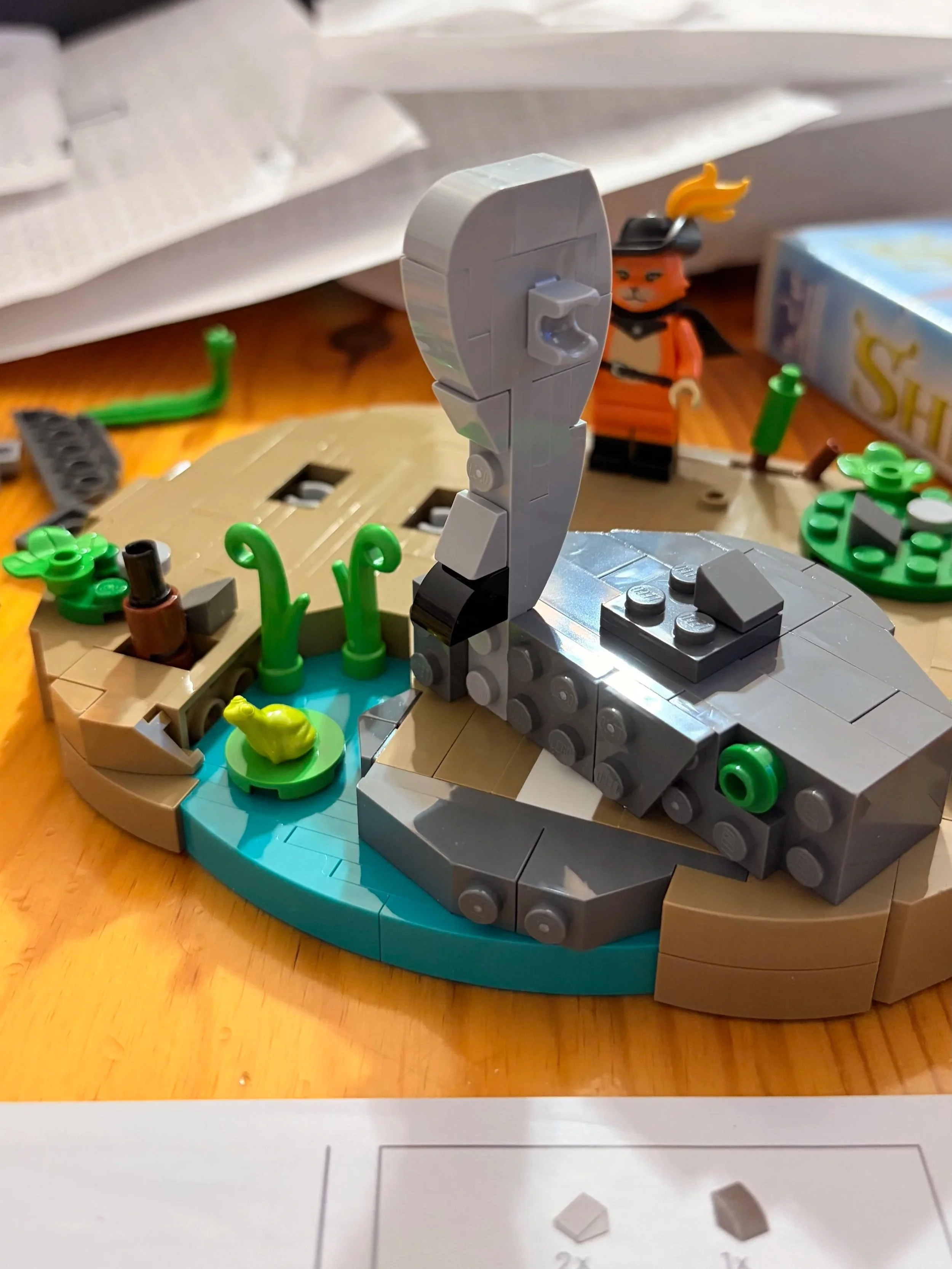
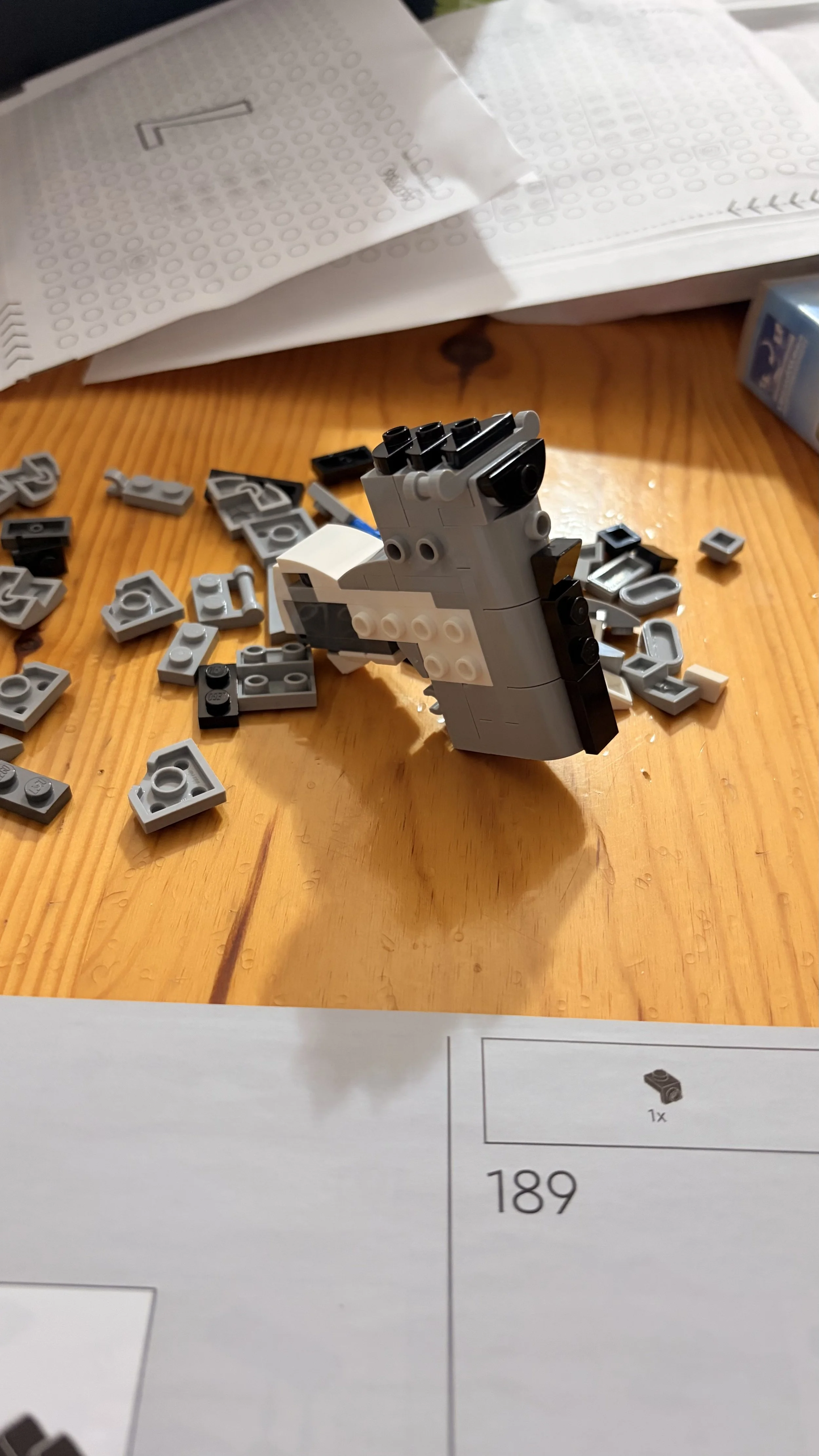
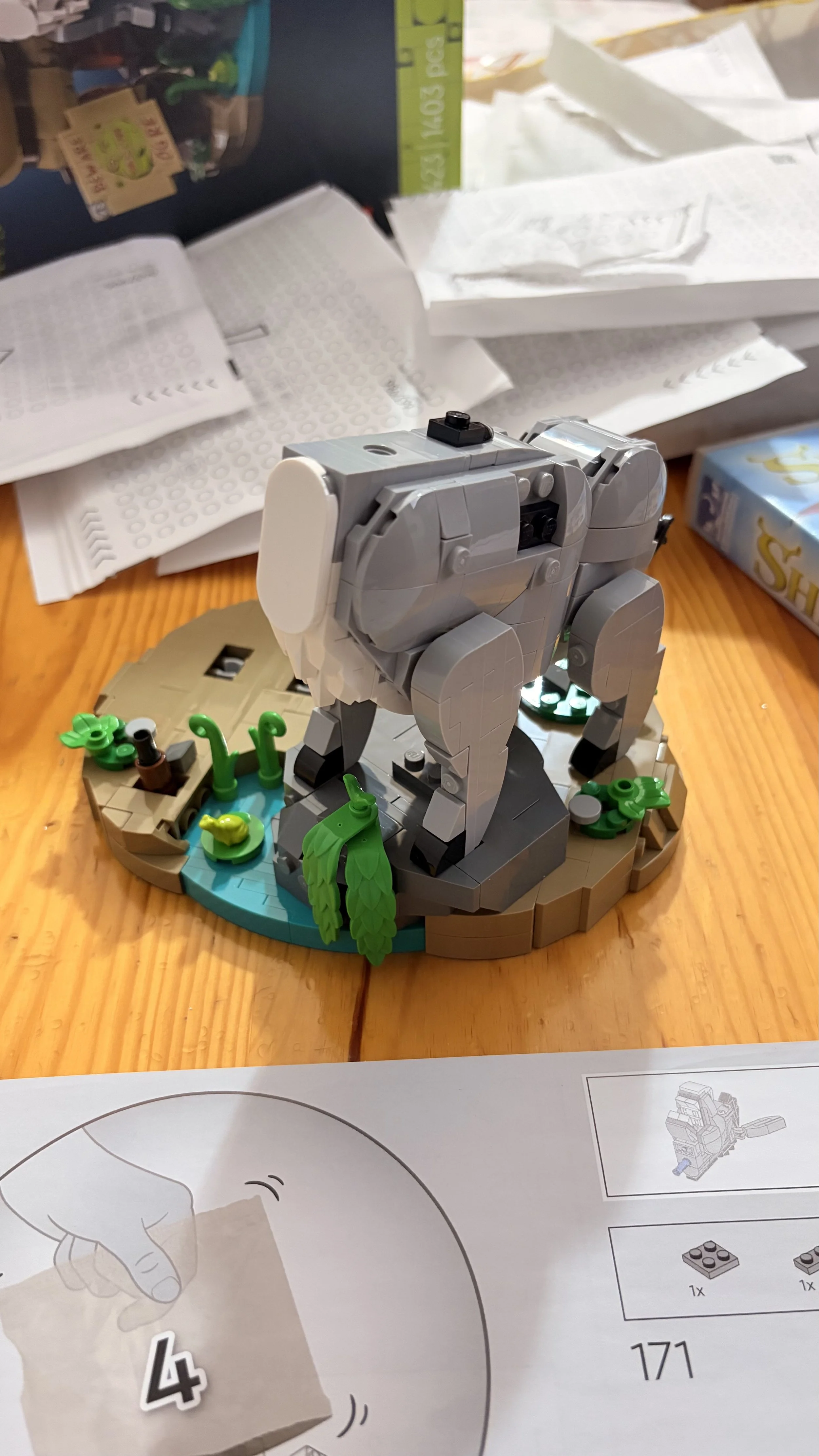
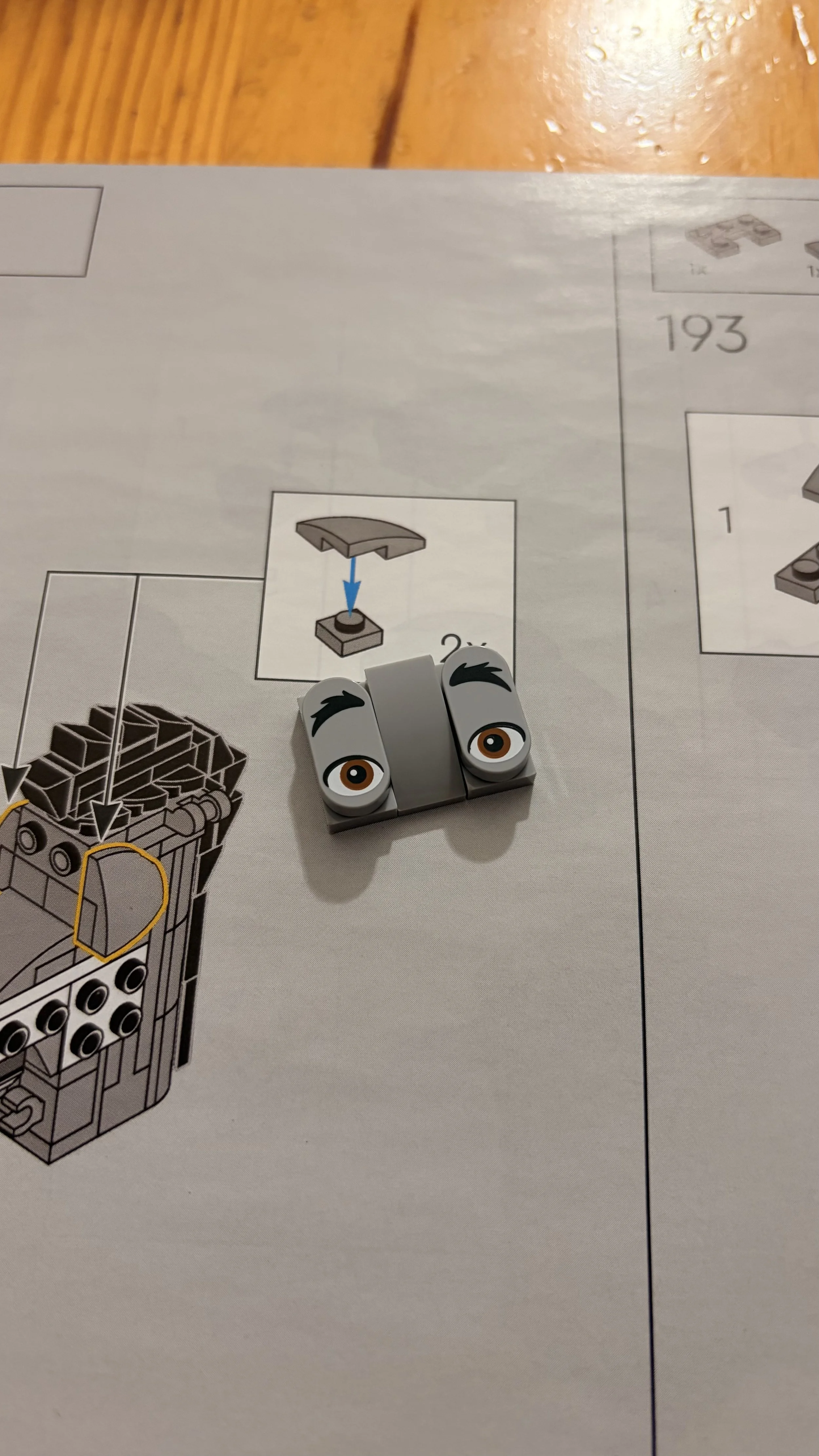
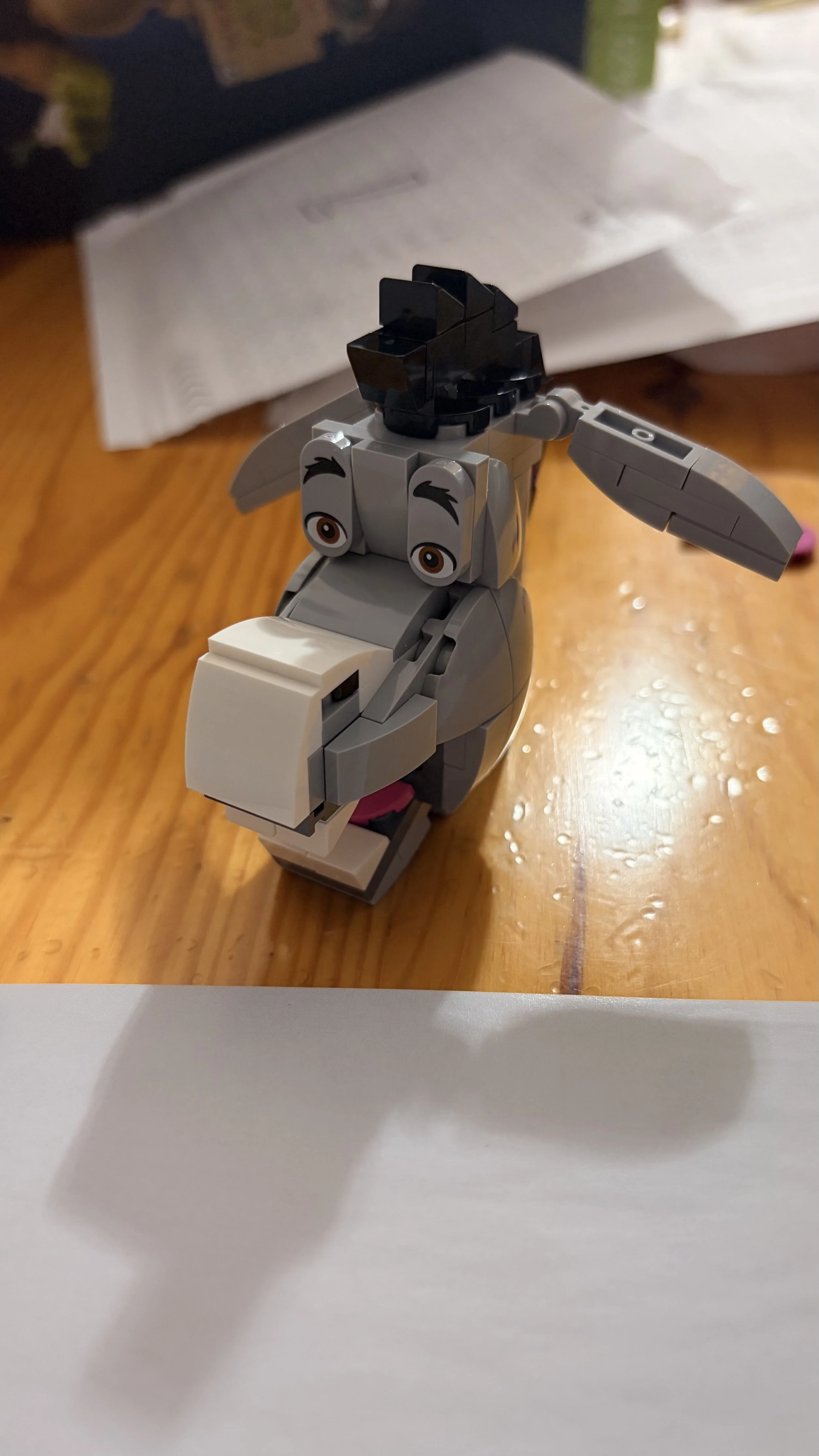
Small details enrich the set even further, including the two sunflowers, the onion referencing one of Shrek’s most famous lines, and especially the “blue flower with red thorns” that Donkey desperately searches for in the film.
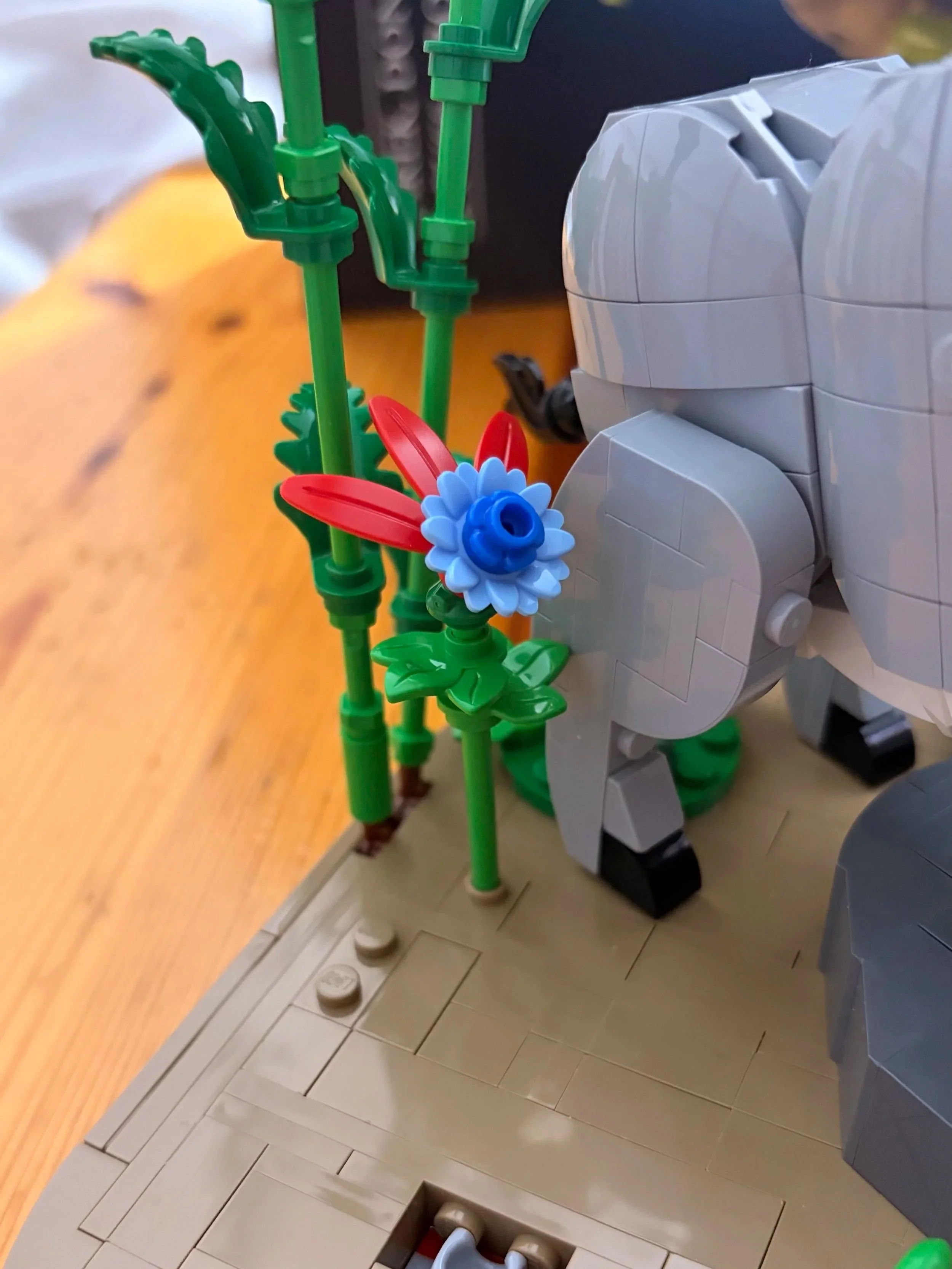
Then we finally move on to Shrek himself. Opening Bag 6 immediately reinforces what I mentioned earlier: building Shrek feels almost like constructing an oversized BrickHeadz figure. One particularly smart design choice is the way the instructions divide the left and right sides of the build using green and red internal elements. Not only does it simplify the process, but it also helps prevent mistakes during construction.
While building, I found myself becoming curious about the history of DreamWorks itself. I’ve always enjoyed learning the stories behind companies because they often give us a different perspective on the films and worlds we interact with. And in many ways, the history of DreamWorks helps explain the unexpected success of Shrek.
DreamWorks SKG was founded in 1994 by Steven Spielberg, Jeffrey Katzenberg, and David Geffen, with the “SKG” acronym coming directly from their surnames. Katzenberg’s involvement is especially important because before DreamWorks, he had been one of Disney’s most recognizable executives, something that would heavily influence Shrek.
From the beginning, DreamWorks Animation tried to distinguish itself from Disney through a more ironic and irreverent style. During the height of the CGI boom, this positioned the studio as a direct challenger to Disney and Pixar. In 1998, DreamWorks released Antz just one month before A Bug’s Life, immediately placing the studios into competition.
That same year, DreamWorks also released The Prince of Egypt, proving the company could balance humor with ambitious storytelling. But in 2001, the studio truly found its defining voice with Shrek. From there came additional successes like Kung Fu Panda and How to Train Your Dragon, franchises that helped solidify DreamWorks as one of animation’s biggest studios. Even today, despite major changes within the industry, DreamWorks continues producing animated films and series, often collaborating with Illumination, the studio behind Minions.
The Ogre That Challenged Disney
“MARTINI eye” - Via: REDDIT
Slowly, I made my way to Bag 8. Here we finally build Shrek’s legs, which are unfortunately fairly rigid, and place some “food” into Shrek’s stomach, including several fun Easter eggs hidden throughout the build, including a cookie, an onion, and a 1x1 eyeball tile, likely referencing the scene where Shrek drinks what appears to be a martini with an eyeball inside. (See the image above.)
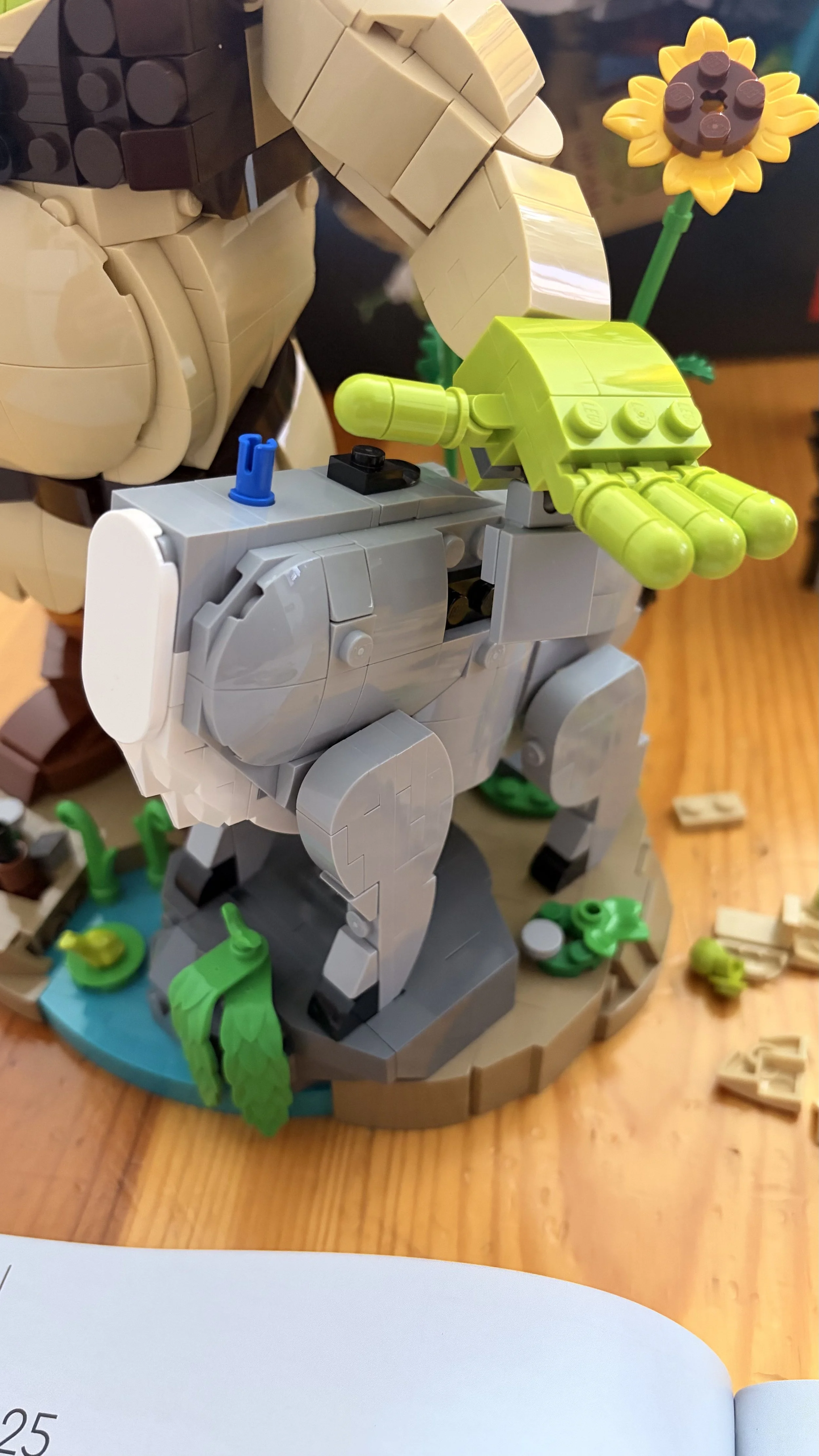
Once Shrek is finally attached to the base and the arms are assembled, the character really starts to take shape. What captivated me most was the technique used to stabilize the structure. Shrek’s left hand connects directly onto Donkey’s back, using the model itself as part of the support system. It’s a technique commonly seen in sculpture, where structural necessity and aesthetics work together at the same time. Obviously, sculptural engineering is far more complex in practice, but the same principle works surprisingly well here too.
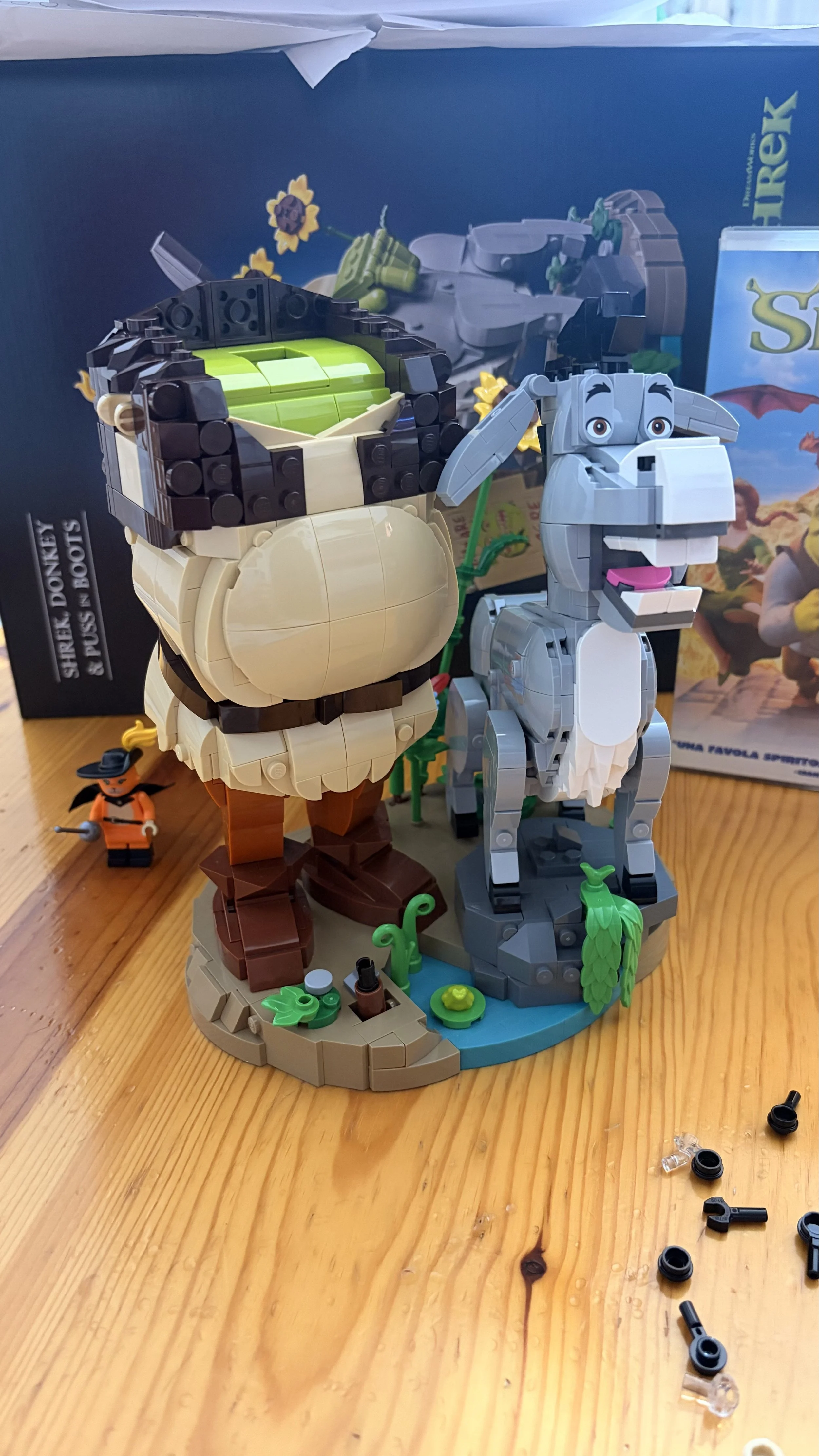
Then we move on to Shrek’s head. Once again, I really appreciated that the entire set avoids stickers completely, even down to the “Beware Ogre” sign. With that final detail in place, the build itself was complete.
At that point, my mind immediately went back to the long-running rivalry between DreamWorks and Disney. In many ways, Shrek itself was a direct response to Disney’s dominance during the late 1990s and early 2000s, largely driven by Jeffrey Katzenberg after his departure from Disney.
Katzenberg had played a major role in the Disney Renaissance, helping oversee films like The Lion King and The Little Mermaid before being pushed out by Disney CEO Michael Eisner. After founding DreamWorks SKG, that rivalry inevitably found its way into the studio’s films. Even before Shrek, DreamWorks and Disney often released competing projects with similar themes, such as The Road to El Dorado and The Emperor’s New Groove.
But the real “diss track” arrived in 2001 with Shrek. Lord Farquaad is widely believed to be a caricature of Eisner himself: short, obsessed with perfection, and ruling over a heavily commercialized fantasy kingdom. Even the name “Farquaad” sounds suspiciously close to a vulgar insult if spoken quickly enough. Duloc itself feels like a direct parody of Disney parks, with its overly sanitized atmosphere, corporate cheerfulness, and rigid perfectionism. Even the song “Welcome to Duloc” mirrors the structure and tone of Disney’s “It’s a Small World.”
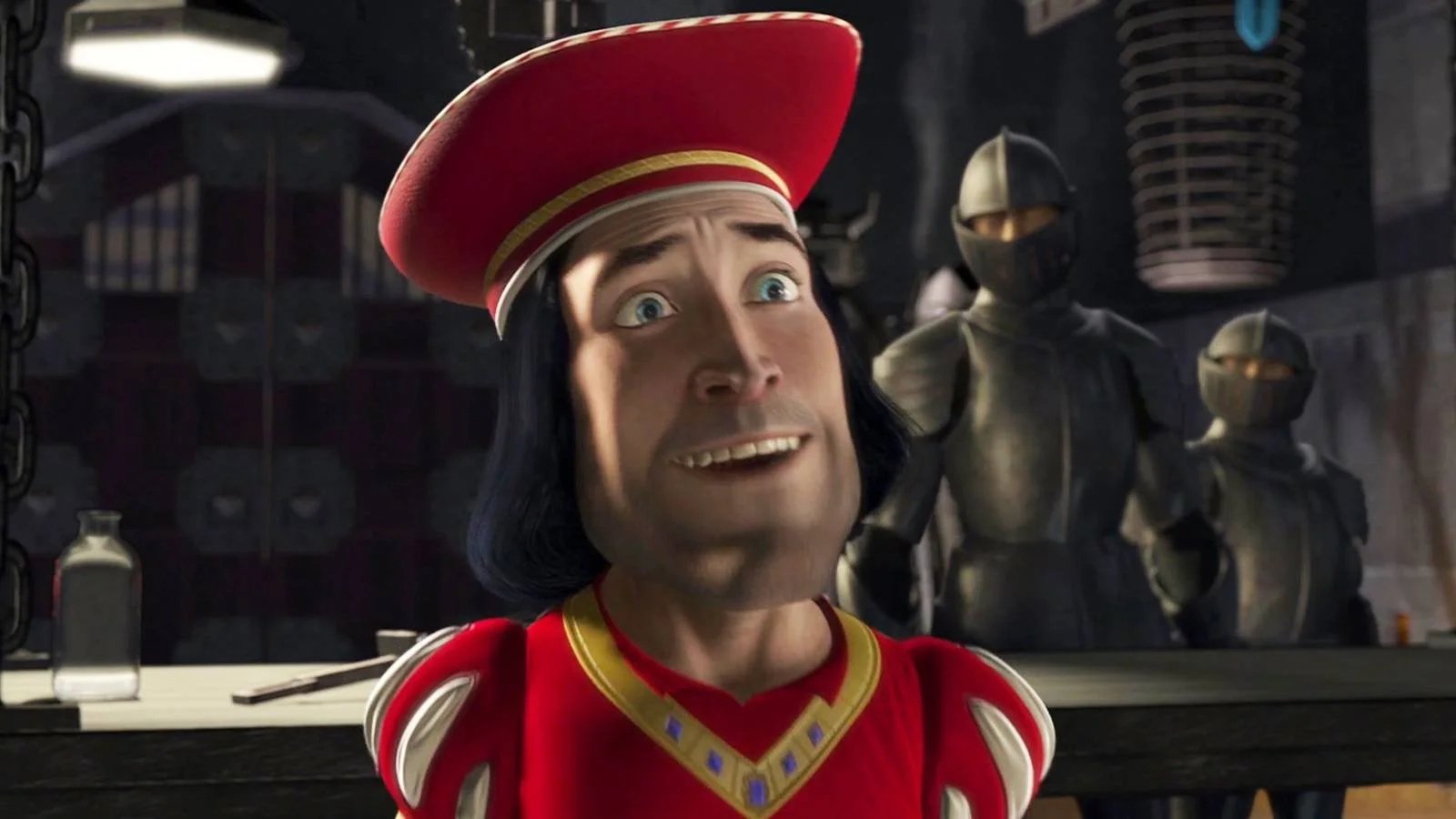
LORD FARQUAAD. via: screenrant
At the same time, Shrek actively deconstructs classic Disney fairy tale formulas. Fiona does not simply wait to be rescued by a prince; she fights, transforms into an ogre herself, and rejects the traditional princess mold entirely. Fairy tale creatures like Pinocchio, the Three Little Pigs, and the Big Bad Wolf are treated as outcasts and dumped into Shrek’s swamp, completely reversing the magical fantasy worlds Disney traditionally celebrated.
Perhaps that irreverent approach was part of the magic formula behind Shrek’s success. At the box office, the film dramatically outperformed Disney’s Atlantis: The Lost Empire, earning roughly $480 million worldwide compared to Atlantis’ $186 million.
Ironically, one of the film’s most iconic elements almost never happened. Mike Myers originally recorded all of Shrek’s dialogue using his natural accent before deciding to completely redub the character with a Scottish voice, reportedly costing the production millions of dollars. And in one final piece of movie trivia, Fiona’s famous burp scene was apparently authentic: Cameron Diaz accidentally burped after drinking a Coke during recording, leading Eddie Murphy to improvise the unforgettable line, “She’s as nasty as you are!”
Happily Ever After?
With the finished set finally sitting in front of me, I found myself thinking about how important the right mix of timing, creativity, and opportunity can be in creating something truly successful. If I’m here today holding this LEGO set in my hands, it’s because of the success of a 25-year-old animated film based on a character who, on paper, was never meant to become a beloved star. Originally, Shrek was designed to embody fear, ugliness, and discomfort within traditional fairy tales. And yet, somehow, Shrek the film worked.
DreamWorks managed to transform a grotesque antihero into one of animation’s most recognizable and beloved characters. To do that, however, the studio itself almost had to become the “ogre,” challenging Disney’s dominance with irony, irreverence, and a willingness to completely overturn the traditional fairy tale formula. Shrek became an unpredictable mix of parody, heart, cynicism, and sincerity that helped reshape animated cinema in the early 2000s. And now, decades later, LEGO has created a tribute that almost feels like a final certification of that success.
Despite a few limitations—particularly Shrek’s fairly rigid arms, with only limited movement in the right arm—I genuinely enjoyed this set. It’s a unique tribute to a character who managed to do the impossible and carve out a lasting place in pop culture history.
Do you prefer LEGO display models like this, or would you rather see more play-focused Shrek sets? Comment below!
Do you want to help BrickNerd continue publishing articles like this one? Become a top patron like Paige Mueller, Rob Klingberg from Brickstuff, John & Joshua Hanlon from Beyond the Brick, Megan Lum, Andy Price, Lukas Kurth from StoneWars, Wayne Tyler, Dan Church, and Roxanne Baxter to show your support, get early access, exclusive swag and more.