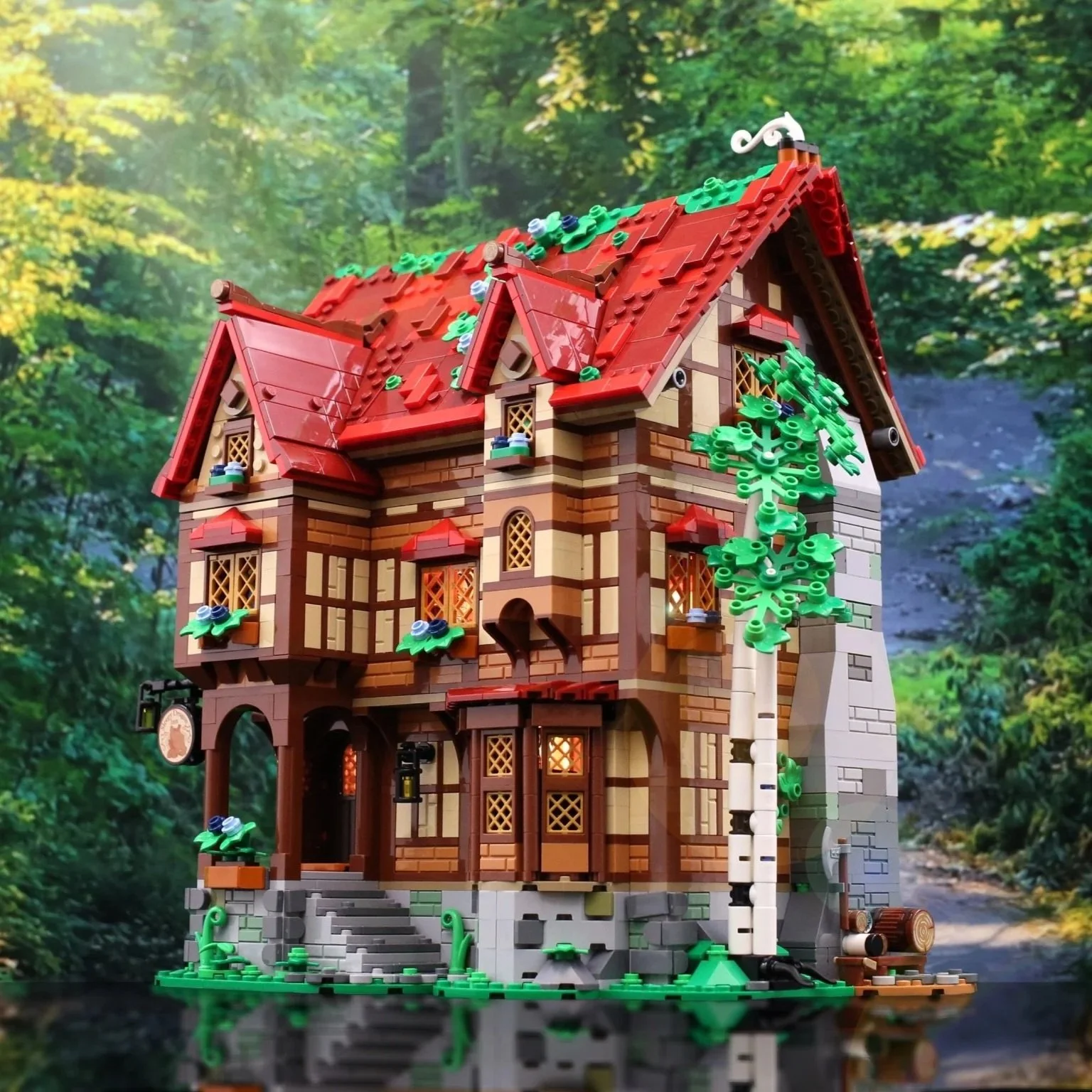
More Than a Christmas Tree: The Build Together Experience
/Merry Christmas, BrickNerd readers! What follows isn’t a traditional set review but more of a holiday experience and story. If it starts to feel familiar, like a certain Dickens story you’ve heard once or twice before, it might be because this author experienced a bit of a “bah humbug” seasonal reckoning along the way.
Ghost of Christmas Past: A UCS Christmas Tree
BrickNerd has a complicated relationship with Christmas trees.

A few years ago—before LEGO ever decided this was a thing—we built our own “UCS Christmas Tree.” It wasn’t a tree in any official sense. It was the 10307 Eiffel Tower, repurposed with lights and ornaments, and it actually served as our family Christmas tree for several years. What began as a joke turned into a tradition, and nothing cements a tradition faster than doing something slightly ridiculous and committing to it publicly. (Foreshadowing?)
So when LEGO offered us the actual “Ultimate Collector Series” Christmas Tree, the one they had now decided should exist, there was never much debate. Of course, I said yes. LEGO had finally caught up to something we’d already lived with, laughed about, and built memories around, and the irony alone felt worth exploring. I have a decent history with LEGO Winter Villages and all things Christmas, so what was there to lose?
Then the box arrived. A big box. Yes, it was a tree, but not quite what I expected. At first glance, 41843 Family Christmas Tree looked like Botanicals had an unholy baby with a LEGO City set with a little Winter Village flair thrown in just in case. There were lots of new leaf elements that looked interesting, and the handful of exclusive holiday minifigures were tempting. But the set itself didn’t immediately capture my imagination the way I hoped it would. The box sat in the corner for a while as I contemplated it.
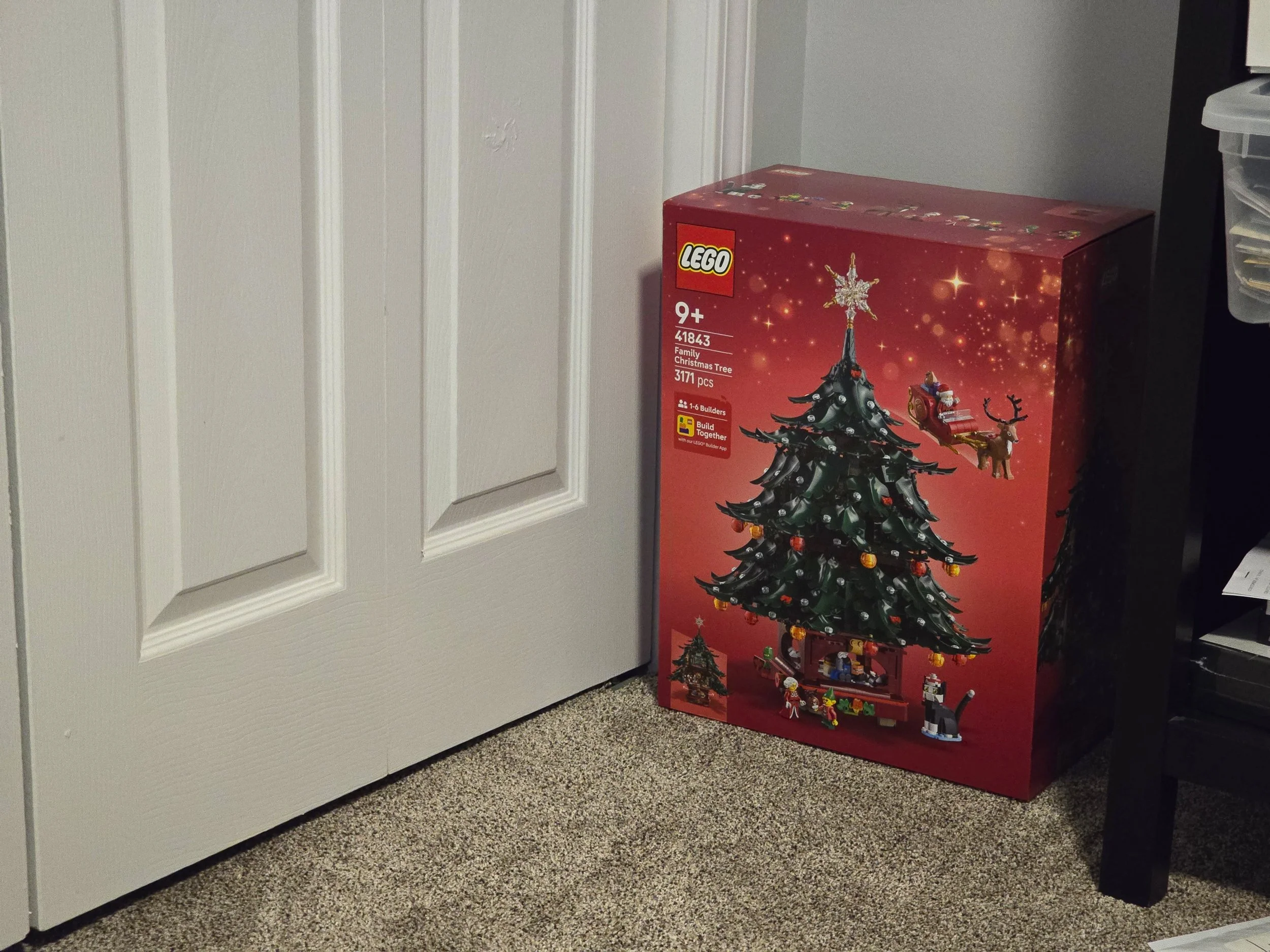
I enjoyed the overall look of the tree from a distance and was indeed a little eager to build the set, but that price… $330. Oof. I just couldn’t get over it. You can do so much with that amount of money. Looking at the box in the corner the next few weeks, I came to resent it a bit. It was too expensive. I had already judged the set almost entirely on price, and I was determined to prove just how absurd that price felt. I even knew exactly how I was going to do it.
We had just moved into a new (to us) home, so we needed to decorate for the holidays. I gave myself a firm holiday decorating budget of $330, with one simple goal: make this house feel like Christmas. So I did what any nerdy AFOL would do: I made a spreadsheet to start budgeting, then went comparison shopping.

I found a six-foot-tall pre-lit Christmas tree for only $50. Then I added a star, ornaments and hangers for another $50. And I still had $230 to play with in my budget! I could get a real toy train to go around the base, a wreath for my front door, and some garland for the mantle.
Heck, after all that, I could still afford the four-foot-tall lit and animated waving Mickey Mouse for my front yard! I was a little giddy, ready to showcasehow expensive the Family Christmas Tree set was in comparison.






Then I thought I’d do the same exercise using only holiday LEGO. With some deal hunting, I found two Winter Village sets for $50 each at Walmart, the most recent Christmas tree set, Santa’s sleigh, and a gingerbread house. I added a candle centerpiece from Costco, along with the Botanicals wreath and poinsettia, and still had enough left over to throw in the City Advent calendar.

That’s nine holiday sets for the same price as this single UCS Christmas tree (though many were good Black Friday deals). The comparison photos were going to be incredible with so many LEGO boxes stacked, or maybe I could build them all to show the true volume! At $330, this set wasn’t just expensive—in my mind, it was competing with everything else Christmas could be.
At that moment, I was not inclined toward generosity—of spirit or of budget. I was practical, exacting, and unconvinced. I was an Ebeneezer, standing before a Christmas tree and wondering how things had come to this. But I still had to build it, and a perfect opportunity was coming up soon.
Ghost of Christmas Present: Build Together
The opportunity came on Thanksgiving. We had a few people coming over, and I had noticed the “Build Together” logo on the box. I’d experienced that only once before at Fan Media Days in 2024, building a dancing Groot in a pot, but I’d never had a chance to test it with a group of people. Building the Christmas tree as an after-dinner activity suddenly felt like the right thing to do.
Once the leftovers were packed away, the house settled into that familiar post-meal calm. Around the table were my husband and I, his parents and sister, and our neighbor and her son, who have shared Thanksgiving with us for several years now and who have never built a LEGO set before. It’s a wonderful group that has become a tradition in its own right—part biological family, part chosen family.

I had warned everyone to bring a tablet or phone and to download the LEGO Builder app in advance. We opened the set, organized the bags, and put the sealed instructions aside, determined to never open them and use only the app. Once we had the tech up and running on everything—new phones, old phones, a tablet, and an older tablet that froze occasionally—we opened the first bag and started building.
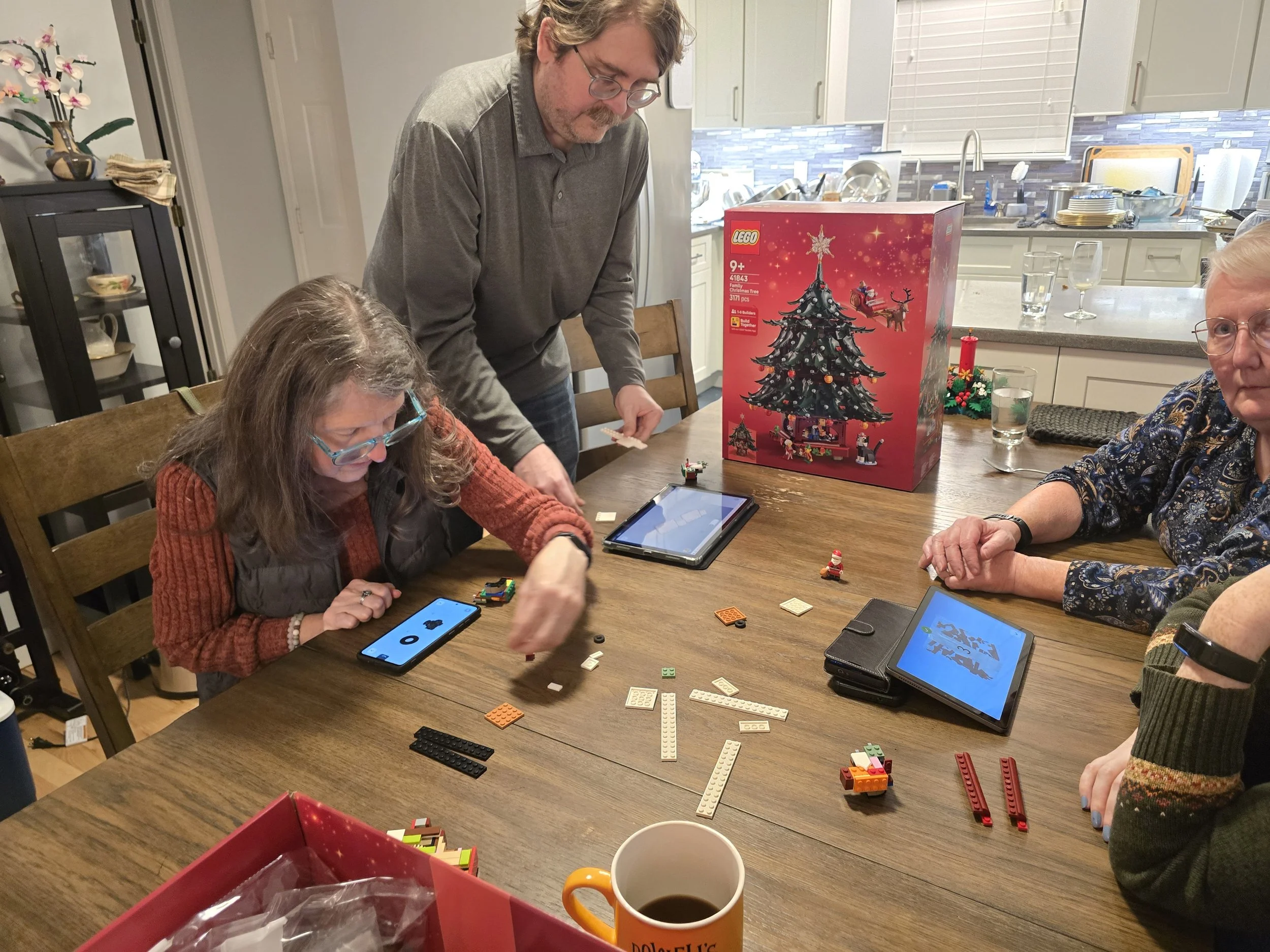
The beginning was awkward. We had to figure out the app. Everyone had an assigned name of a minifig from the set, so it took a while to figure out you were the elf or Santa himself. It would be much easier to write your own names, but I understand that with kids, this is probably a privacy requirement. The feel and flow of the app took some getting used to as well. I had never built with digital instructions before, so the animations and part inventories before each step had to be navigated.
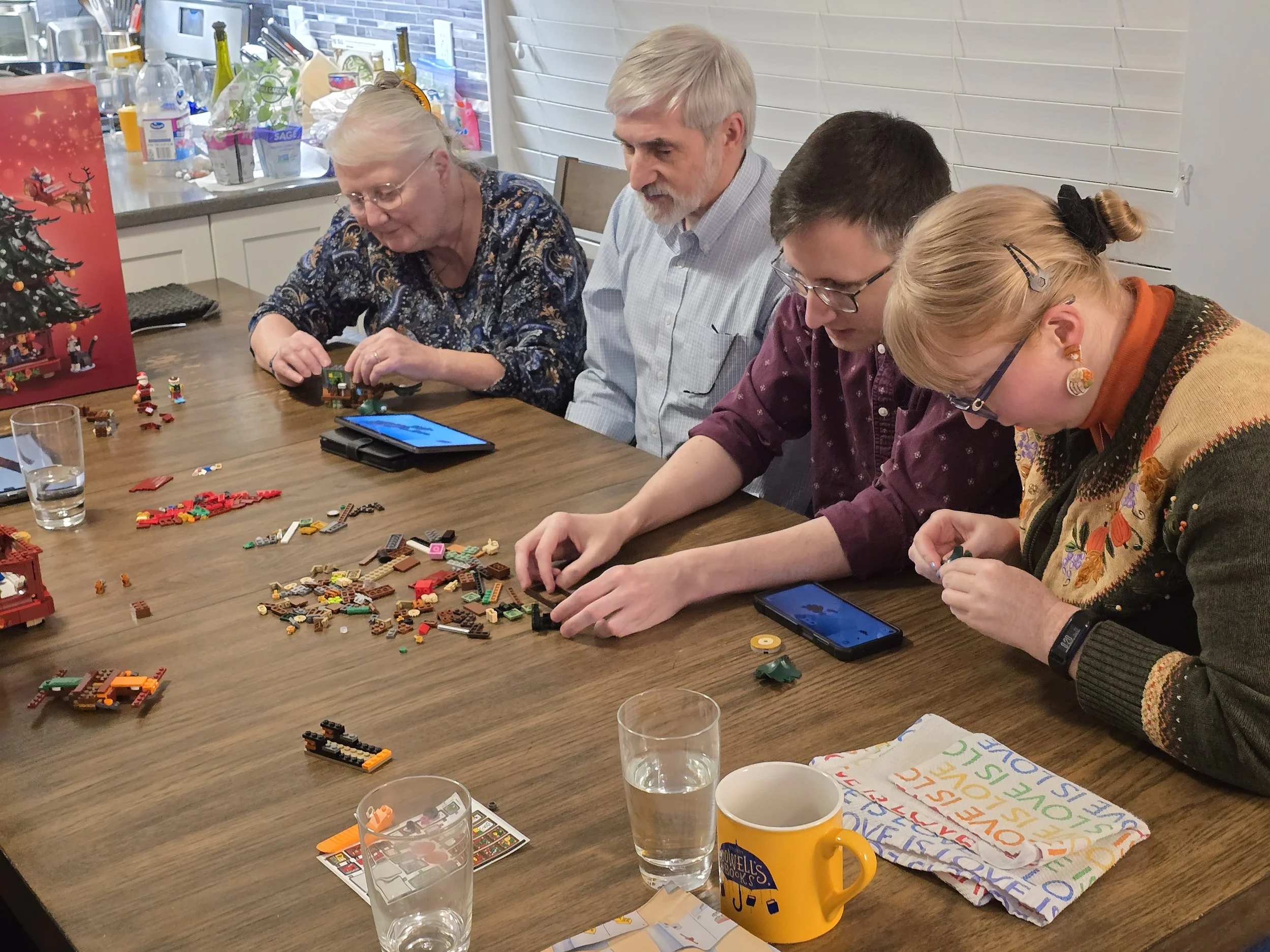
Soon, things started moving forward as we each began building unrecognizable chunks that someone later had to combine. And that is where the magic happened. Everyone started their own task, yet with one overall goal. One person was excited that they got to assemble a minifig, while two others seemed to be creating mirrored parts of another build. Some of us worked on tiny details; others tackled larger sections, and unfinished assemblies passed from hand to hand as we moved forward.
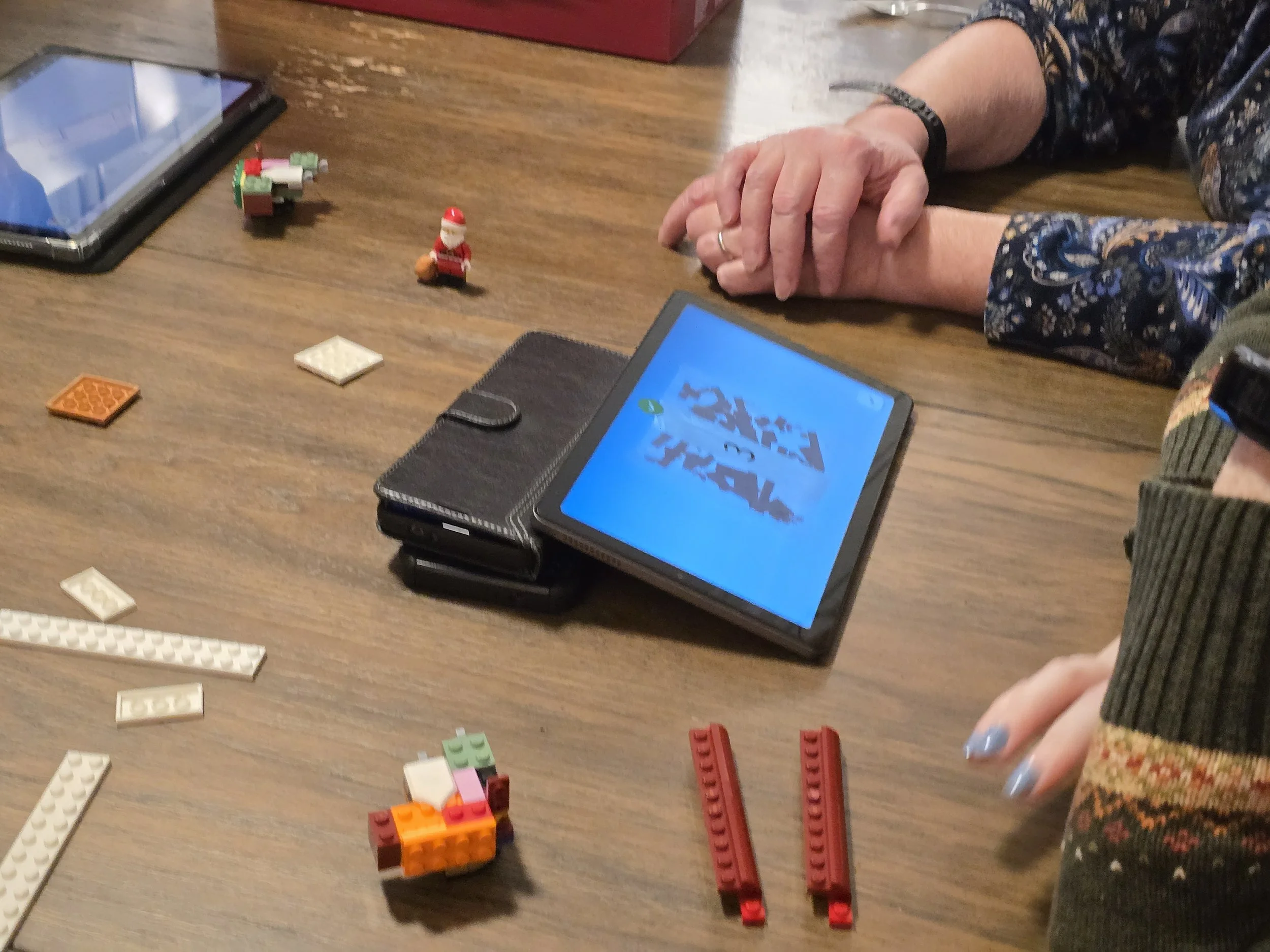
It was certainly a stress test on whatever cloud-based system the app uses. One builder was going fast, the other slow. The app kept pace with us, nudging faster builders ahead and slowing things down when someone stopped to talk or step away. One older tablet kept freezing, but the app recognized it and adjusted until the device could be rebooted.
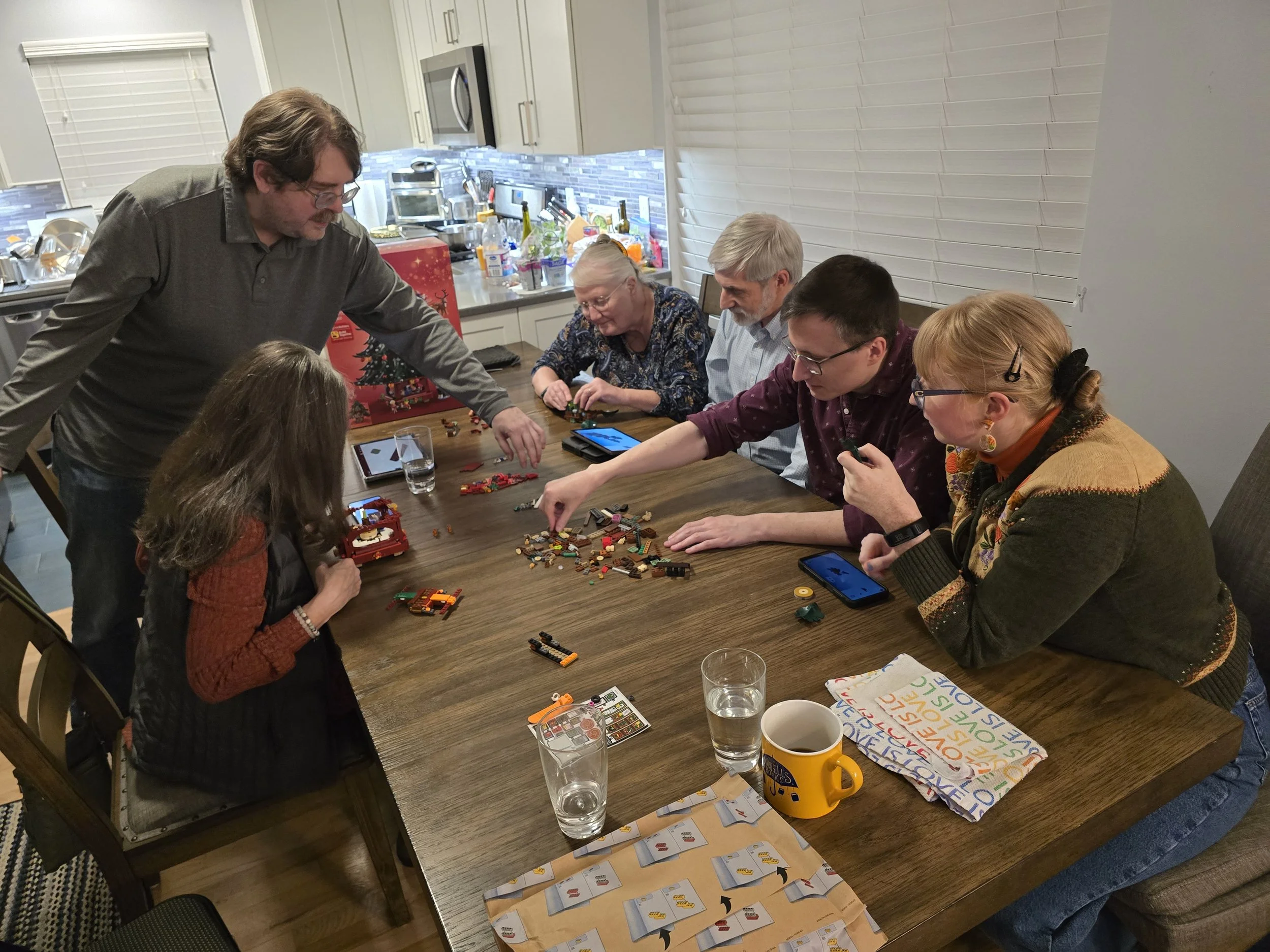
The app encouraged us to build past bag boundaries, which meant dumping pieces into shared piles and inventing a system on the fly to manage pieces and know which bag they originated from. Someone asked for the shiny parts, someone else needed a “flat top one,” and another cheered when they got to do the next minifig. (We did have to open the instructions packet to get the stickers.) Subassemblies slid across the table, and people actually started to… build together. At one point, someone asked where a piece went and three people answered at once, which is when I knew this was working.
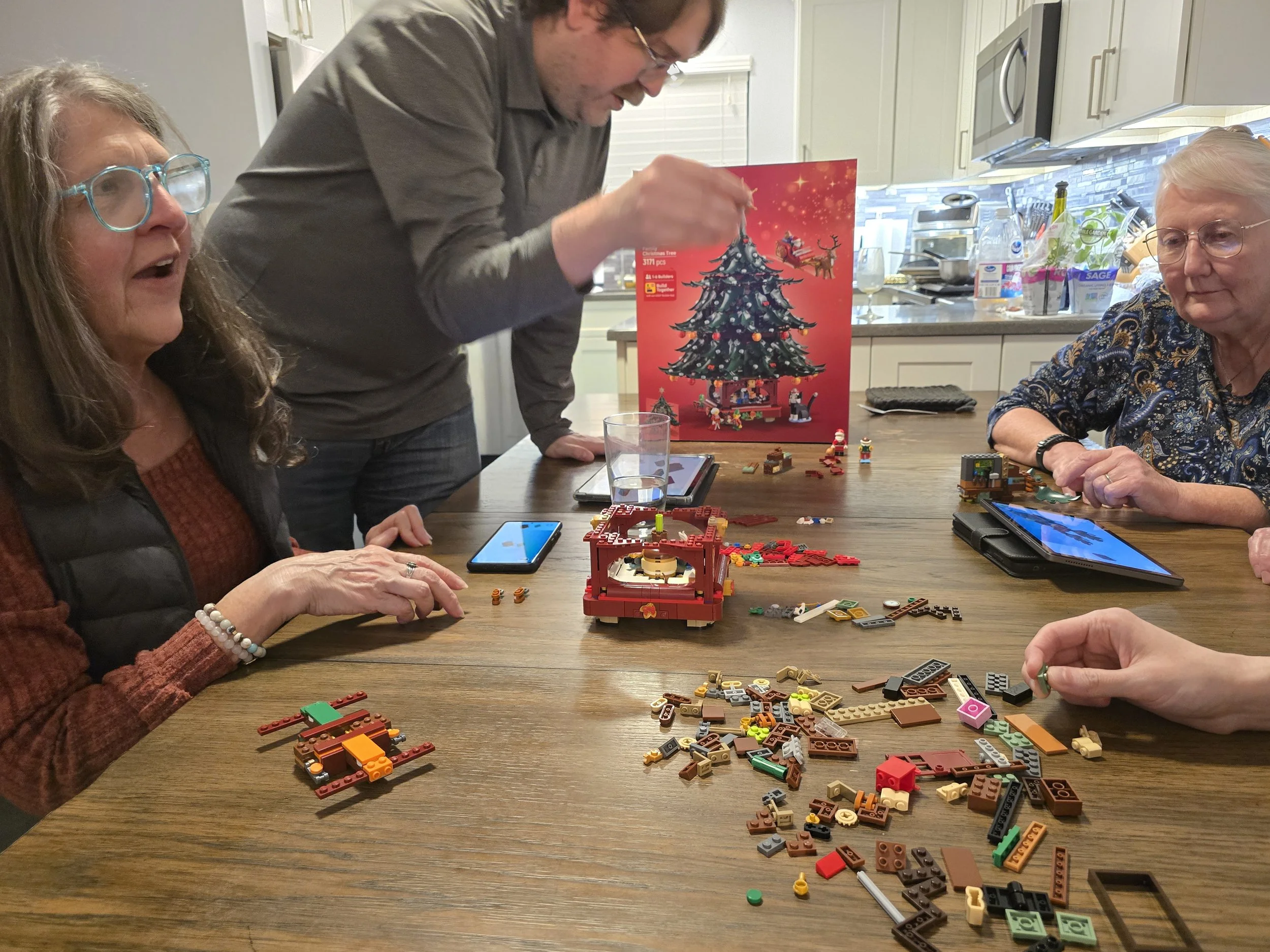
Our neighbor had never built a LEGO set before. There were also very experienced builders at the table. Somehow, neither fact mattered. Everyone had something to do, no one was rushed, and no one was left waiting. Conversation flowed around the building. People asked what pieces were for. Others were flummoxed by a missing part until we found it as a group. This wasn’t everyone building from their own booklet, but genuinely building together, engrossed in the process (to the point where I forgot to keep taking photos).
Somewhere along the way, time began to behave strangely. We stayed up far later than intended, absorbed not just in the building but in the shared momentum of it. The tree itself faded in and out of focus, and it could have been anything, really, but the fact that it was a Christmas tree gave the moment weight. Everyone wanted to know where their piece would end up and what it would become. We didn’t finish that night, and no one minded. We got about two-thirds through the set, and then had to promise to send photos when we finished. Everyone was invested more than I had expected. My neighbor left, excited to try building a LEGO set for herself in the near future.

The next day, the house was quieter, just my husband and me picking up where we had left off. The app noticed the change immediately and adjusted, asking us to take over sections that had belonged to others. The experience didn’t diminish; it simply changed shape. Some of the beautiful energy was gone only building with two people but it still felt the same—building together rather than separately, though our speed picked up.

Before long, we were finished. A small celebratory video played on the app, and I sent photos to the Thanksgiving group chat. The replies came back quickly, cheering the whole group. The build was complete, but the experience clearly hadn’t stayed at the table.
Somewhere across those two days, the spreadsheet math I’d started to eviscerate the set stopped feeling quite so important.
Ghost of Christmas Yet to Come: The Future of LEGO Instructions

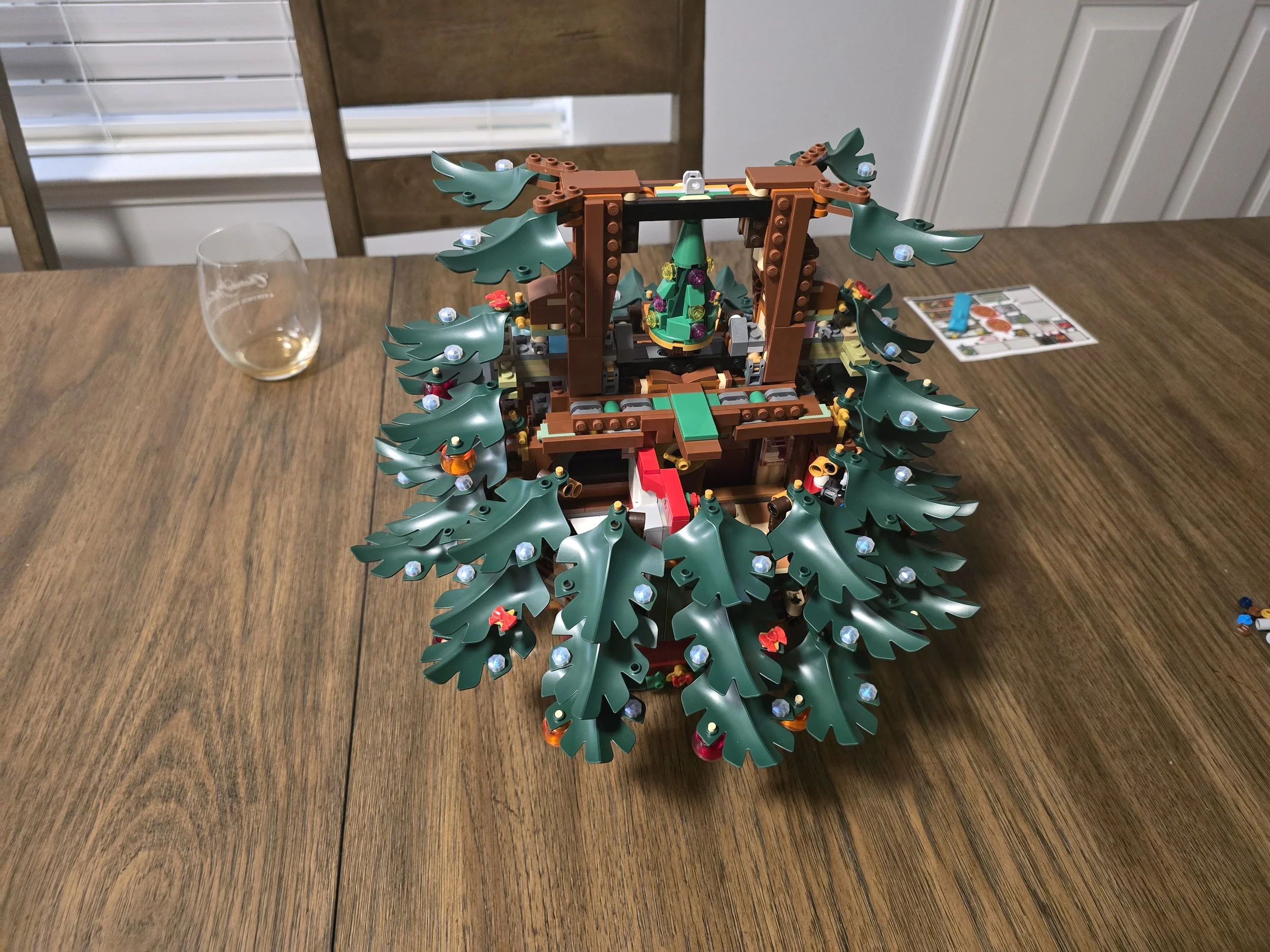
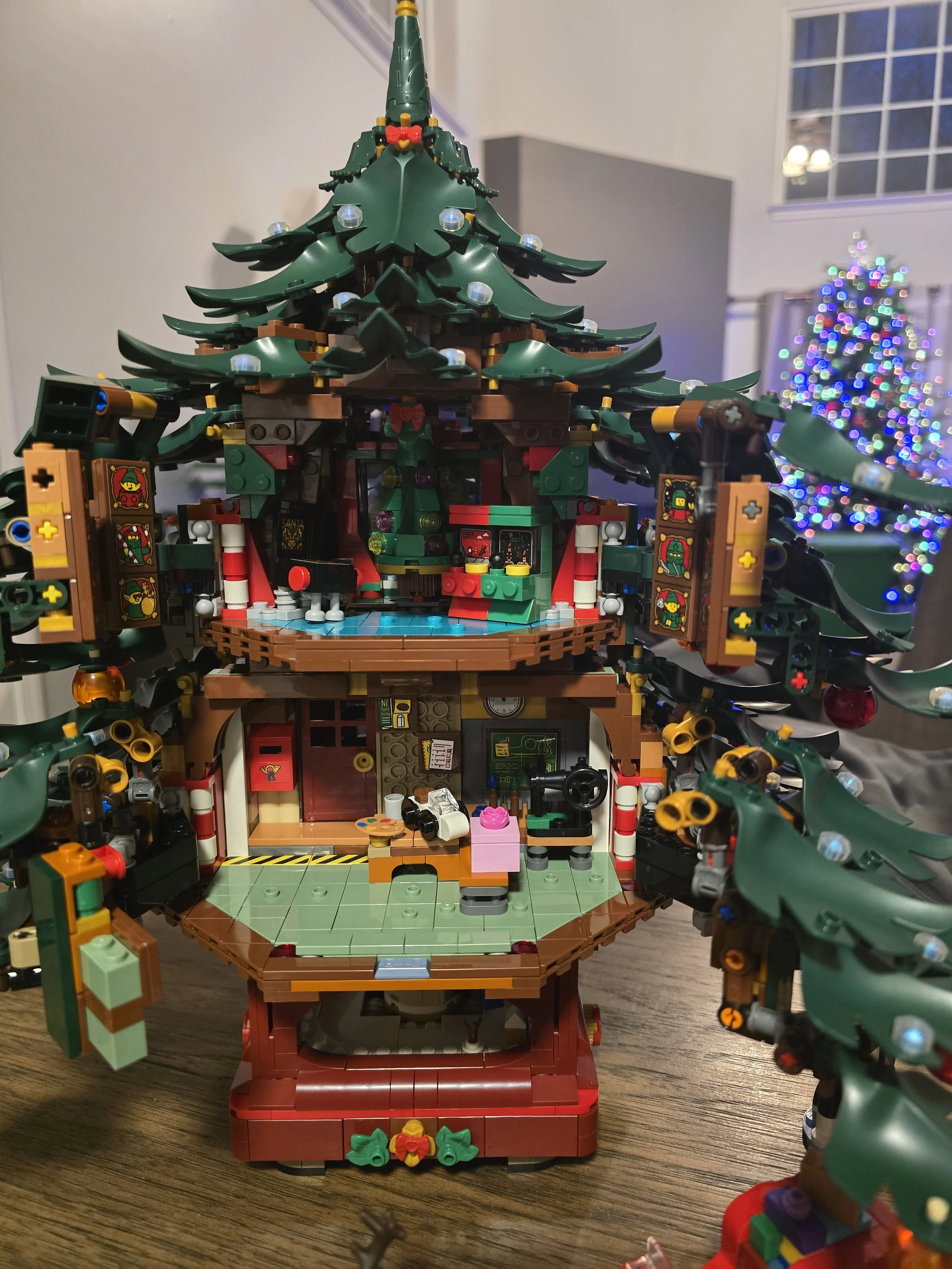
The next few days, I looked at the completed set to evaluate it for what it was. The LEGO Family Christmas Tree is filled with good intentions. The design clearly wants to do something more than assemble a cone of green slopes and call it festive. The tree has hidden scenes meant to reward curiosity rather than demand attention, though I don’t exactly agree with the execution.
The exterior foliage relies heavily on ball joints. From an AFOL perspective, that’s a red flag for a display-first model that still wants to be handled. Gravity always wins here. Over time, the branches have started sagging. Decorations fall off every time you open the side panels to peer inside, and the tree seems to resist being explored even as it invites you to try. This is one of the first LEGO sets that promises discovery while, in my opinion, quietly penalizes curiosity.
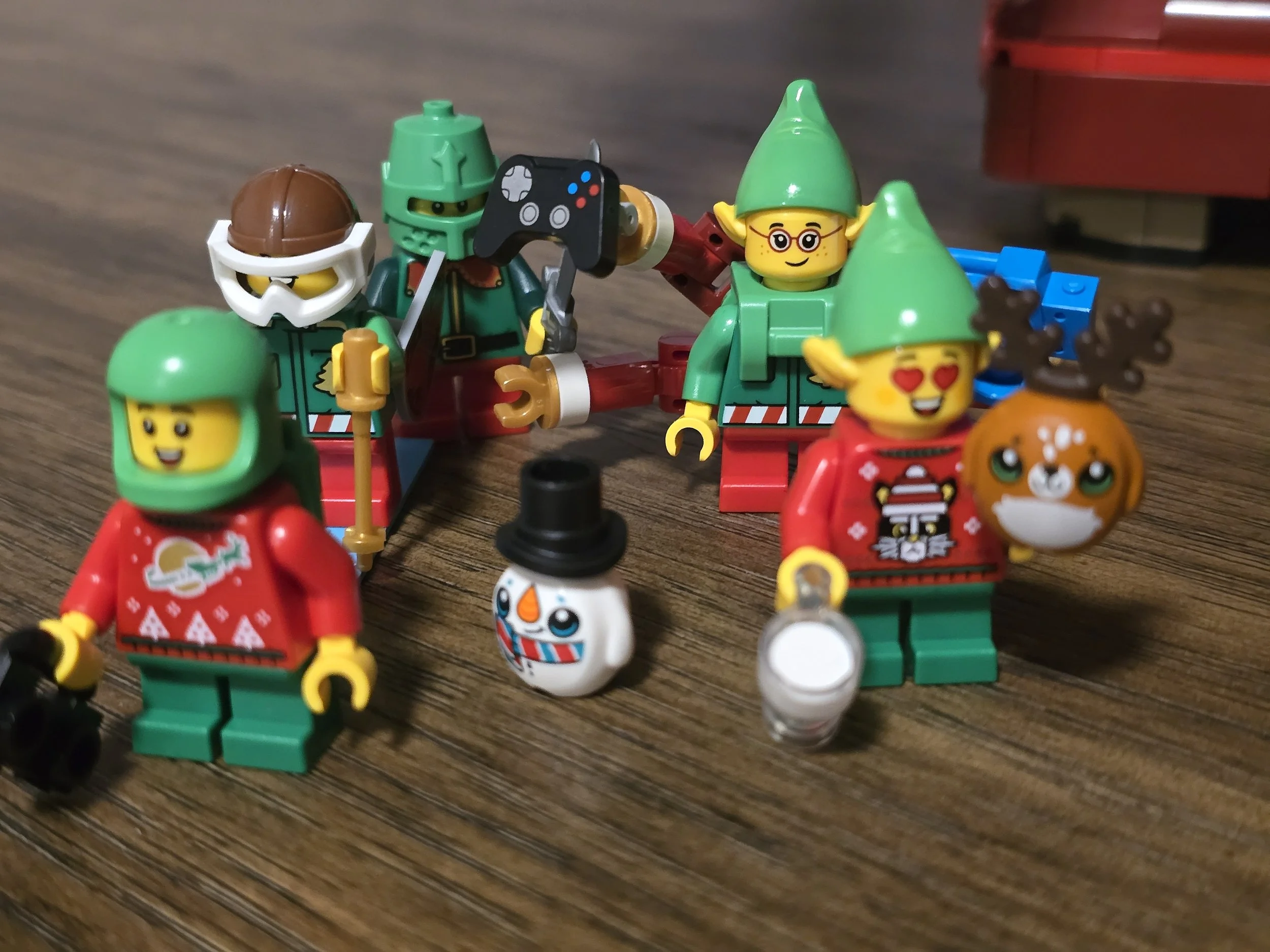
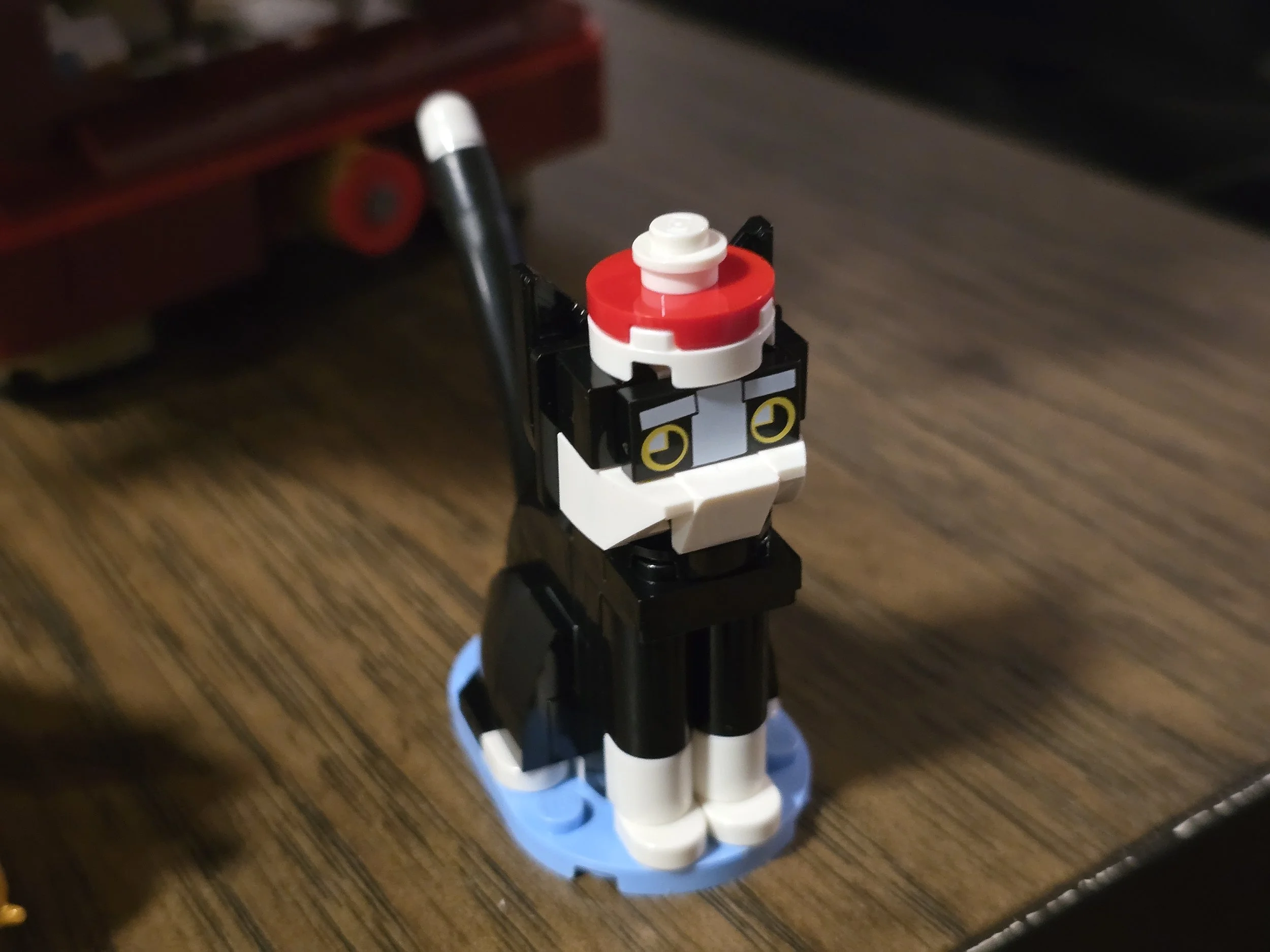
The minifigures still feel more like reinforcement than necessity, included in a way that seems designed to help justify the price or entice a buyer rather than because the tree truly needed them. And then there’s the return of LEGO’s inexplicable holiday cat character, Cataclaws, appearing once again without explanation because apparently some traditions simply refuse to stay in the past. (Full disclosure, I am terribly allergic to cats.)

To be fair, there are things this set gets right. The star on top is genuinely lovely, the modular construction is clever, and the storage box is thoughtfully designed for annual reuse, making it clear that LEGO expects this to return year after year. But I secretly wanted to take it apart to have that magical experience of building the set again.

Looking back, I loved the process of building the set together with my family more than anything else. The app had worked better than I expected. There were a few moments when we had to say “trust the app,” but I marveled at the technical accomplishment of whoever had developed it. Build Together hadn’t replaced anything outright. The printed instructions were still there in the box, untouched. The traditional solo build experience remained perfectly intact. Build Together doesn’t feel like a mandate so much as an option—something you can use when it fits the moment and ignore when it doesn’t.
Though it comes with some tradeoffs. LEGO designers and instruction teams put an enormous amount of care into how a build unfolds. There’s a rhythm to it, a pacing, and often a moment where you turn a subassembly around in your hands and suddenly understand what you’ve been making all along. Build Together disrupts that flow. Sometimes the realization belongs to someone else. Sometimes the thing you were working on comes back to you already complete, its purpose already revealed. That build flow is gone, but another aspect takes its place.

There is delight in seeing a section you built reappear later, woven into something larger. Delight in watching the system quietly adjust as people come and go. Delight in being part of the process without needing to control it. The experience shifts away from discovery in isolation and toward contribution through participation. (My husband really wants to see a team speed build using the app at a LEGO convention!)
The Build Together experience also won’t suit every LEGO set. Some models resist being broken apart into so many subassemblies. Others rely on long, linear sequences that are clearly meant to stay in one pair of hands from start to finish. Larger, modular builds, though, feel well-suited to this approach. These are sets where progress matters more than precision, and where the shared experience carries as much weight as the finished model.

What this means for the future of LEGO instructions is still unclear. Paper instructions aren’t going away. Build Together introduces an algorithmic layer into a process that has traditionally been very human, carefully authored step by step. It doesn’t erase that craft, but it does reinterpret it, breaking the build flow apart and reassembling it on the fly in ways the original designers may not have intended. Whether that feels exciting or unsettling probably depends on what you value most in a build.
I don’t know where this leads, or how far LEGO intends to take it. But what I saw that night—and again the next day—felt like a glimpse of something still taking shape on the verge of greatness. These weren’t the shadows of things that will be, exactly. They felt more like the shadows of things that might be, if LEGO chooses to keep exploring this path—and if builders are willing to follow.
A Change of Heart
When I look back at the experience now, I find myself lingering on it longer than I expected. I honestly struggled to write about this set for a while, and every time I tried to describe the tree itself, I ran into a kind of writer’s block. Something wasn’t clicking. My father-in-law finally put it into words for me: “You aren’t writing about a Christmas tree. You’re writing about the app.”
He was right. It didn’t matter what the set was. The experience is what we were still talking about. That’s what felt magical in the moment to the point that we’re exploring other sets that offer the Build Together option to repeat the experience.

I still know exactly what $330 can buy, and I still think it’s a lot to ask for a LEGO Christmas tree that feels a bit haphazard in places. That hasn’t changed. But the questions I kept circling—about price, value, and justification—no longer feel like the most important ones. What stayed with me instead was the energy around the table and how naturally the experience brought people together.
I went into this fully prepared to compare and critique, crying “bah humbug” to anyone who would listen. What I learned had less to do with what model ends up on the shelf and much more to do with what happens while you’re building it, and who’s there with you when you do.
And that, it turns out, is a much better way to keep Christmas.

What has your experience with the Build Together feature been like? Let us know in the comments section below!
Do you want to help BrickNerd continue publishing articles like this one? Become a top patron like Marc & Liz Puleo, Paige Mueller, Rob Klingberg from Brickstuff, John & Joshua Hanlon from Beyond the Brick, Megan Lum, Andy Price, Lukas Kurth from StoneWars, Wayne Tyler, Dan Church, and Roxanne Baxter to show your support, get early access, exclusive swag and more.