A Lush Behemoth: Bringing a LEGO Ent to Life
/Today, we sit down with LEGO builder Ben Arkley to discuss one of the most impressive Treebeard MOCs we’ve seen in quite some time. Towering, organic, and packed with subtle detail, this massive Ent captures the weight and realism of Tolkien’s ancient shepherd of the forest while still embracing the creativity and charm of LEGO building. From twisted branch techniques to structural challenges and a deep love of fantasy worldbuilding, Ben shares how this incredible creation slowly grew from a simple experiment into a true showstopper.
Subtitle
Marco: Looking at your feed, I can see MOCs that are often Elvish or fantasy-themed. These are lush and vibrant. Is that your favorite theme to build for, and why? Are you a Lord of the Rings fan, and what inspires you about it?
Ben: I guess fantasy is my favourite theme, but I’d happily build in other themes too. Like many others, I played with LEGO as a kid, then went into my dark ages. I got back into building when my daughter was little, and we bought her a few sets. She loved the Elves theme, and as we built together, fantasy just kind of stuck in my head. I’m not a prolific MOC builder, so I find it offers me the chance to try different ideas and techniques without having to build lots of different MOCs.
I’m mostly drawn to building landscapes and natural elements —trees, caves, waterfalls, and so on, but fantasy lets you create unlimited types of architecture, vehicles, animals, large figures, microscale... you name it! And then I’m a big Lord of the Rings fan—both the books and the films. I love that it has both an epic scale and much smaller, quieter moments, so it offers almost endless ideas to build. Also, all the lore behind the books and the visual detail in the films make it feel grounded and real—like those places and people could really have existed long ago. I love the feeling that “it could be real,” and I try to capture it in my builds.

Alternate head design
Marco: Treebeard is also a very lush and fantasy-inspired creation. How did you come up with the idea? Because looking at your feed, I spotted a Treebeard head made in 2022. Were you already playing with the idea of building it?
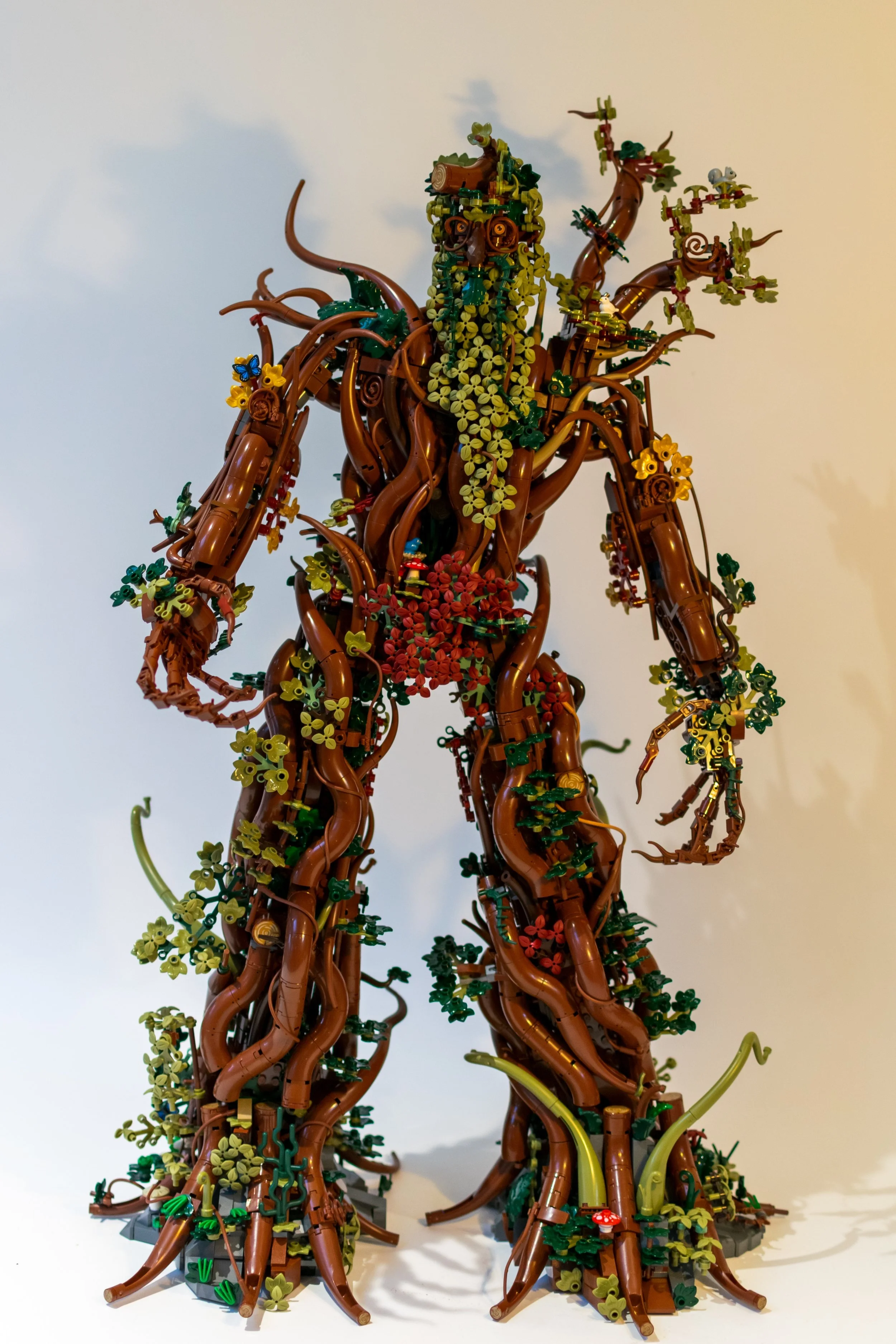
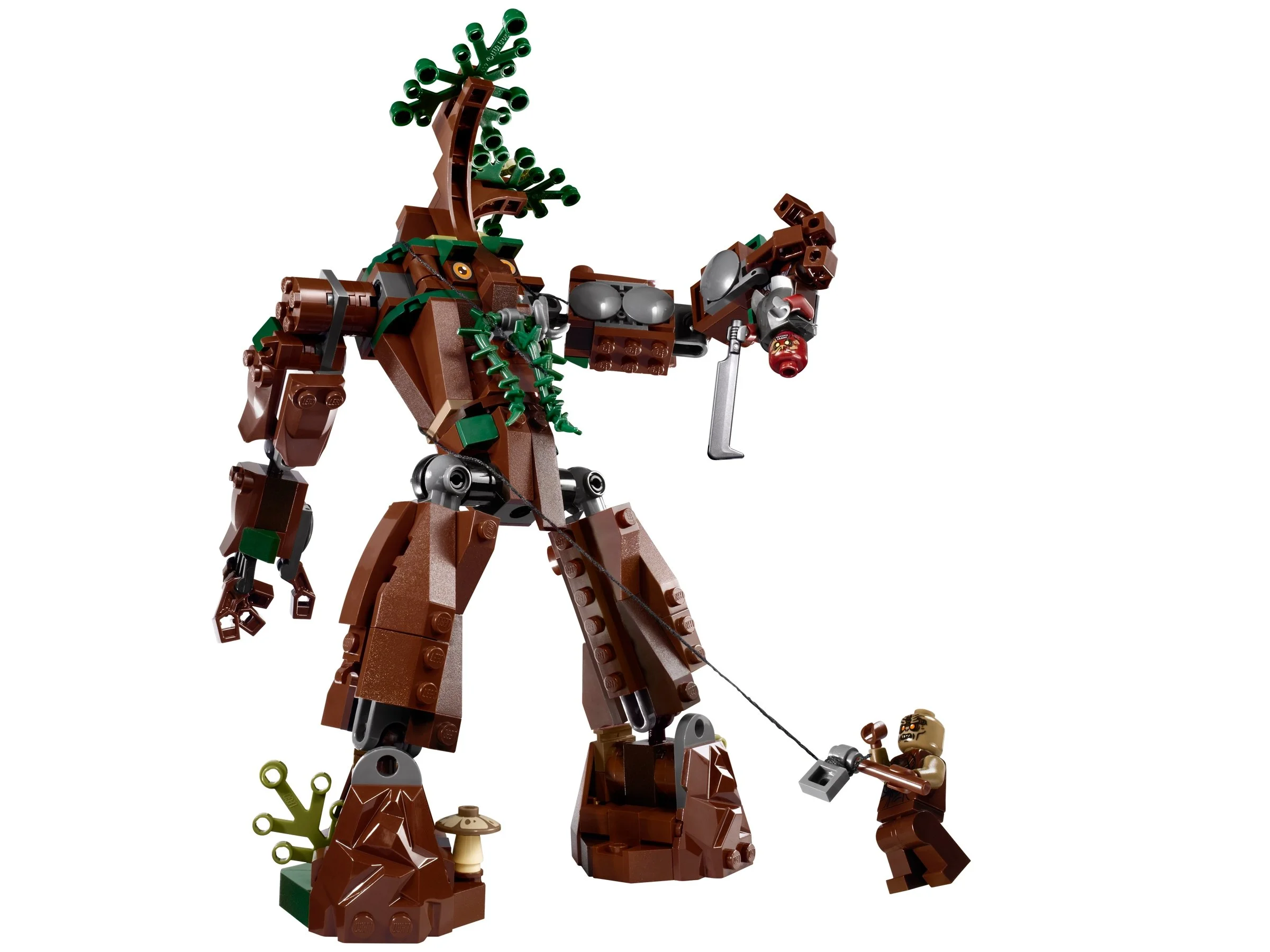
Ben: Being a fan of both The Lord of the Rings and of building natural things, I think it was just a matter of time! I’d seen the official version that came with the 10237 Orthanc set and also lots of the other really cool Treebeard MOCs out there, and I was inspired to build a version in my style that would (hopefully) capture that sense of realism as well as looking cool. I’d built a couple of gnarled old trees in previous MOCs, but I always felt I could have gone further to make them a bit more natural.
Then, I got a few of the large curved macaroni bricks (I think from the Bonsai tree) and figured they would create a more twisted and organic look than anything I’d managed before. I could intertwine other branch parts to fill gaps and add a few leaves. After that, the seed was planted! (Pun intended.)
And yes, I actually started playing around with the idea back in 2022. I was messing around with a few parts left over from another build, and before I knew it, I’d created the basic structure of his head. Once I realised I was onto something, I quickly created a very rough skeleton to size up the rest of him, but that then posed a lot of other challenges. So he went on hold for a long time before I started work on him again properly.
Marco: What is your approach when starting to build something like this? Do you sketch, build online, or just start from scratch?
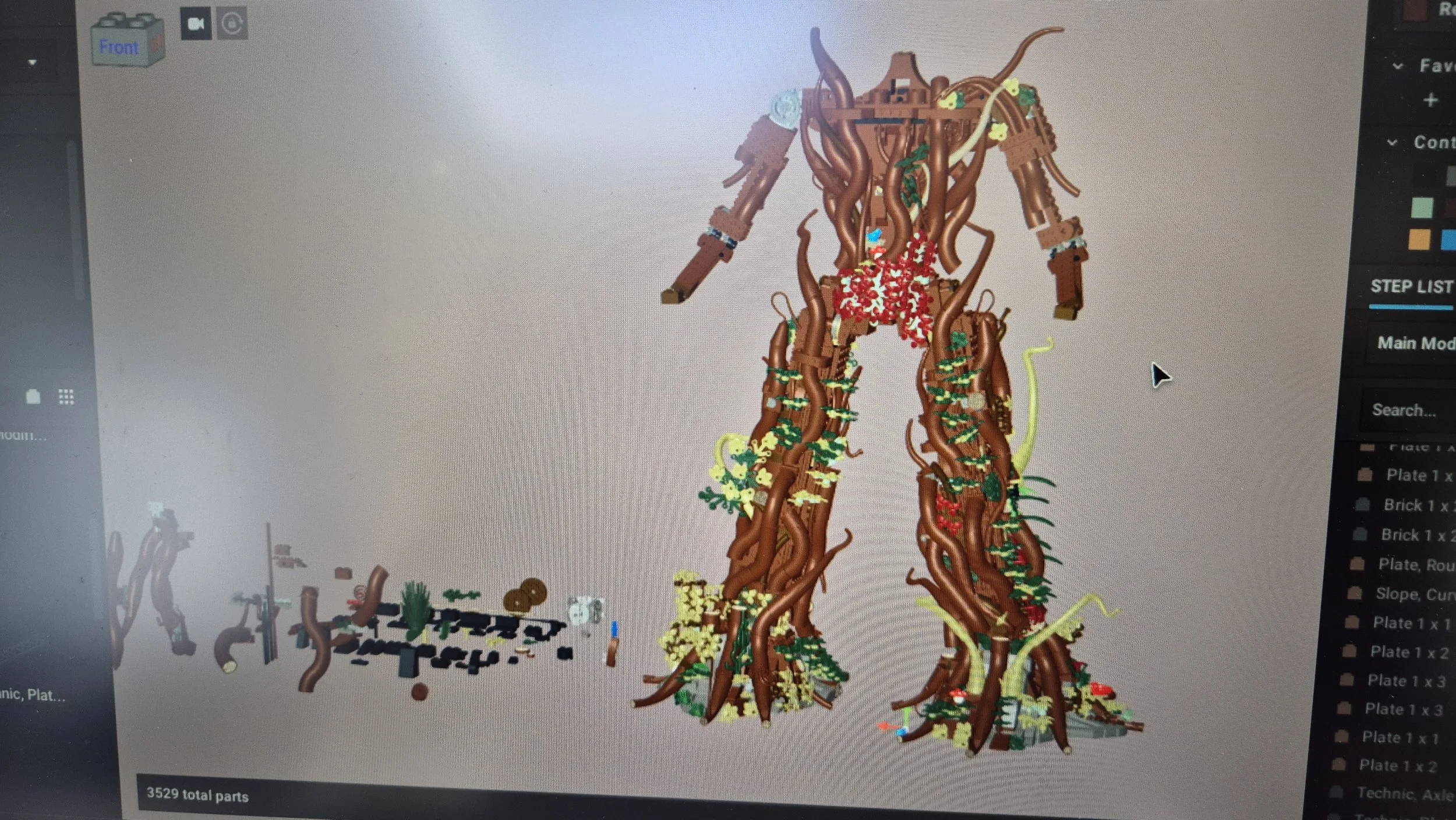
Ben: I always have a vision of what I’m aiming for in my head before I start. Inspiration can come from anywhere, but quite often it’s seeing another cool MOC or building technique, watching a film or reading a book, and I suddenly realise that a certain brick would be perfect for a MOC of it. Then I’ll just get started, playing around with real bricks to test things out, perhaps working on parts that aren’t connected, trying different ideas until I find what works. Sometimes everything clicks the first time, but often there will be something I hadn’t considered.
Then I’ll sketch out rough ideas to help me figure out how to solve any problems. But mostly it’s just “get building and seeing what happens.” My problem then is that life gets in the way, and I can end up putting things on hold for long periods of time. But even that has a positive side as it gives me the opportunity to come back to a build with fresh eyes (and new bricks!). And because I don’t worry about how long it takes, I’m happy taking something apart and rebuilding it as many times as I need to be happy with it.

Marco: How did you determine the scale? It’s quite large.
Ben: I knew from the beginning I’d need to go large—definitely bigger than minifig scale because I was aiming for that sense of realism (or as real as a talking tree made out of plastic bricks can be). Then it was the size of certain bricks that set the scale. I used the official Treebeard eye tiles, and this is about as big as I could go before they started to look too small.
Then came the dragon tail parts I used to create the splayed roots of his feet. Again, if I’d built him any bigger (or smaller), they would have looked out of scale. After that, it was just a case of finding parts that worked. One thing I hadn’t realised is that many of the parts I used are actually animal parts rather than plants! I quickly learned the BrickLink references for lots of different necks, tails, horns and teeth!
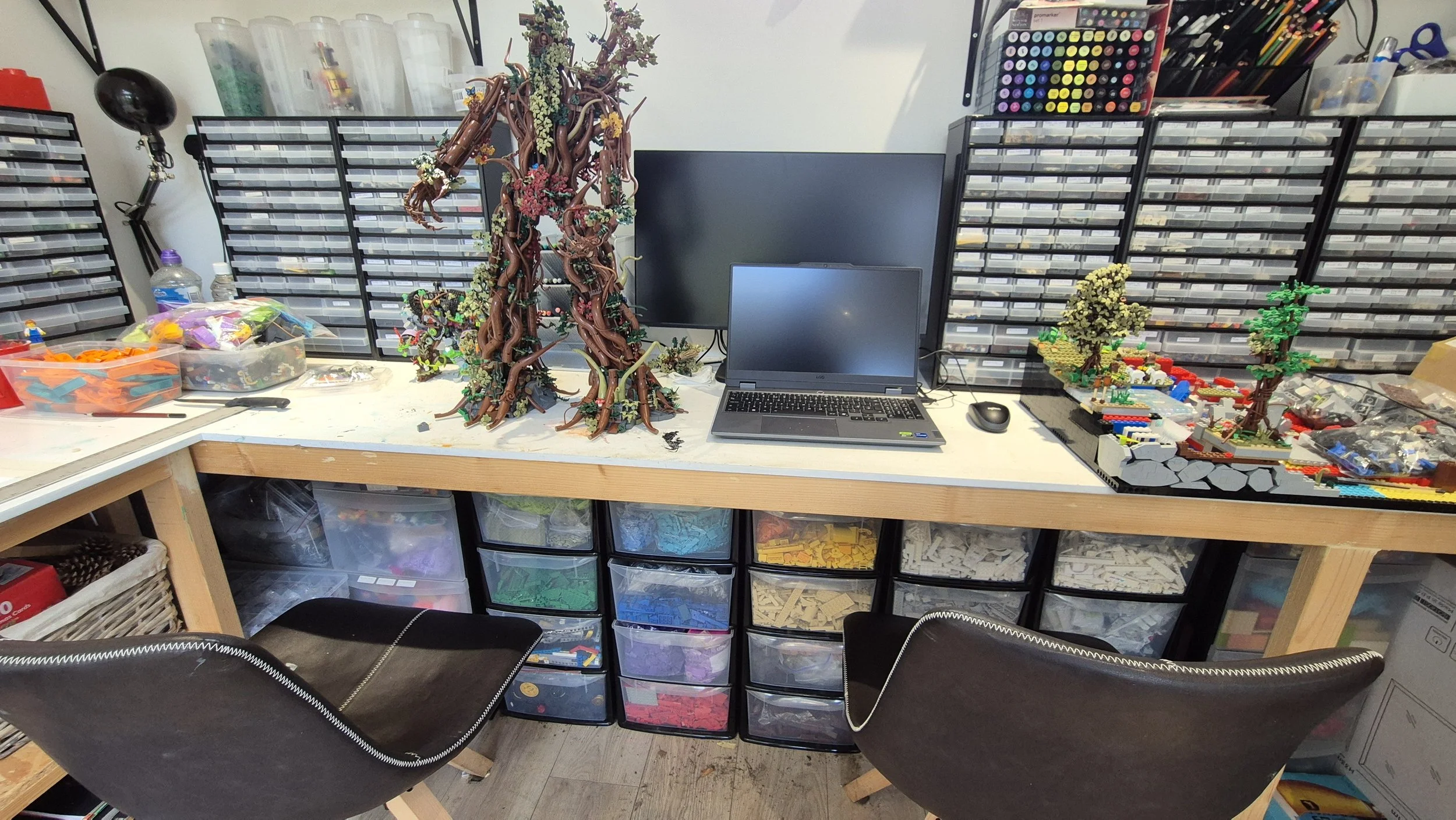
Building area
Marco: Were there any tricky challenges while building Treebeard, and how did you solve those? Looking at it, stability does come to mind.
Ben: Stability was definitely a concern. Once I realised how big he was going to be, my next thought was, “How will I make him stand up?” My knowledge of modern joints parts/techniques wasn’t up to date, so I did plenty of research, but in the end, I was going around in circles. So I decided to stop overthinking and just go for it with the parts I had available and see where I ended up. And it worked!
He’s built with a fairly simple internal skeleton using a couple of different types of click-hinges that have been around for ages. I doubled them up where I could, and it’s surprisingly sturdy—he can be picked up and moved around without a lot of trouble. I still built him with ankles, knees, hips, shoulders, elbows, wrists, and neck (skipped the waist because the twisted branch look I wanted just didn’t allow for it). I found it hard to get his proportions quite right, so I went back and forth on that for a while, too. Even now, for some reason, photos always make his legs look shorter than they do in real life.
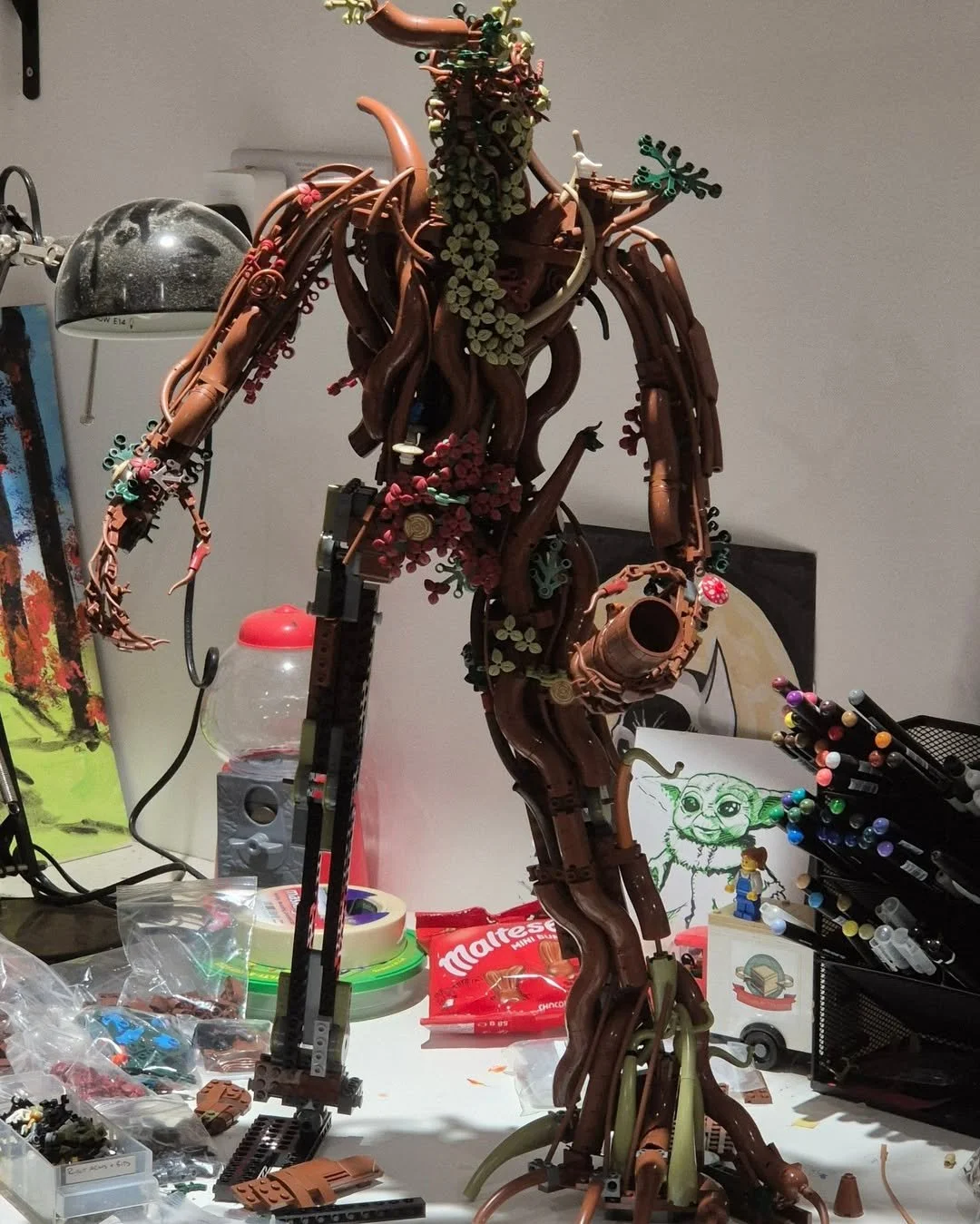
Inner frame
One happy accident was that I always wanted his body to be hollow and his legs and feet to broaden out below the knees. Those two things mean his center of gravity is naturally quite low, which gives him a lot of natural stability.
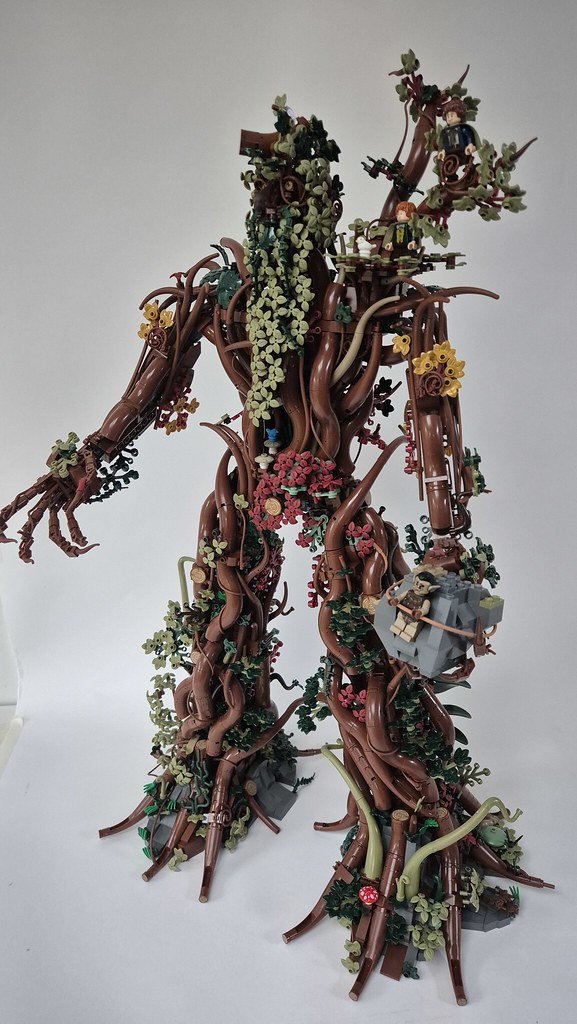
In the end, the main challenge with him was the detail. Firstly, using axles to connect the round bricks limits the range of rotation, which in turn prevents them from being twisted around his skeleton as closely as I wanted. I solved that by using bars instead of axles, but the shortest usable bar is 3L, which meant I had to extend the length of some bits of branch to accommodate. And in a true catch-22 that led back to the original problem of not being able to twist them closely around the skeleton! I got the hang of it after a while, but early on, I was rebuilding sections over and over to get it to look right.
To make things even more complicated, I also built all the various branches and vines on ball joints or hinges so they can be moved out of the way when posing him, but that means if you pick him up in the wrong place, they tend to fall off quite easily. Other challenges included not overdoing it when it came to the organic look. I got quite carried away adding all the leaves and branches, but found it could quickly start looking incoherent. Dialing it back a bit, plus keeping to some loose symmetry, definitely helped keep his overall form readable.
The last challenge was gathering all the parts—he contains around 4,500(ish), and a few are quite rare or expensive. Thankfully, I have access to adult money and a very understanding wife!
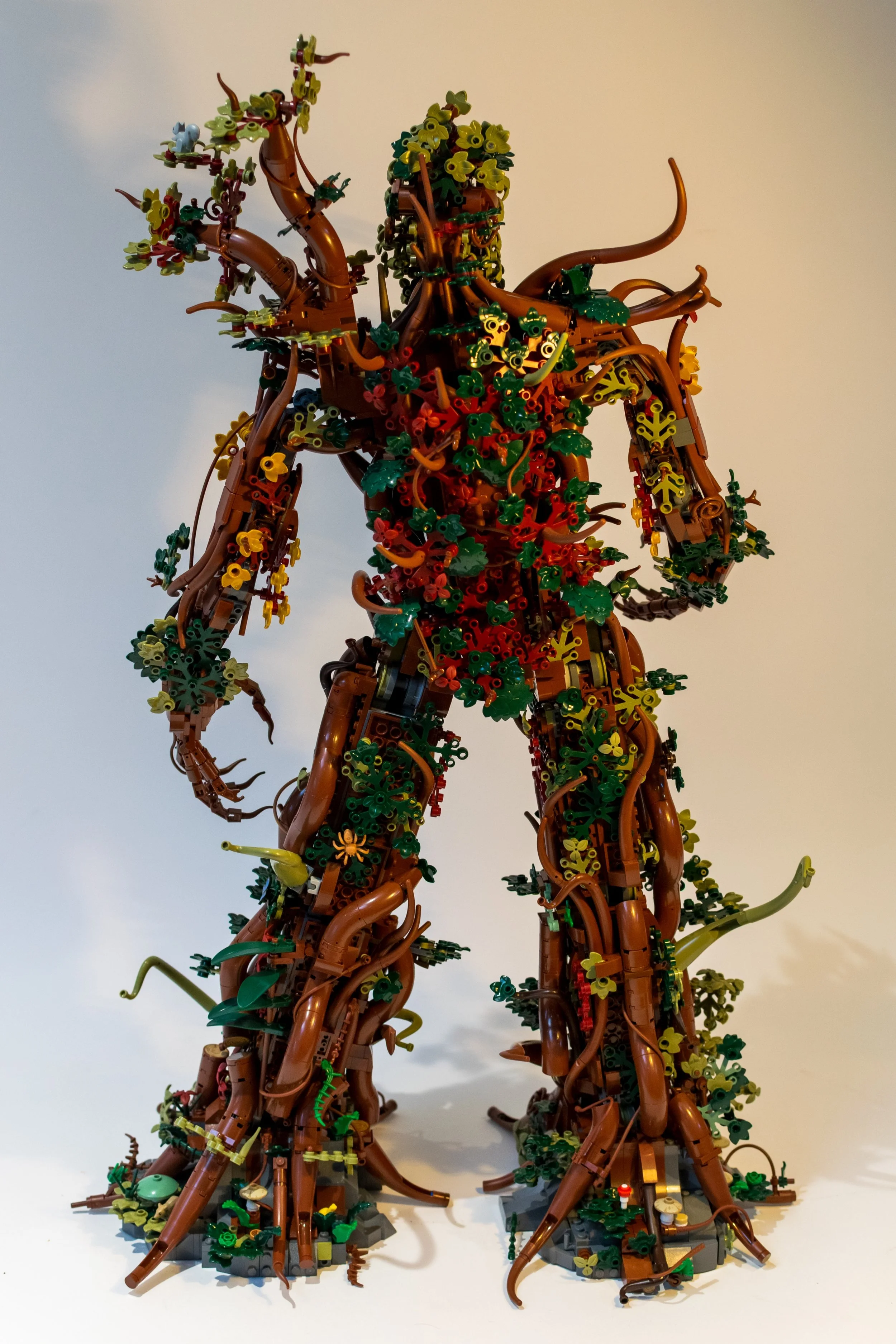
Backside of the model
Marco: What do you like the most about the Treebeard you’ve made?
Ben: I like that it uses the official eyes as a nod to the original. I also like all the hidden details—there are quite a few animals living around him! I’m pleased that I managed to make his body hollow (complete with a bird’s nest and mushrooms) but still keep it structurally sound. And I’m pleased that his overall shape, with all the branches and vines, gives him a sense of movement—stiff and heavy like the character should be. Finally, I like that it seems to have resonated with people—I’ve had lots of positive comments and messages about him, which is really rewarding.
Marco: Will it be on display at a show or LUG meeting? Because this would be such a showstopper!
Ben: Thanks! I’m not a member of a LUG, but I am considering taking it to a show. No firm plans yet, but I’m based in the northwest UK, so it would probably be in that area if I do.
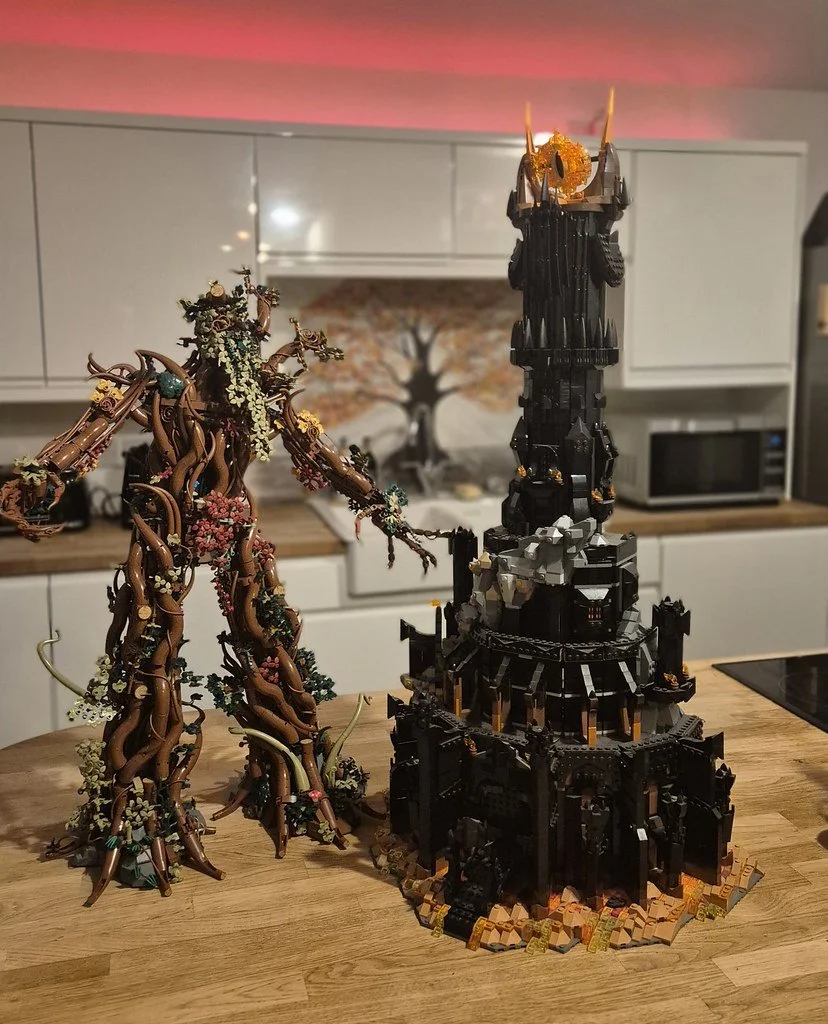
Towering next to Barad Dur
Marco: I’ve read on your Instagram that you were making instructions for it. Is that something you do often? Or is it because of popular demand?
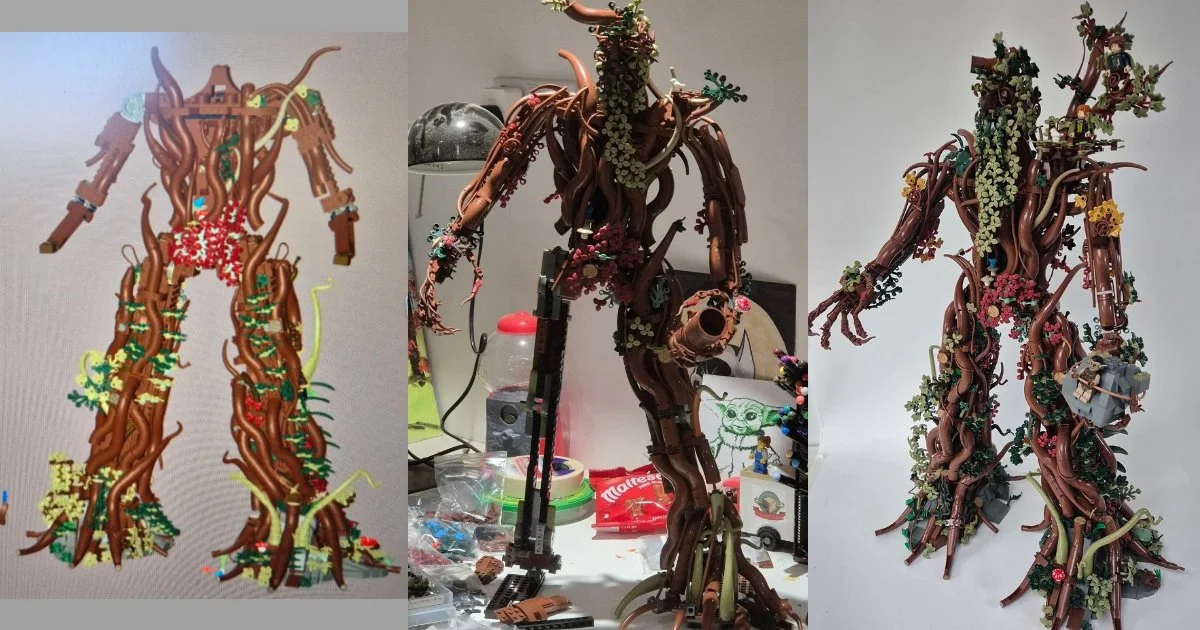
Ben: I am working on instructions, just because so many people have asked for them. It’s taking me a lot longer than I thought it would, though! I’ve only ever done it once before, a long time ago and for a much simpler MOC. The software has improved a lot since then, but rebuilding it digitally and then arranging each part into building steps is still laborious work. I have lots of respect for the folks at LEGO who do that job! I’m having to make a few changes as well, for example, to solve an illegal technique I’d unwittingly used to strengthen his hips.

Close up detail
Marco: Lastly, do you have any (big) plans for the future?
Ben: I need to finish the instructions first. After that, I’m considering building another Ent in different colours and styles. Or maybe a couple more so I could have an Entmoot! I’ve got half an idea to redo an earlier MOC (Elves Crystal University), now my skills have improved. And I’ve got another Lord of the Rings MOC underway—it’s in the very early stages so I don’t want to say too much about it except “the road goes ever on and on…”
Marco: Thank you so much for your time, and I’m looking forward to seeing what you build next!
How do you make trees and plants feel alive in your own LEGO builds? Let us know in the comments below!
Do you want to help BrickNerd continue publishing articles like this one? Become a top patron like Paige Mueller, Rob Klingberg from Brickstuff, John & Joshua Hanlon from Beyond the Brick, Megan Lum, Andy Price, Lukas Kurth from StoneWars, Wayne Tyler, Dan Church, and Roxanne Baxter to show your support, get early access, exclusive swag and more.