Go for Launch? A Technic-al Look at the Artemis Space Launch System
/Sometime soon, four humans will be on their way to the moon! We wanted to post this article when the SLS rocket launched and to wrap up Engineers Week, however, Central Florida weather and pre-flight testing have caused delays.
While Artemis II is not a mission that will land on the moon, it is set to make a lot of history. Commander Reid Wiseman, Pilot Victor Glover, Mission Specialist Christina Koch, and Mission Specialist Jeremy Hansen, will be the first humans in Lunar orbit since Apollo 17 left in 1972!
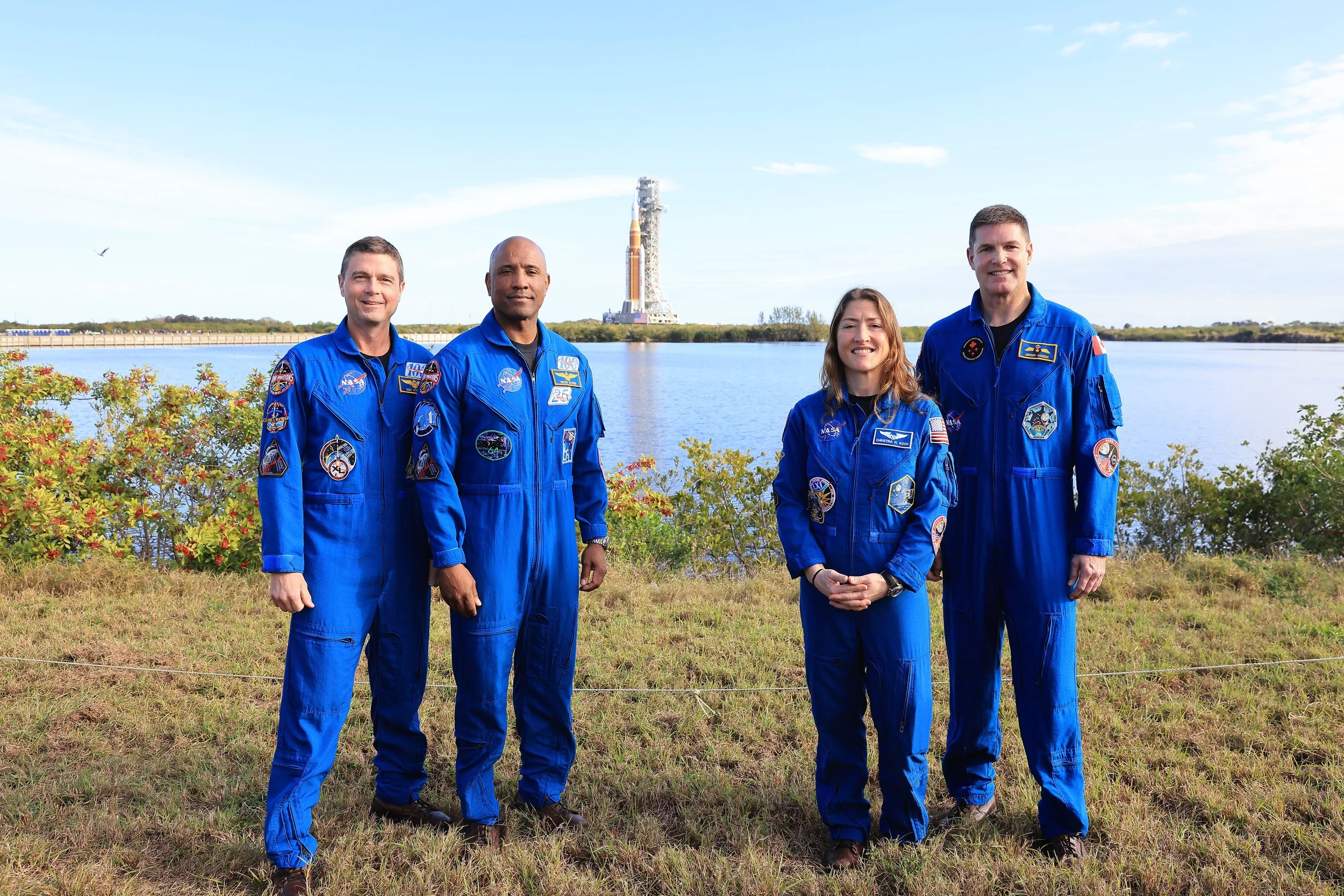
Artemis II Crew and SLS Rocket during Roll Out to the LC39B Photo credit: NASA/Kim Shiflett Via KSC’s Flickr
Some notable firsts of the mission will include:
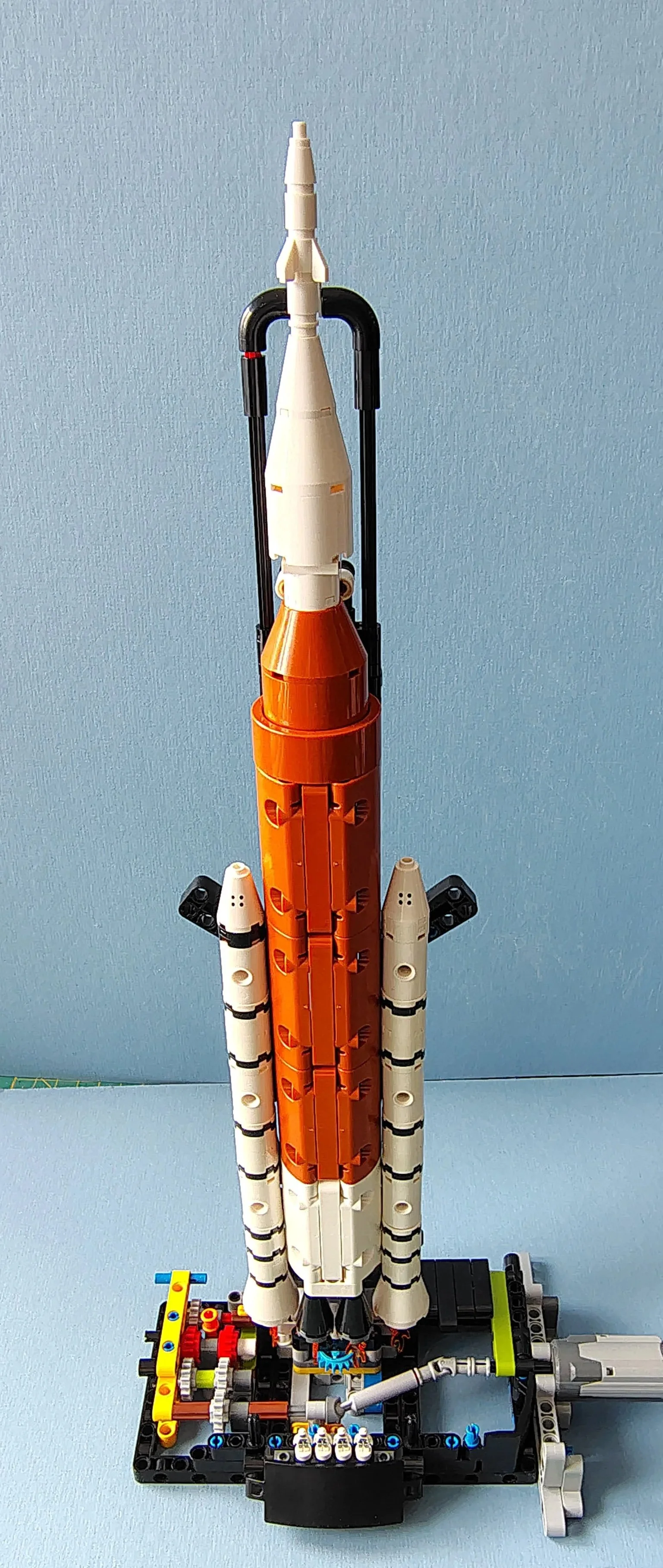
We are Go for Lift off!
The lunar flyby is such that all 4 will have traveled the furthest from earth of any human exceeding that of Apollo 13.
Glover becoming the first African American to flyby the moon.
Hansen becoming the first Canadian and US citizen to flyby the moon.
Koch will add to her impressive resume as first woman to flyby the moon. She was part of first all-female EVA (spacewalk), and current record holder for longest continuous time in space by a woman 328 days).
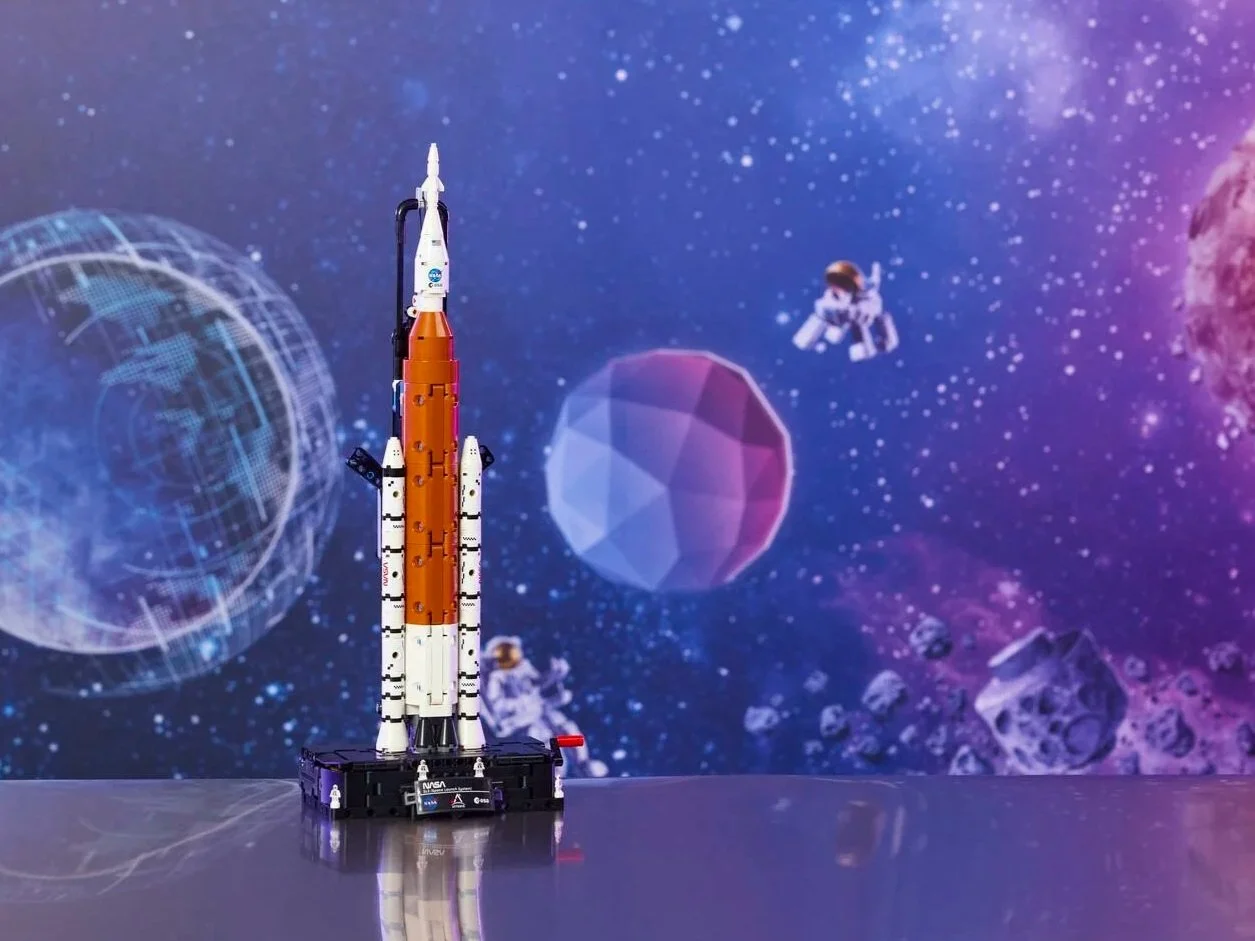
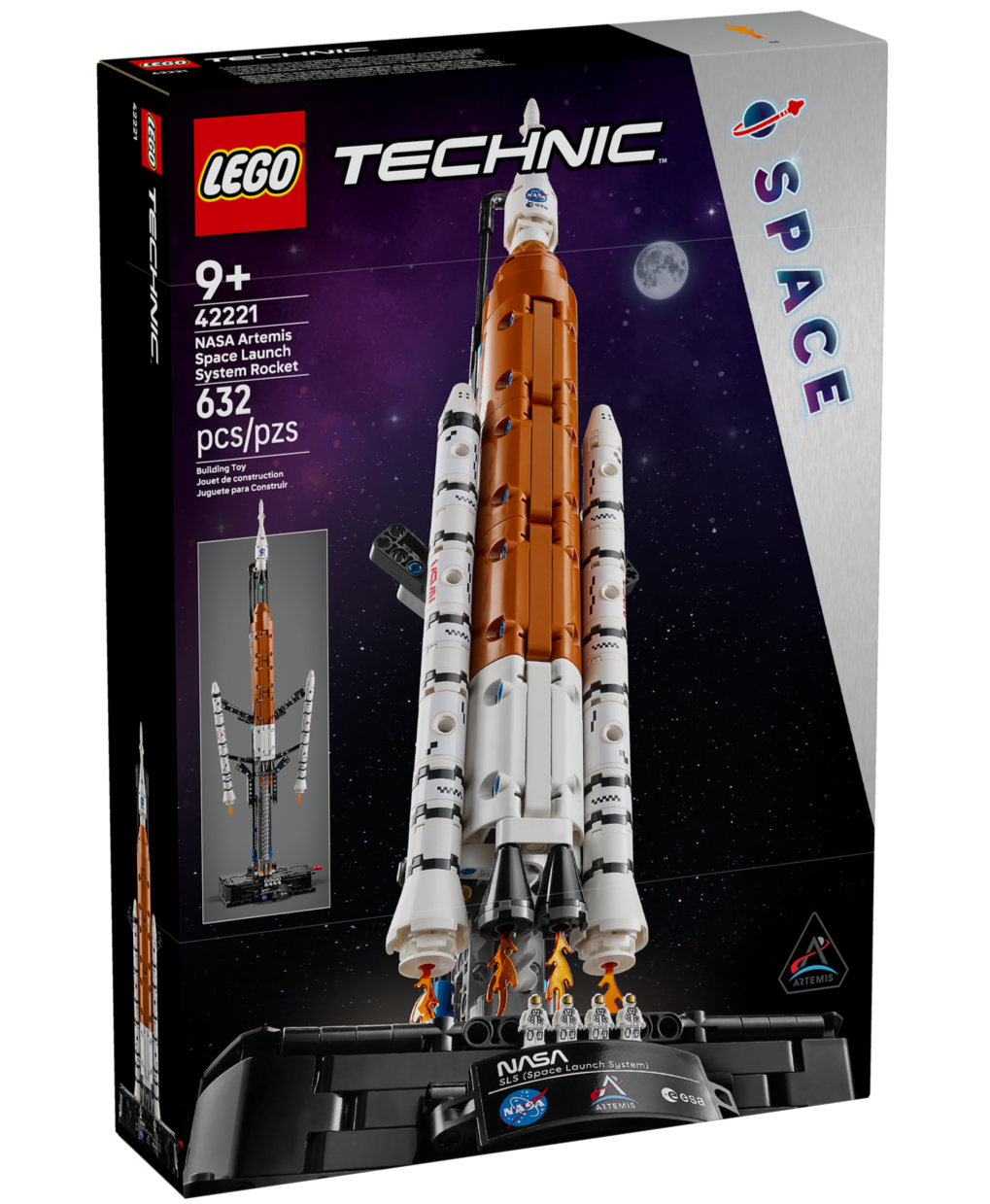
Over the past several years, LEGO has released several sets celebrating the Artemis program and the SLS rocket. This year’s unique offering is LEGO Technic 42221 NASA Artemis Space Launch System Rocket, which replicates the launch of the SLS!
Let’s Light This Candle
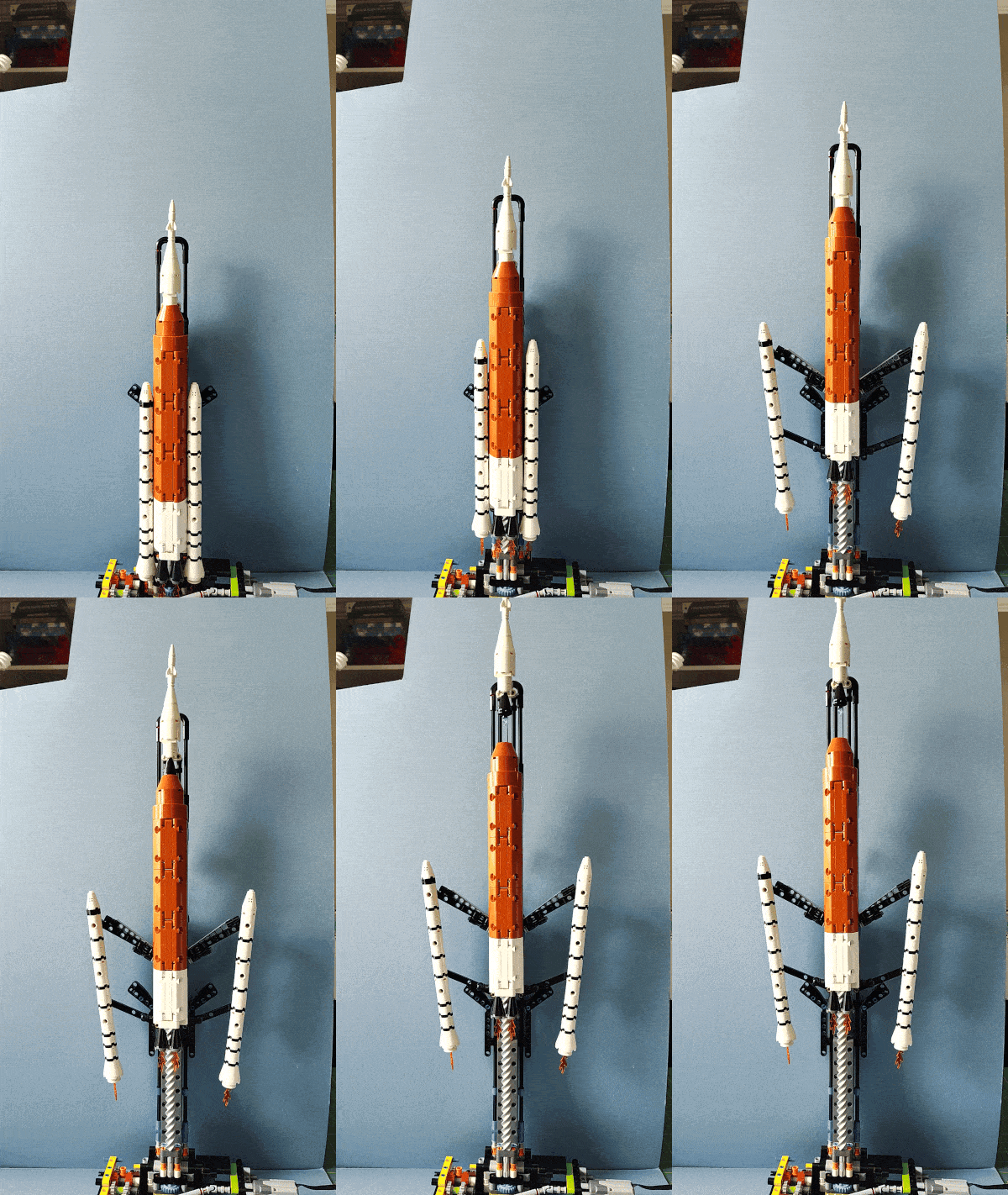
Up and Away!
The set’s main function is a worm gear that the rocket rides up and down on. This is accomplished through a newer worm gear piece and a brand-new Technic worm gear follower. This part should open up a lot of possibilities for these worm gears. Doug’s amazing ISS build used these worm gears to excellent effect, so go check it out!
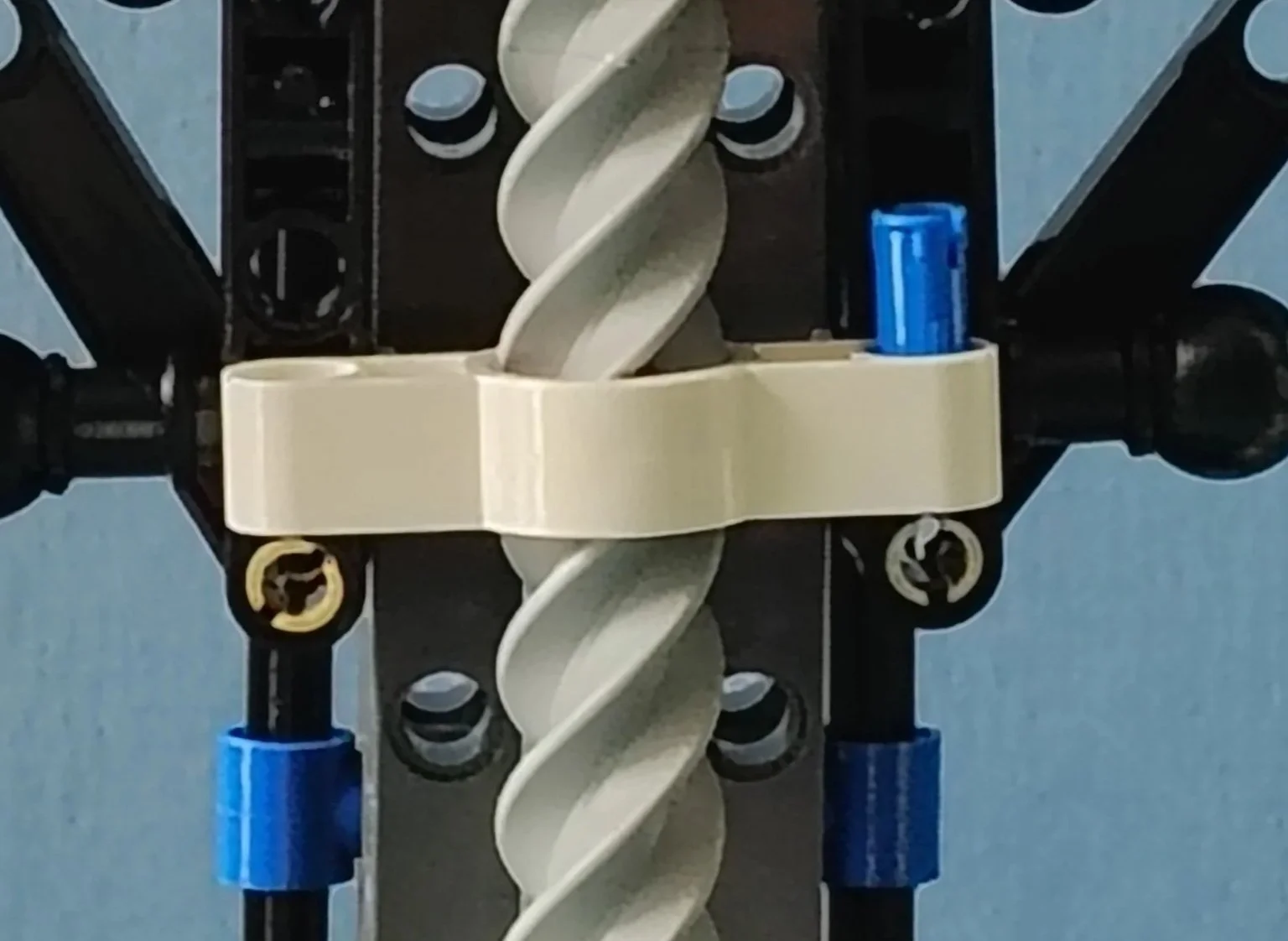
NEW PART NEW PART NEW PART!
Are we missing something?
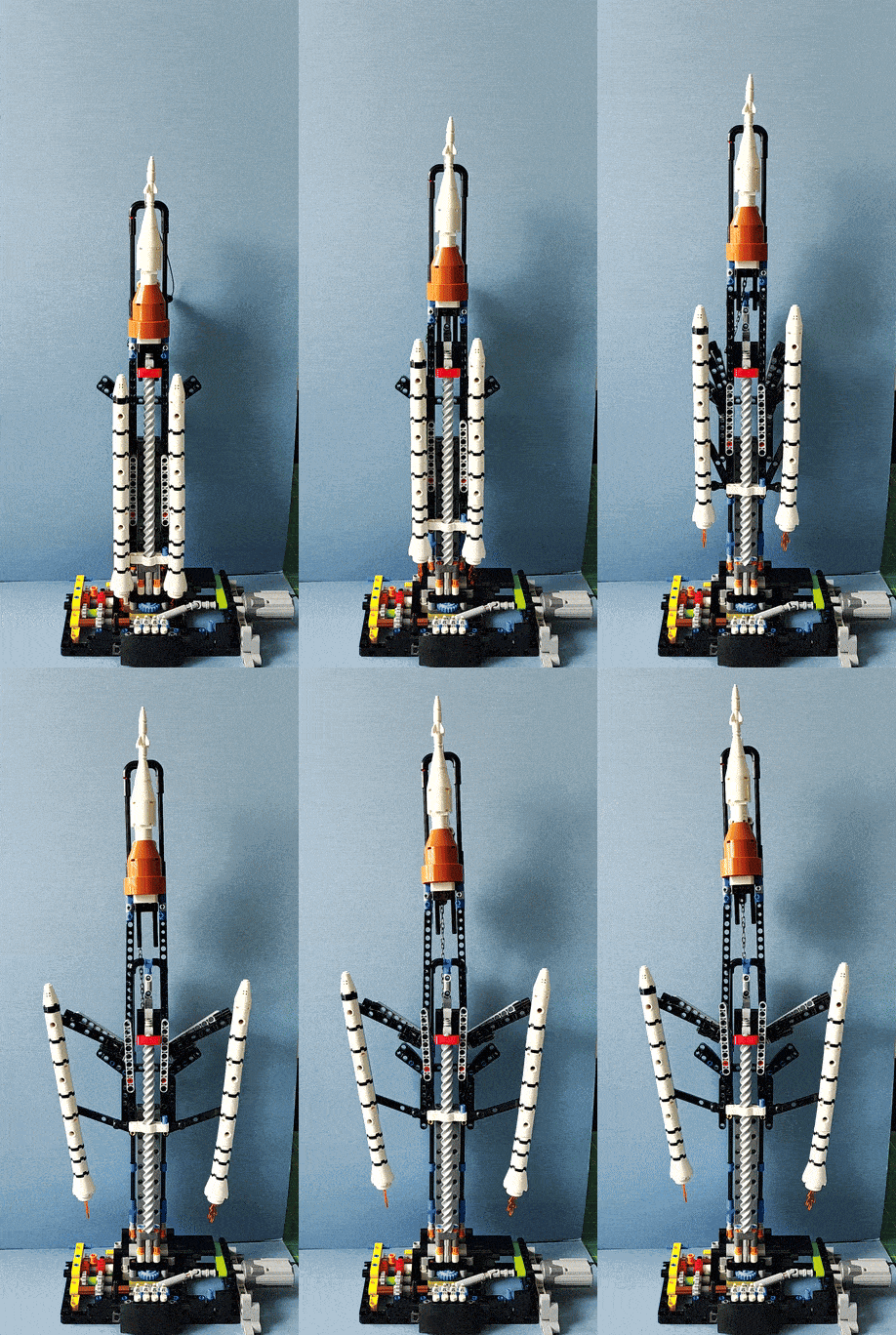
As the rocket climbs, the solid rocket boosters (SRBs) separate and fall away. From years of watching Space Shuttle launches, the simple follower mechanism does capture the SRB separation arc well. I do wish that the SRB assembly stopped while the rest of the rocket carried on.
I noodled with trying to find a solution, and even my best ideas were overly complicated and finicky! I removed the rocket’s body so we can see what’s happening. As the rocket rises, the boosters are held in place on the sides by the gray beams that ride along the black beams and curved pieces. The linkages then set the angle at which the boosters fall away. Then the whole thing binds up because I didn’t use enough pins.
A neat detail that took me a while to figure out is the Technic balls at the bottom of the boosters. They help hold the boosters in place at the lower end as the rocket rises! Without them, the bottoms of the boosters swing away from the rocket ever so slightly.
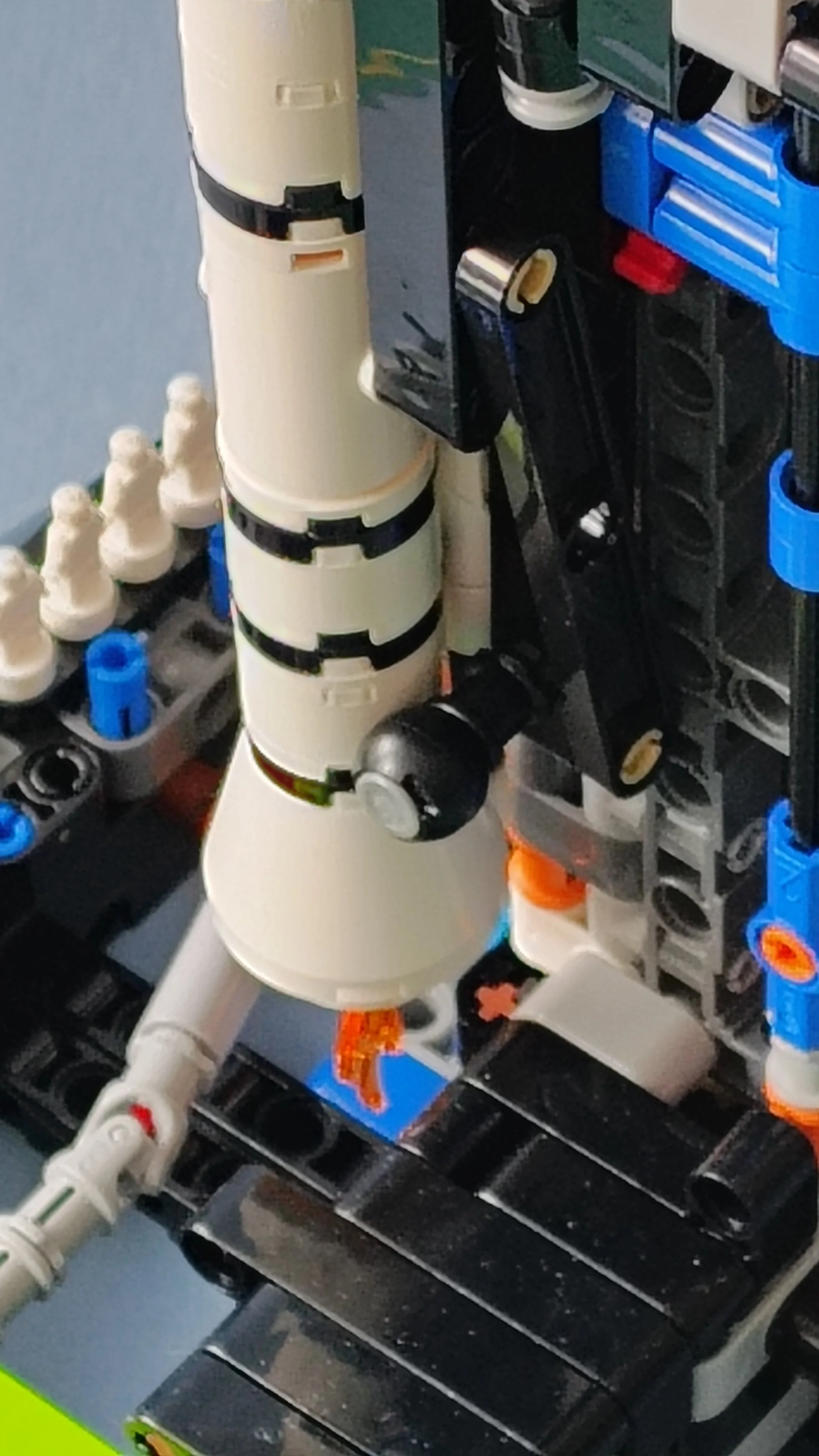
I love a simple and clever solution!
The Orion Spacecraft
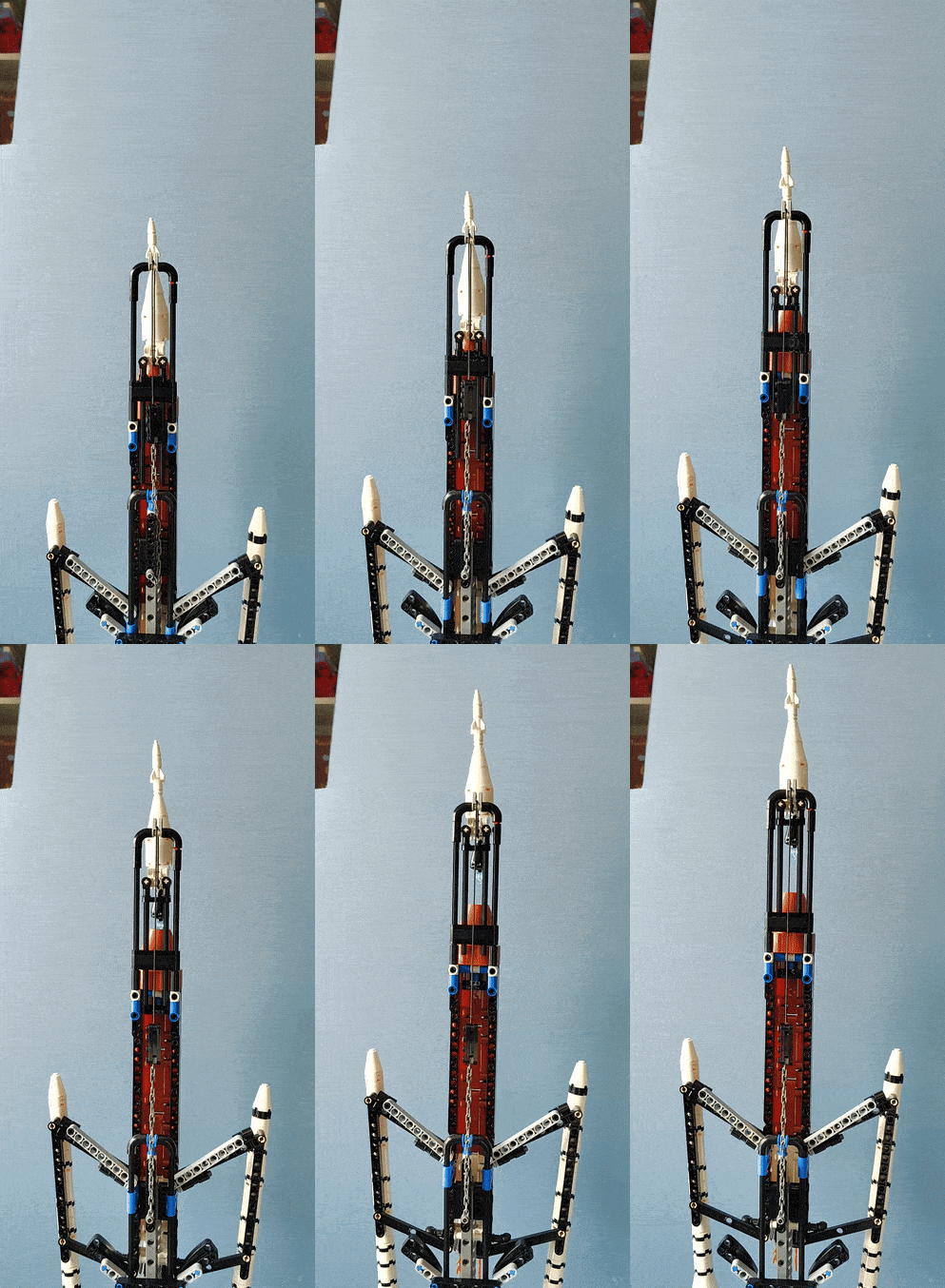
Rocket got back, see how the ICPS and Orion pull away faster as the string&chain tighten!
The next step is the Orion spacecraft and the ICPS (Interim Cryogenic Propulsion Stage) separating from the SLS core. This is done with a simple pulley! The line stays slack for most of the climb, and then, due to the function of a pulley, the ICPS and Orion pull away at twice the rate the rocket is going up.
This works because one end of the line is anchored and the pulley moves. For a fixed pulley, when the line is pulled, an equal distance passes on both ends. When the pulley itself is moved, both sides of the line move upward (in this case), so you get double the displacement!
The overall gear train that accomplishes this is fairly simple: an input shaft, some idler gears to ensure that clockwise rotation raises the rocket, and the right red gear, which is only engaged when the rocket is descending, acting as a brake. It is mounted to a friction pin so the rocket stays in the vertical position you leave it in. Finally, there is a set of bevel gears to turn the rotation 90 degrees.
I’ve seen some arguments that the gear train is overly complicated or could have been more compact. I suppose it could have fit on the right-hand side of the model, but it still would have had to fit around the flames. Also, I think the clockwise-is-up function feels more natural and probably influenced the design as well.
Note: I have deliberately left the coverings off to show the gear train below, and the Power Functions motor and gray support structure do not come with the set.
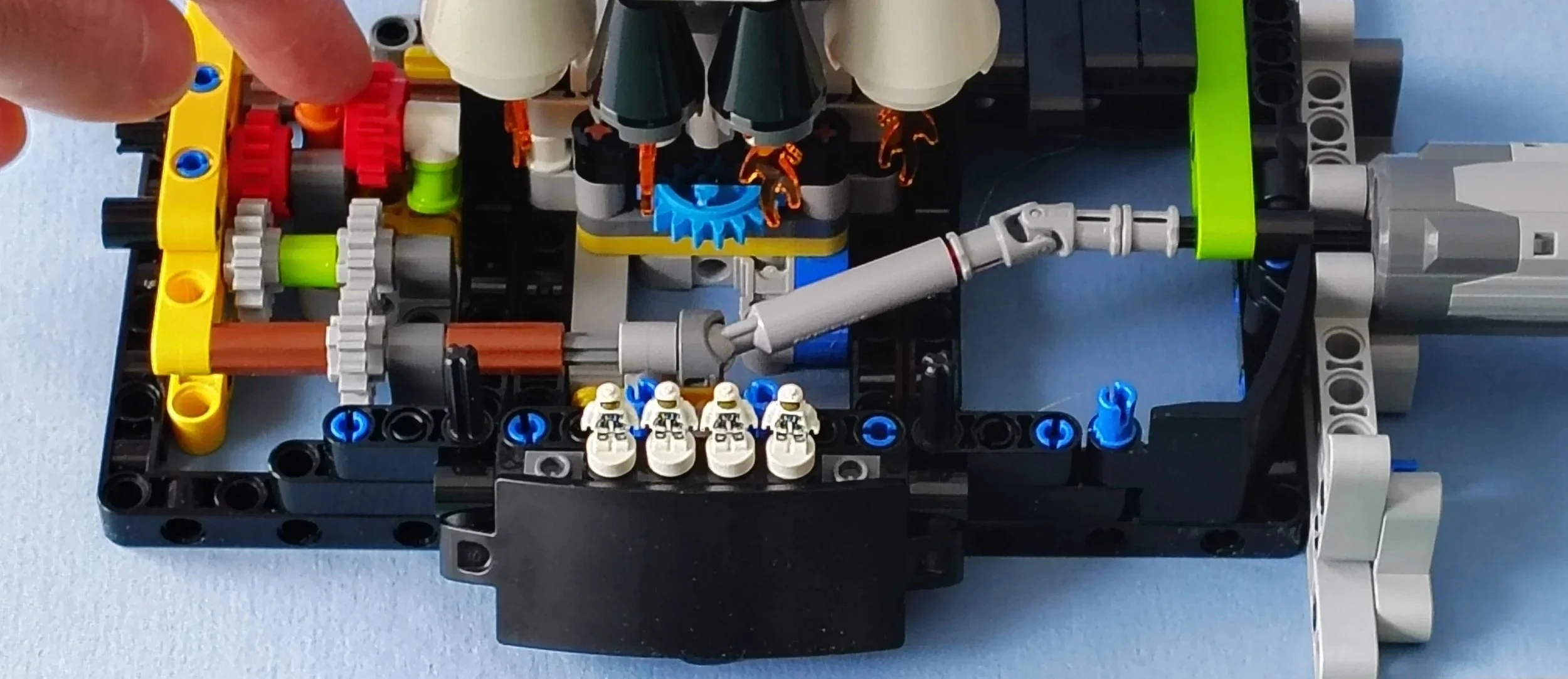
gear train note my finger holding up the red breaking gear
Time for Rocket Science

Because it is Engineers Week (Feb 23–27 this year), we’ll dig into why rockets shed boosters and stages as they ascend. As said in Monty Python and the Holy Grail, “It’s a simple question of weight ratios!”
The key ratio is the mass of your rocket compared to the mass of your fuel. The ISS orbits at a 250-mile (400 km) altitude—not too far away, but its orbital speed is 17,100 mph (27,600 km/h, 7.67 km/s). To get going that fast, you need some hefty acceleration.
Luckily, we don’t start completely at 0 velocity the earth spins at 1040 mph (1674 km/h) at the equator, and 913 mph (1470 km/h) at Kennedy Space Center this is a function of the cosine of the latitude, but that still leaves the rocket needing a significant ΔV (Delta Velocity or change in speed) of 16,236 mph (26,130 km/h).
We all know from Newton that Force = Mass × Acceleration, so the more mass we have, the more force we need to accelerate to a higher velocity. But the more force we need, the more fuel we need—which means more mass! (Fellow rocket nerds: I’m using “fuel” to include propellant and oxidizer to keep things straightforward.)
These facts led at least four different people to independently derive what is known as the Rocket Equation: Konstantin Tsiolkovsky (Russian, 1903, and generally credited), William Moore (British, 1810), Robert Goddard (American, 1912), and Hermann Oberth (Austro-Hungarian/German, around 1920).
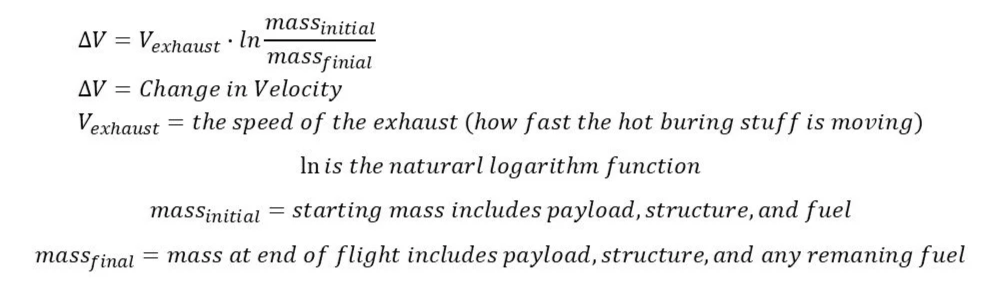
Math is exciting when you’re using it to launch things on a column of fire!
So let’s make that digestible. The mass-initial to mass-final ratio measures how much fuel we use to change speed. If you need a bigger change, you need more fuel.
V-exhaust has a lot of factors tied into it (fuel used, engine efficiency, etc.), but in general, the faster the rocket sends fuel out the back, the bigger change in velocity we get.
A natural logarithm is a mathematical function tied to the number e (~2.718). The chart below is a carpet plot showing the mass ratio on the X-axis (1 is equal fuel and rocket mass; 100 means the fuel is 100 times the mass of the rocket), the delta-V on the Y-axis, and five curves for differing V-exhaust values. The numbers are generalized to illustrate the nature of the equation.
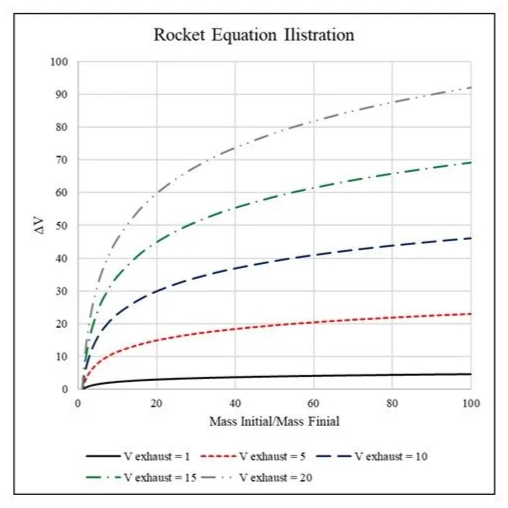
A higher V exhaust and more fuel spent means more speed!
Can we cheat the math? Can we get a bigger delta-V? We can by using boosters or stages (or both). Boosters are extra rockets that attach to a bigger rocket (e.g., the solid rocket boosters on the Shuttle and SLS). Stages are inline, where the lower portion of the rocket is dropped away.
I’m going to show a staging example where the V-exhaust is the same, making the math easier to follow (hopefully). Boosters add a bit of complexity to the math as well. If we assume two rockets “both alike in dignity,” both with a V-exhaust of 20, an initial mass of 100, and a final mass of 3.019—but one of the rockets is two stages and the mass is split evenly between them—then each stage has a final mass of 1.510 and an initial mass of 50.
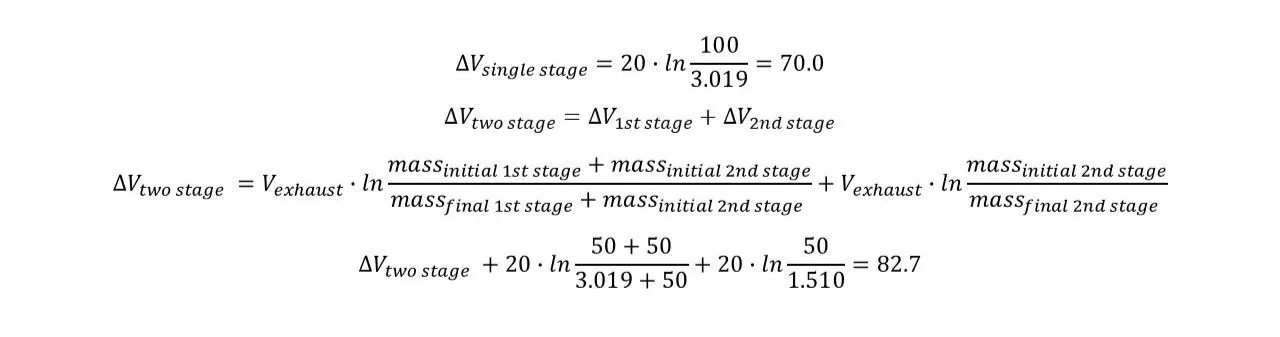
more fiery math!
That is why rockets stage. The less mass we take to our final destination, the more efficiently we get there than if we tried to take it all with us.
I know that seems like an obvious conclusion (and I tortured you with math to get there), but now you know why, and you’re not just taking the word of some random rocket scientist who happens to write for a nerdy LEGO website!
Go for Purchasing?

45 degrees off straight on and not such a nice view!
I like the set. It is much more affordable in price and shelf real estate than the LEGO SLS/MLP I looked at a while back, although it is nearly as tall at full extension. Though I am a little disappointed that only half the rocket is there, making the only really good view from the front.
I really think the functions could have worked with a full rocket, but the trade-off was likely weight-related (I do not currently have a Technic selection big enough to try that out).
The functions work well, and it is definitely something different from your standard Technic wheeled vehicle set. At $60 (£55 / €60), it is definitely worth some shelf space if you are a Space or Technic fan!
Launch Windows for Artemis II
As I mentioned above, pre-flight tests have found some issues. Initially, a liquid hydrogen leak was found in the “wet” dress rehearsal earlier this month, and this past weekend an issue with the helium system was discovered in the ICPS that requires a rollback to the VAB (Space.com - Artemis). These April dates are the earliest next attempt: April 1, 3, 4, 5 & 6. The launch can be watched online at https://www.nasa.gov.
Launch windows are determined by a number of factors. Given that the original February, March, and April dates were all 28 days apart, lighting on the lunar surface due to the Moon’s phase is a consideration. However, other factors such as communications satellites and resource availability also play a role.
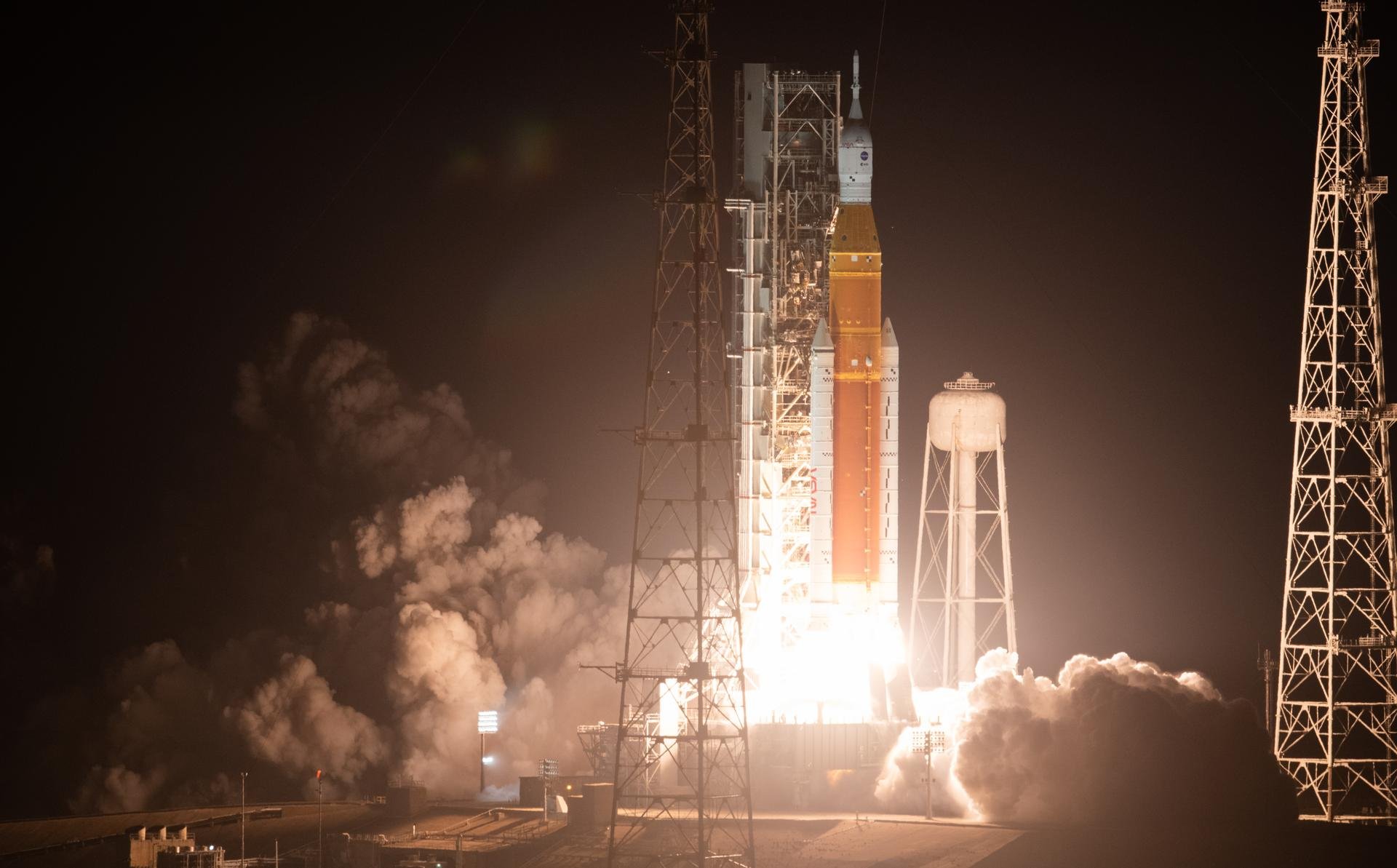
Artemis i Launch nov 16, 2022: Photo Credit: (NASA/Joel Kowsky)
Artemis II is shaping up to be a major milestone in human spaceflight, even if the exact launch date is still in flux. Whenever the countdown finally reaches zero, it will mark humanity’s return to lunar orbit for the first time in more than 50 years. Until then, this Technic version of the SLS is a fun way to bring a little bit of that launch-day energy home with you.
Rocket Science References
Fundamentals of Flight, 2nd ed, by Richard S. Shevell, Prentice-Hall, 1989
Wikipedia: Tsiolkovsky Rocket Equation
More Info on Artemis II
Wikipedia: Artemis II
NASA: Artemis II Flight Crew
NASA: Artemis II Mission
Are you following Artemis II launch in real time like we are, or are you just here for the rocket science? Let us know in the comments below.
Do you want to help BrickNerd continue publishing articles like this one? Become a top patron like Paige Mueller, Rob Klingberg from Brickstuff, John & Joshua Hanlon from Beyond the Brick, Megan Lum, Andy Price, Lukas Kurth from StoneWars, Wayne Tyler, Dan Church, and Roxanne Baxter to show your support, get early access, exclusive swag and more.