The Art of Everyday: Building a Hyper-Realistic LEGO Kitchen
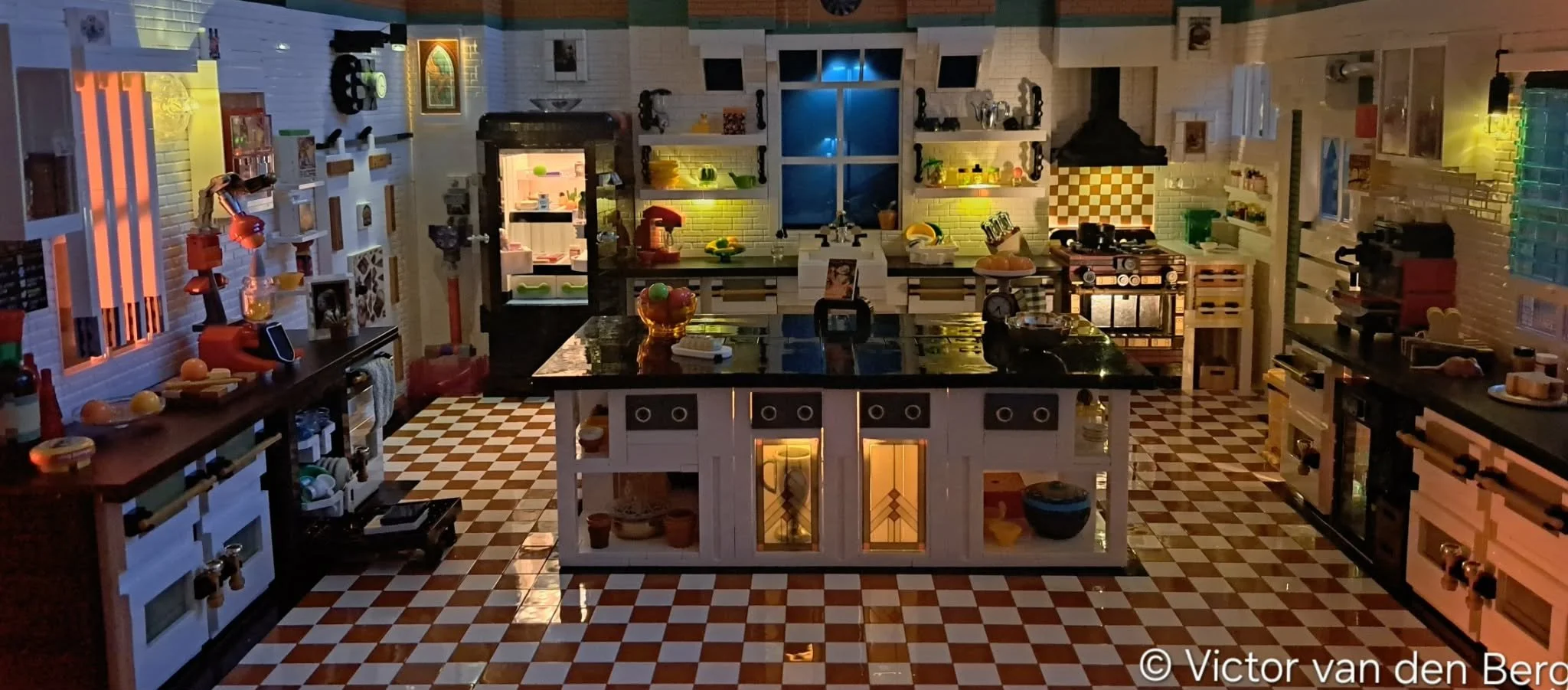
/Today, we’re excited to visit an absolutely fantastic LEGO kitchen and discuss its thoughtfully crafted design with the creator of this masterpiece, Victor van den Berg! Victor’s gorgeous creations are rich with eye-catching details, and their magical realism leaves a lasting impression on anyone who sees them.
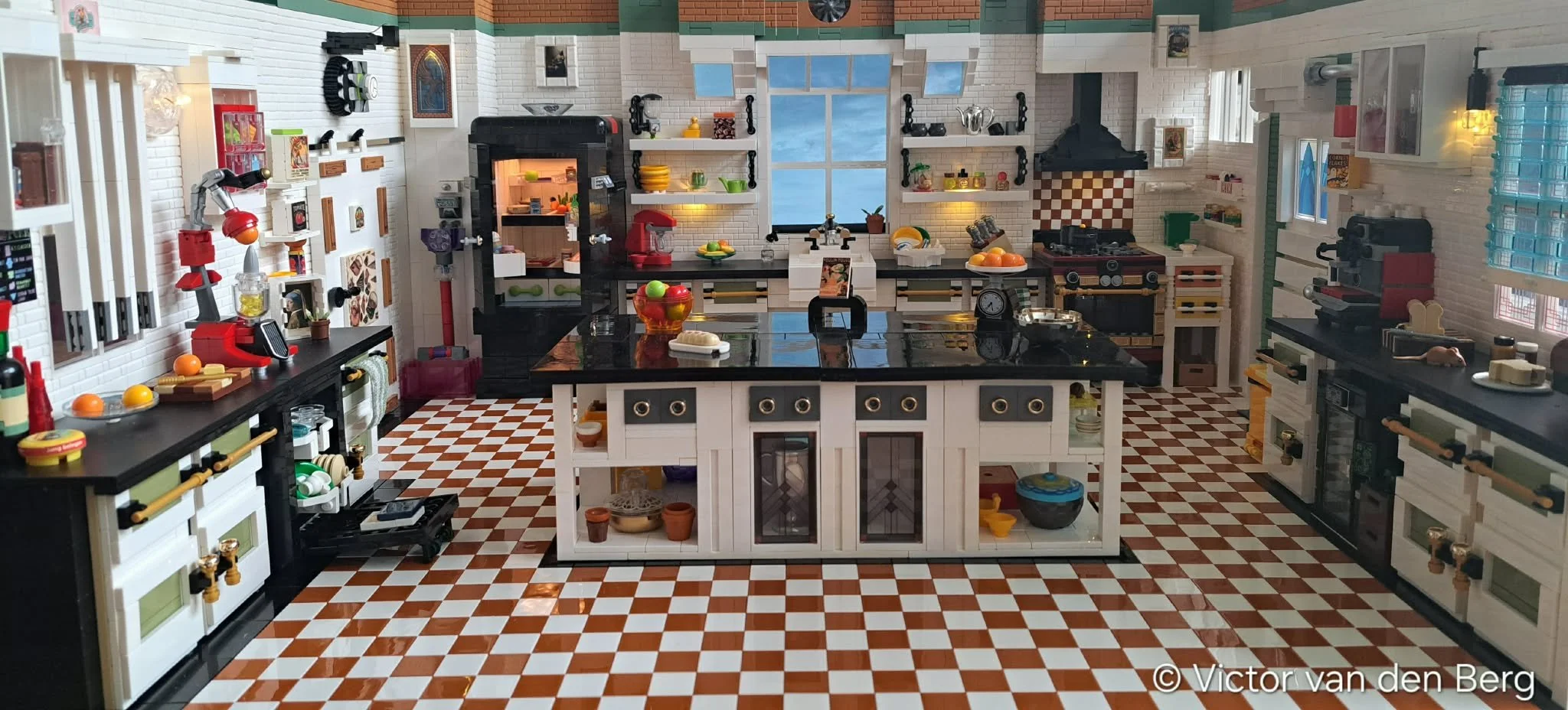
Ann: Hi Victor! We’re happy to welcome you back to BrickNerd and learn more about your new LEGO kitchen!
Victor: Hi Ann, it's nice to be back! I'm always delighted and proud to be interviewed. It's a great idea that people can read about building and especially what it can bring you. In my case, I was already featured in the Masterpiece Gallery at LEGO House in Denmark, which is a dream come true, of course, but also that people recognize your building style and even know your name. So the solitary nature of building at home definitely has a very social side and leads to many connections and familiarity. These kinds of interviews allow you to delve deeper into the subject matter, which I really appreciate.
Ann: Let’s start at the beginning of the creative process—how did the idea for this MOC first come to you?
Victor: For some time, I’d wanted to create a kitchen that was different from my usual work and therefore more contemporary. It had to be a kitchen that everyone would want to walk into, where they felt comfortable and recognized.
In the Netherlands, we have an almost untranslatable word that we use a lot: gezelligheid. The word refers to comfort—something nice, social, cozy, homey, snuggly, enjoyable, intimate, and wholesome. It can refer to the company you keep, but also to the atmosphere that arises when you’re together. It can even describe a room with beautiful paintings, plants, or a warm interior. It’s inviting. I wanted to capture that very feeling in the kitchen.
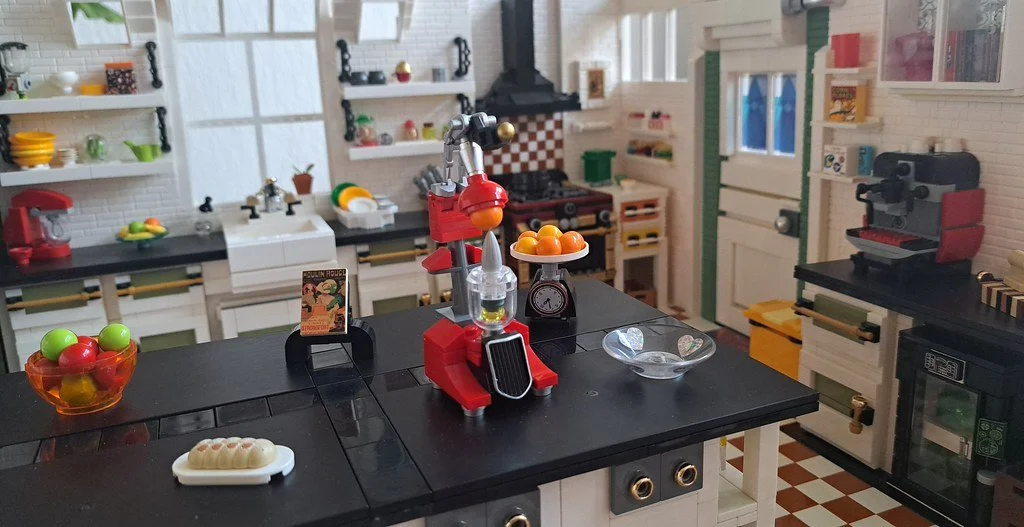
A test photo along the way.
For me, a kitchen is the soul of the home. You’re there every day, making things that bring you joy, and for me personally, it's the place where you gather. You talk while preparing food, and sometimes you even eat there. A kitchen is also a place where many things are always present—appliances, pots and pans, bottles, jars, herbs, food… in short, a collection of things you've accumulated over time.
I wanted to bring all these elements together in what I planned to build. But I also wanted to create something that everyone can relate to.
Ann: Your previous model, Old Dutch Kitchen, beautifully captured the character of 17th-century interiors. This new kitchen feels much more modern and familiar—the viewer feels at home rather than like they’re in a museum. How would you describe the architectural style of this build?
Victor: For me, the challenge was to build something from this era. That way, you keep things interesting by stepping outside your comfort zone and trying something new. So you look for examples of contemporary kitchens and everything that comes with them.
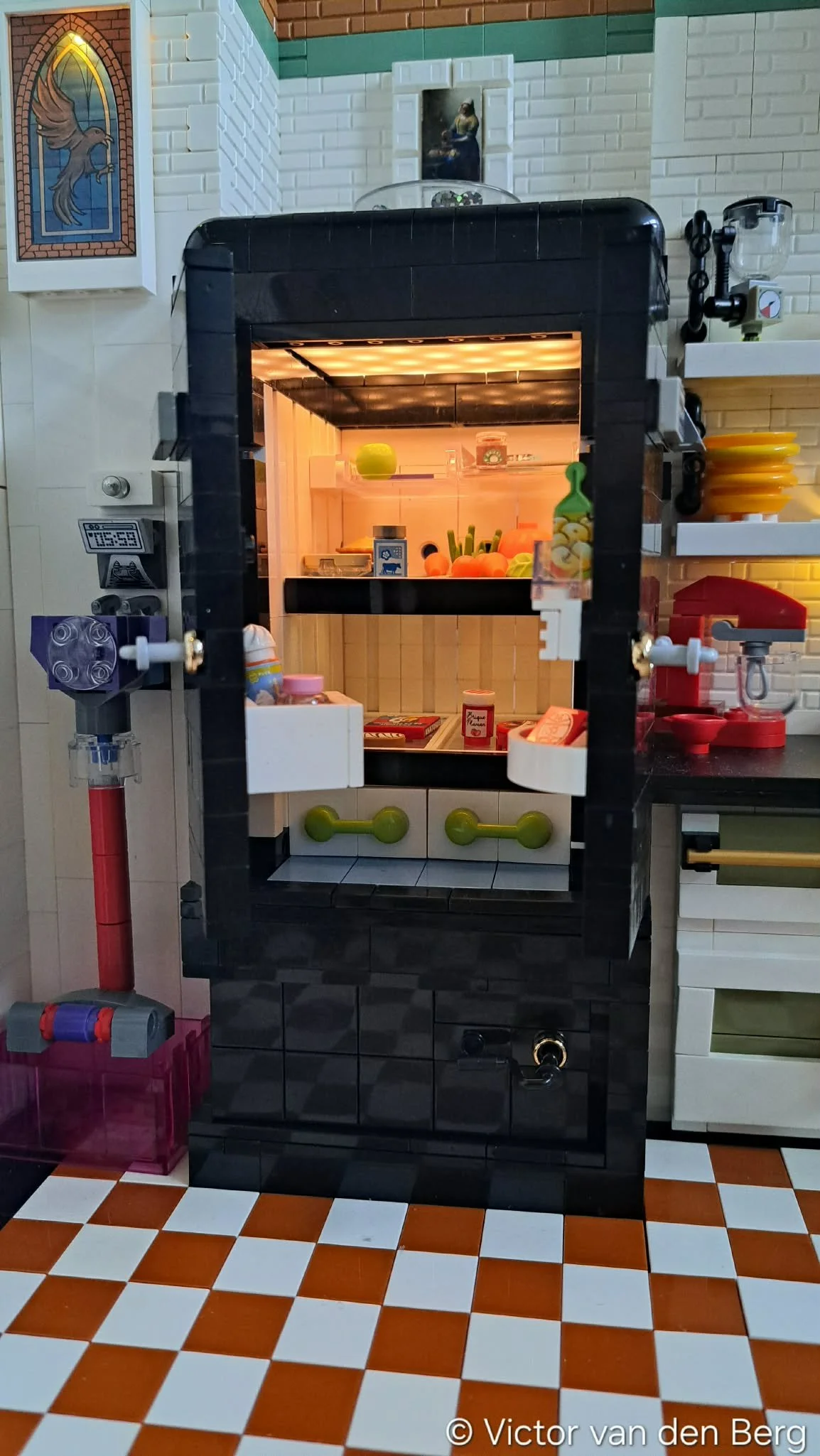
Manufacturers of kitchen appliances have done their best over the past century to make them recognizable to everyone. Now the challenge is to recreate that with LEGO bricks so that people recognize things at a glance.
I usually start with elements like furniture, appliances, bottles, jars, and so on. That already evokes a certain feeling. Then I try to visualize where everything should go. I also look at pictures online of real kitchens and the atmosphere people try to create in those spaces. Gradually, a more complete picture emerges that you can work toward.
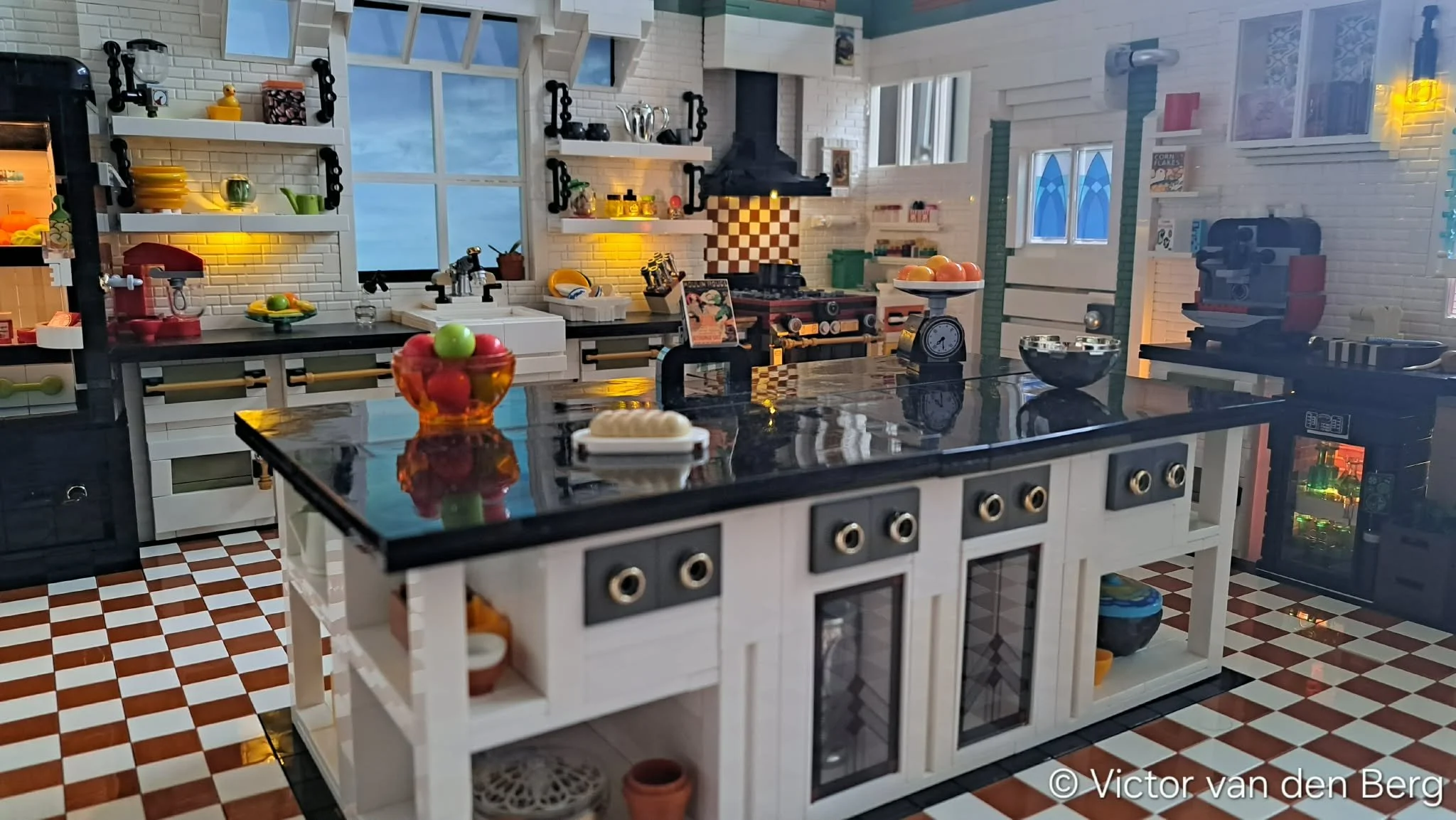
Our recognition—almost like a kind of “meme”—resides in a specific area of the brain. For each thing, there’s a trigger that activates our neurons, so we recognize it. Our brain also uses context. If you see a road, your brain expects a car. In this kitchen, when a specific appliance is visible, the brain imagines what else should be there.
I was very pleased to read that many people thought they were looking at a real kitchen photo at first. They found it strange to see it on a LEGO page and had to scroll back to check. That confirmed that I had captured the familiarity of all those elements. First, they think: kitchen. Then they realize: LEGO.
Ann: Did you design the interior entirely from your imagination, or were you inspired by real-life kitchens?
Victor: For me personally, it’s very rewarding to take the time to create something that hasn’t been done before (probably), and that seems almost impossible. Sometimes it works very quickly, but other times it can take hours to build something like the juicer.
Of course, I look at the real objects first and then try to recreate them. But LEGO often has a rather angular appearance, so you look for less common pieces that have those shapes you need. Luckily, I have a lot of LEGO, but sometimes it takes hours to find the right piece—and then figure out how to attach it.
I was pleasantly surprised when someone recognized that the juicer contained a piece of a Star Wars drone. I used it because it had a nice shine, exactly the shapes I was looking for, and could be easily attached to other pieces. Although it can be really time-consuming, it’s so satisfying when you manage to build something you know works!
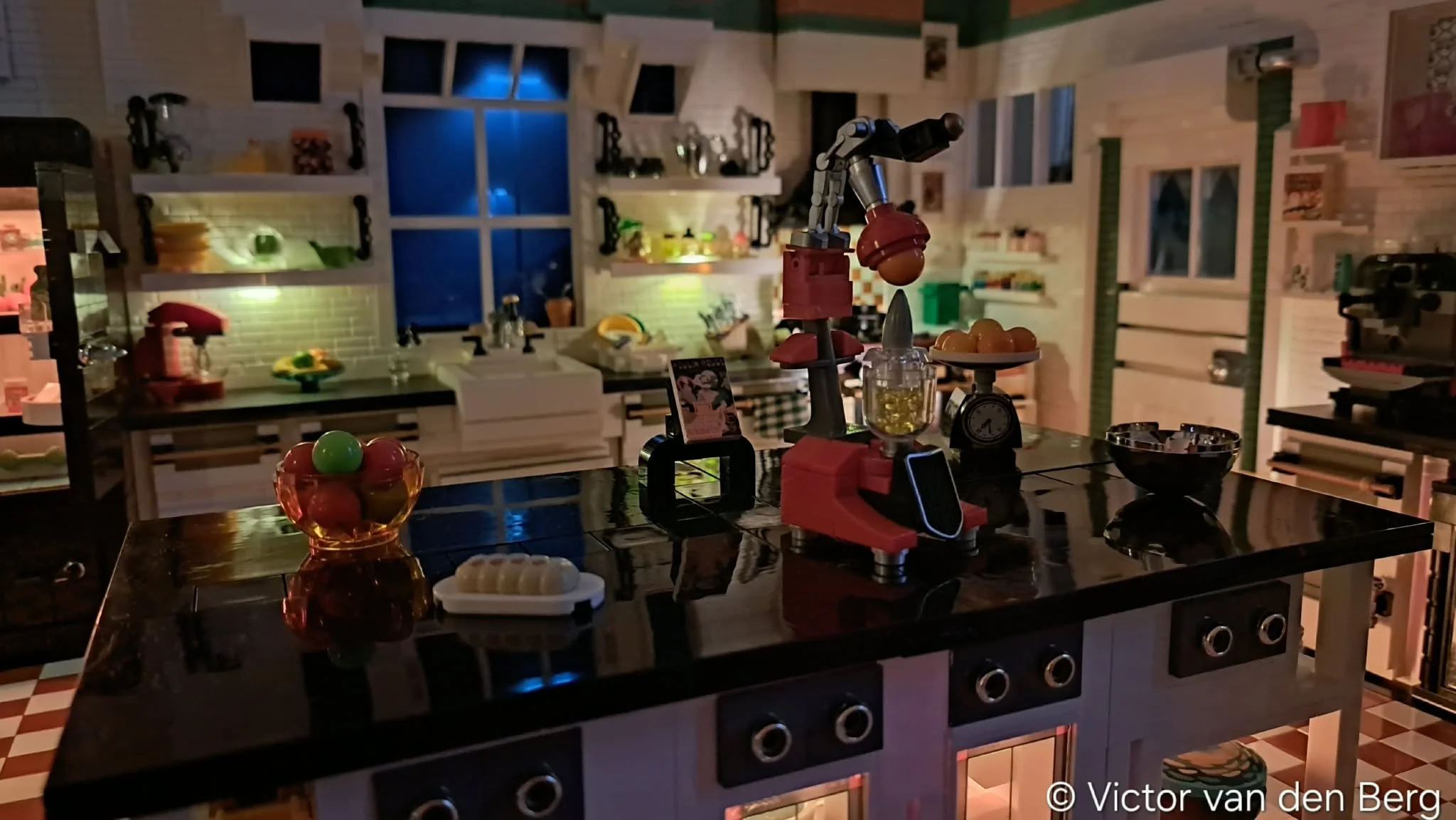
Ann: I’m really impressed by your use of color—you have a clear talent for combining tones in a way that creates such a cozy atmosphere.
Victor: Indeed, color use is also one of the things you have to pay close attention to. A lot of time goes into testing it. I might use four or five different colors for something first and see how they look in the overall scheme of things. Luckily, I also have my wife to help, and she has a great eye for it.
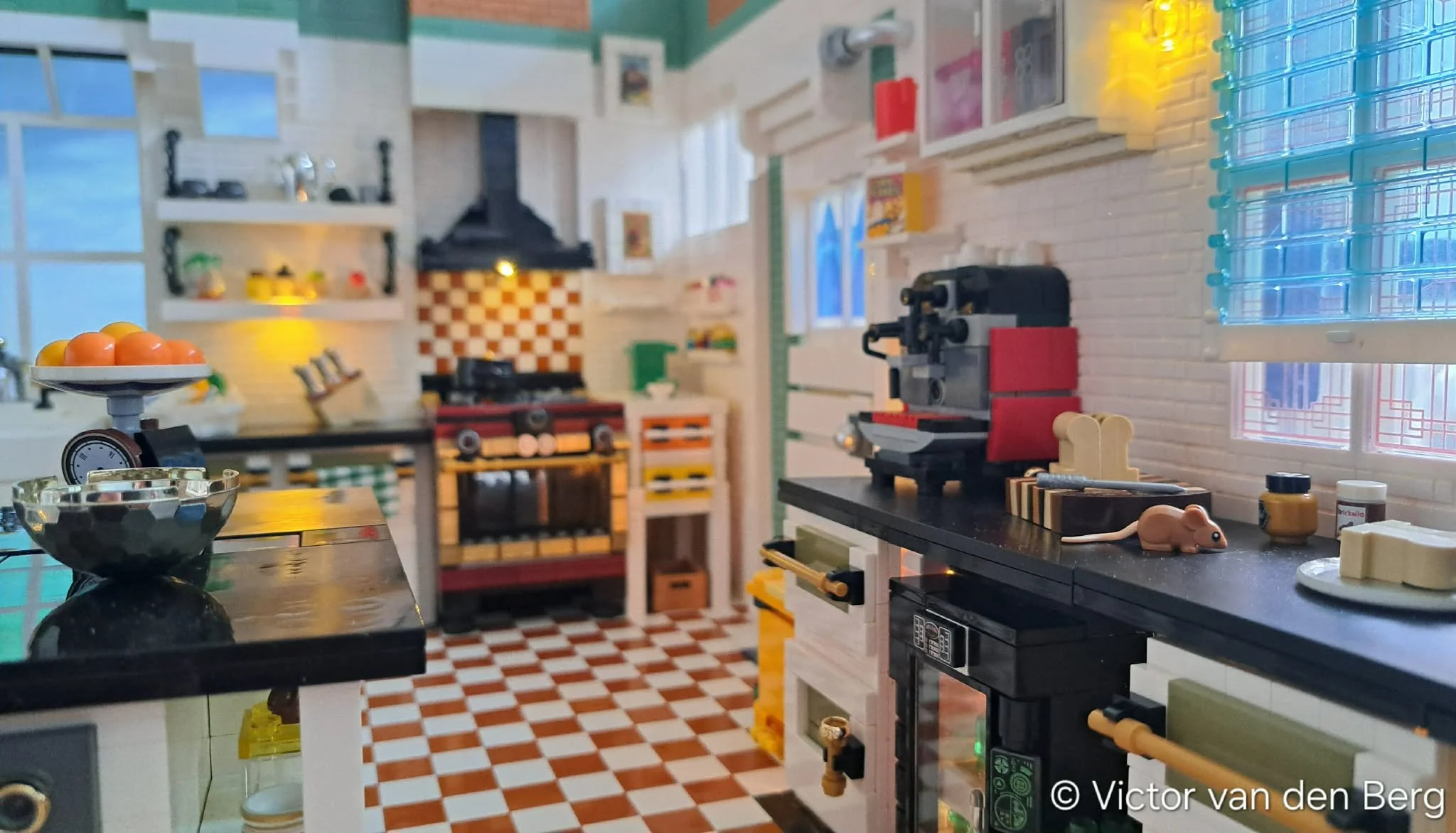
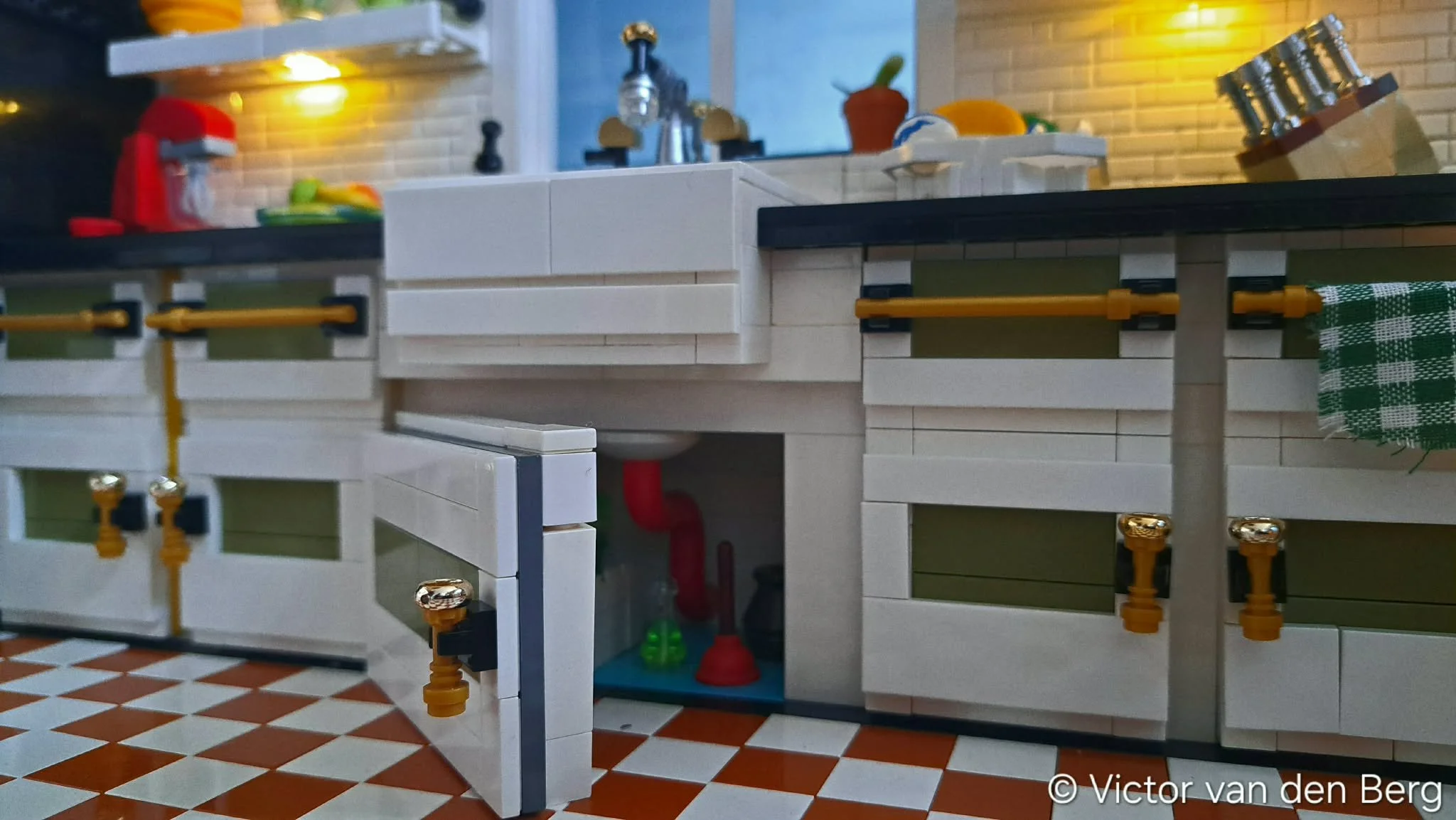
Take the cabinet to the right of the stove, for example. I initially used yellow and orange for the drawers simply because those tiles were nearby. I didn’t think they would work, but I needed to move forward. After testing many other combinations, it turned out those original colors were the best choice. So yes—lots of testing!
Ann: Could you tell us more about the custom decorative elements you created, like stickers, printed tiles, and references to famous artworks?
Victor: I like using custom-printed pieces to add that touch of authenticity. It’s often the smallest details, things we perceive almost subconsciously, that enhance the realism. I especially like including typically Dutch elements, like The Milkmaid or Girl with a Pearl Earring. The latter, in particular, feels as though she’s looking directly at you, which really shows the brilliance of painters like Rembrandt.
I also thought about what kind of art or posters you would actually hang in a kitchen and chose things I would personally include. Naturally, I wanted it to be realistic, so I opted for some custom-printed images. LEGO itself doesn’t have many realistic-looking printed tiles.
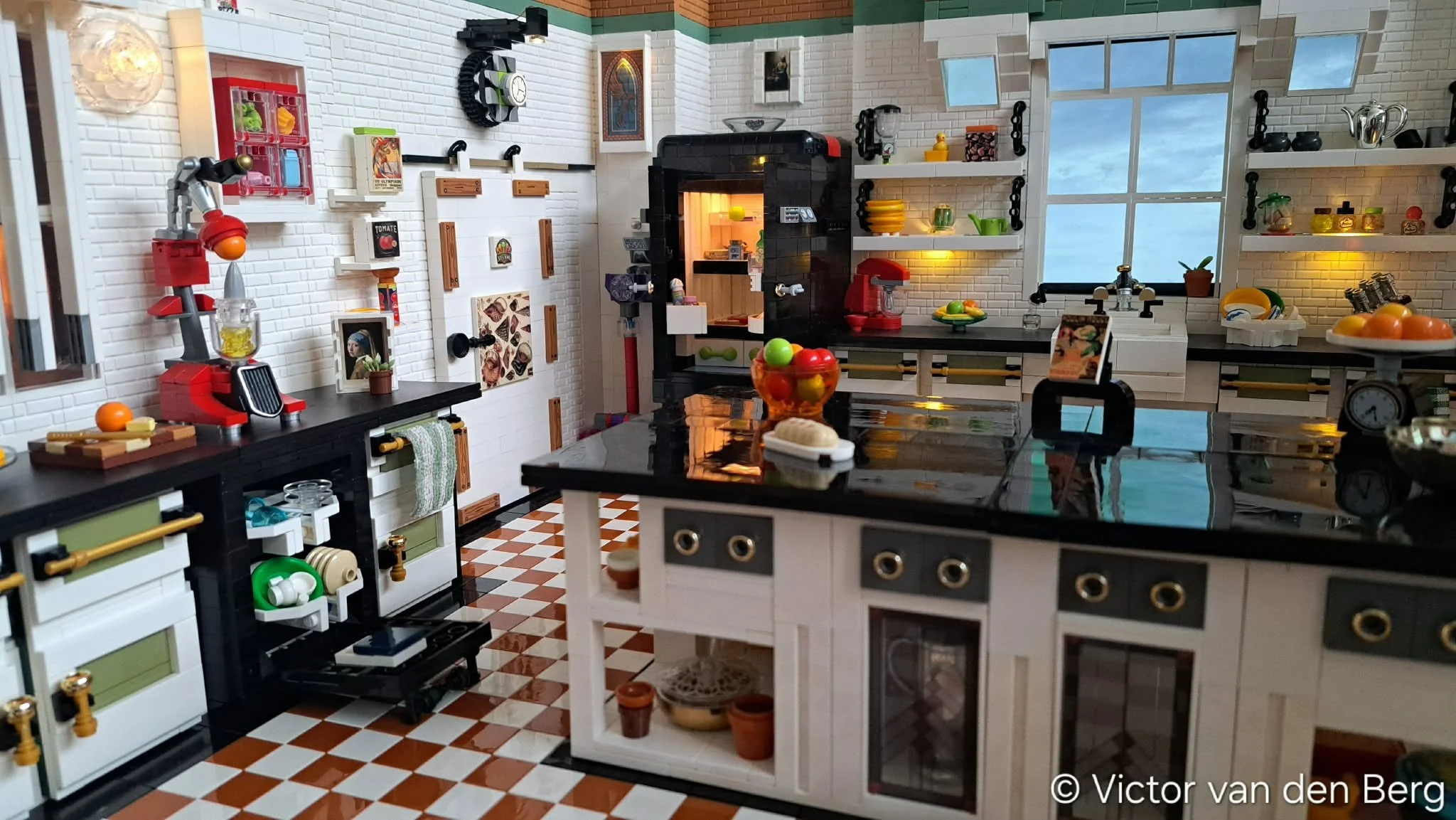
Ann: The lighting looks incredible! What kind of system did you use to achieve such a vivid effect?
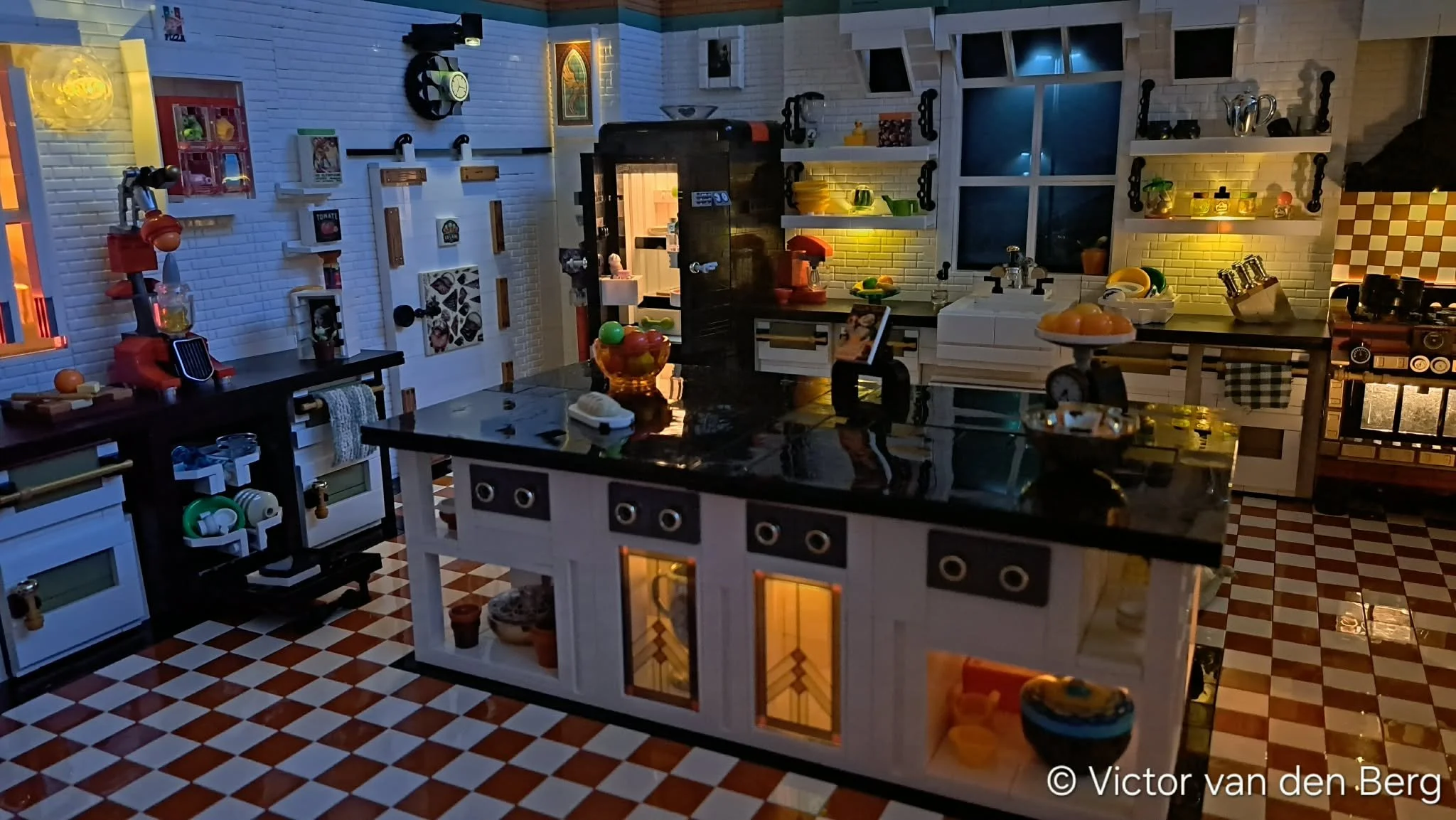
Victor: I once bought lights from a Dutch maker who designs them specifically for LEGO. I collected them, and they’re also nicely integrated into the construction. But they’re very small, and the copper wires don’t really cooperate. It takes a lot of time, but the effect is always beautiful.
For the photos, I always wait until dusk because that gives me exactly the right lighting to make the lights stand out. I don’t achieve that effect by, for example, darkening the room or closing the curtains. Dusk only lasts for a short time, so I have a short window to take my photos with the right exposure.
Through the windows, you can see clouds or lampposts at night. I usually use a laptop or tablet to project those scenes. It adds another layer of realism, and people often believe the illusion is real.
Ann: I can’t help but admire the realism of the cooking and technical details. How long did it take you to select and create all the accessories for this MOC?
Victor: I’ve tried as much as possible to focus on those small details—those “memes” our brain looks for to complete the picture and create the illusion of reality. It also helps, of course, to look at pictures on kitchen websites and at your own kitchen. What exactly do you find in a kitchen? Each day, I tried to create something that feels like it belongs in a kitchen.
It’s precisely why those small details are the most fun to create. It becomes a bit addictive—you want to keep making things you’re proud of, things you know people will notice and comment on.
Ann: When working at this scale and level of detail, do you imagine the personality of the person who lives in the space? It really feels like a lived-in kitchen.
Victor: While building, I try to imagine how it would feel to move through the space. That helps determine the right proportions for the kitchen. This kitchen would be amazing to cook in! My wife was watching too, of course, and I was thrilled with her reactions, like: “Wow, you can just walk right in!” That's enough for me. ;)
Ann: I noticed you kept adding new details and refining the lighting as the build progressed. It really gives the impression of life behind the scenes. Were you sharing a finished build in stages, or was it an evolving process?
Victor: Every day, I tried to step back and look at the whole thing. Was everything right? The colors, the proportions, the overall look and feel. I posted some photos during the building process and received a lot of positive feedback, which really helps, of course. So each day became a process of testing and observing. I also take a lot of photos to see how it looks from different angles—and, of course, how everything works together as a whole.
The funny thing is that you end up working almost the same way you would in a real-life kitchen. You gradually collect more and more things and figure out where they fit best, whether that’s in a practical sense or just aesthetically.
For me personally, it was a big challenge to create something contemporary that people would immediately recognize, and to make it as realistic as possible. Given the incredibly warm and enthusiastic response the project received, I think I succeeded!
Ann: Thank you so much for this wonderful conversation, Victor! We truly enjoyed exploring your creation and wish you continued inspiration for many more masterpieces!
What’s one small detail you’ve built into a MOC that made the biggest difference in bringing it to life? Let us know in the comments below.
Do you want to help BrickNerd continue publishing articles like this one? Become a top patron like Paige Mueller, Rob Klingberg from Brickstuff, John & Joshua Hanlon from Beyond the Brick, Megan Lum, Andy Price, Lukas Kurth from StoneWars, Wayne Tyler, Dan Church, and Roxanne Baxter to show your support, get early access, exclusive swag and more.