The Conversation Piece #12: Molds That Break The Mold
/
“The Conversation Piece” is a monthly BrickNerd series about creativity and building with LEGO authored by our friends over at the Builder Improvement Initiative (BII), a Discord-based community that helps LEGO builders of all levels get better at their craft through knowledge-sharing and constructive feedback.
Have a question you would like us to consider for a future article? You can submit it here. Enjoy!
Why So Many New Molds?
Browsing the LEGO element catalog the past few years can make you feel like a kid in a candy store, or perhaps more accurately, a mall of candy stores. For nearly every category of part, we’ve seen several groundbreaking additions to the family: plates now come rounded with bar holes, wedge plates are becoming tiles, and brackets are always getting a new variant. The graph below charts the amount of new parts per year (taken from Brickset), although it is inclusive of printed parts and recolors, and thus does not necessarily show a trend accurate to molds.
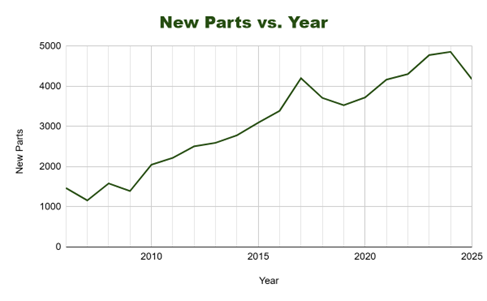
With so many new parts being added, it isn’t unreasonable to ask why this is the case. While we’ve received plenty of new molds in the past, the pace of releases and novelty of the molds have felt especially extreme over the last year or two, and based on the January sets just released, it looks like 2026 will continue that trend. So, what is LEGO doing that demands such an influx of new and inventive molds?
Before we dive in, it should be noted: a majority of this article is strictly conjecture, based on observation and experience as LEGO enthusiasts. As always, you are free to draw your own conclusions. You may have a different perspective, and that’s okay!
Modernizing the System
Lately, there has been a shift in the style of LEGO sets. In recent years, LEGO has been developing and pushing sets that appeal to the adult model builder demographic, especially within the Icons, Botanical, and Speed Champions themes. As part of this, sets – and subsequently parts – look increasingly modern, with compact designs and complex geometry being used to achieve higher accuracy in a smaller space.
This stylistic shift can be seen most notably in the Speed Champions line, which has been officially going on for 10 years (feel old yet?). The graphic below shows LEGO Speed Champions over the years and illustrates how style shifts and new parts are linked. Early designs were considerably blocky – like many LEGO cars at the time – but have grown increasingly sleek and complex. One of the most noticeable ways this is evident is in how LEGO approached hood design over time.
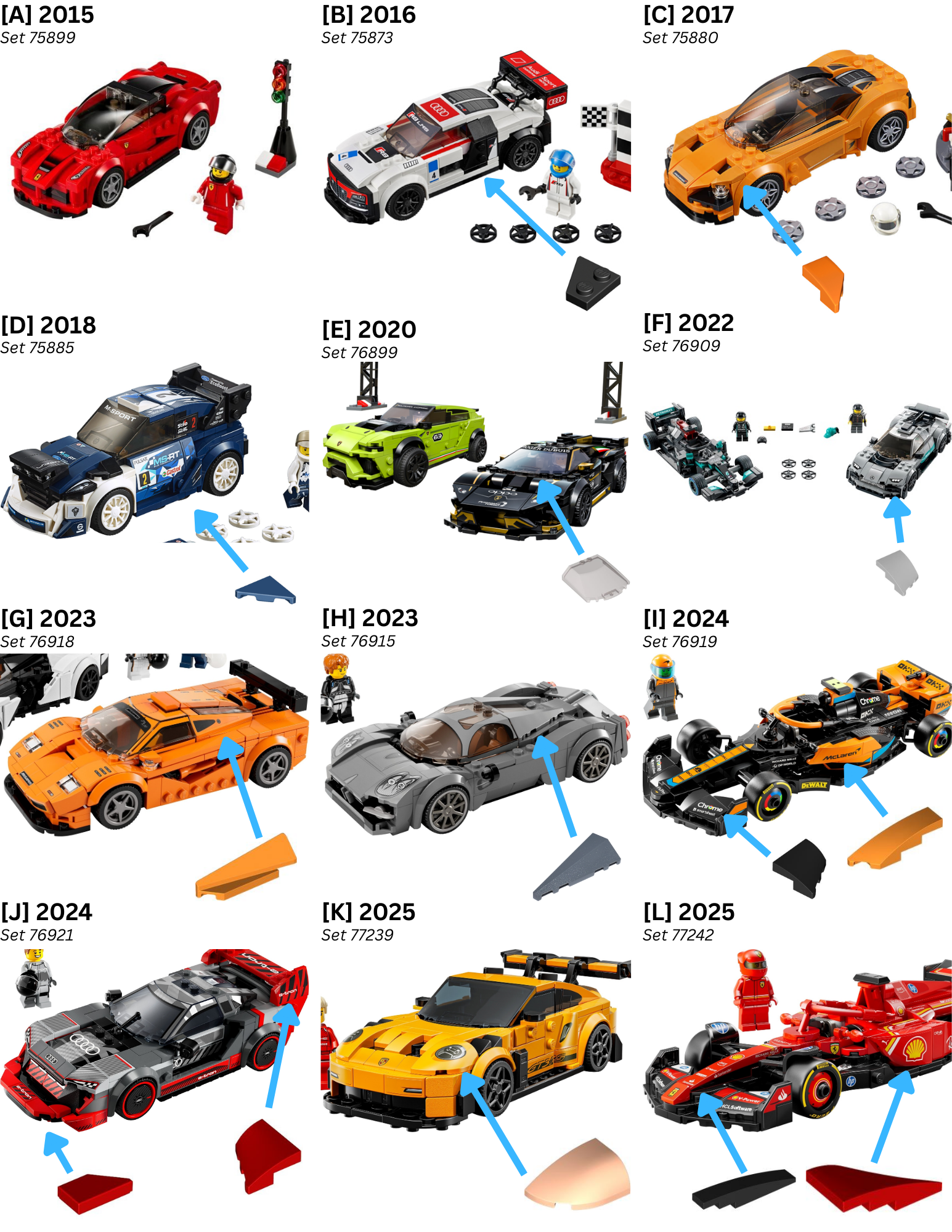
In 2015 and 2016, slopes were simply staggered to give the illusion of a curved appearance (e.g, set [B] above). In 2017, LEGO introduced the 2 x 1 x ⅔ Wedge Slope [C], allowing for more accurately tapered edges. The 2 x 2 Triangular Tile was introduced in 2018’s 75885 Ford Fiesta M-Sport WRC [D], adding to a growing family of angled tiles. Both these parts continue to see use in the Speed Champion line to this day, and 2020’s 76899 Lamborghinis [E] use both for hood shaping. This set still showed the limitations of 2 x 1 x 2/3 Wedge, however, as the lime green Urus ST-X hood still looked somewhat awkward and blocky. This geometry was solved with 2022’s 3 x 2 Wedge Slope [F]. The part selection only improved in following years with the addition of 2 x 2 Wedge Slopes [J], 2 x 3 Curved Beveled Slopes [K], and 4 x 2 Wedge Slopes [L].
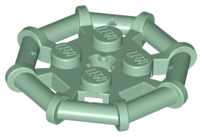
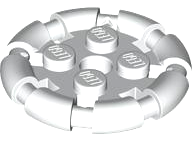
While new slope elements are a great way to modernize the appearance of sets, outside of the Speed Champions line, LEGO has also made efforts to modernize parts that are typically used internally. The 2 x 2 Octagonal Bar Plate (below, left) was released in 2008 and has been a staple part in the MOC sphere since then. While the function of the part is useful, its octagonal form is rather bulky and dated. In 2025, however, a functionally-identical part (well, nearly identical) was released in the form of the 2 x 2 Round Bar Plate (below, right). The updated mold has a smaller footprint, which combined with the round form, lends itself to a more modern design. Only time will tell if the original part will be retired in the upcoming years.
Fixing the System
There have been several parts – new and upcoming – that seem to be addressing issues with the current LEGO system, whether that be a gap in the catalog or an inconsistency.
The family of 1 Stud Radius Curved Bricks – referred to as Half Bow Slopes for the remainder of the article – is a relevant example of parts affected by a change for the sake of consistency. Released in 1992, the 1 x 2 x 1 1/3 Half Bow Slope has cemented itself as a community staple. The part, however, had one feature that limited its use. The diameter of the curve is 2.5 plates, which means that there is an extra 1.5 plates of height to the slope. In most applications, this doesn’t pose an issue. However, it did limit how tight you can build with the piece; for example, assemblies that used the part with stud reversal techniques were limited to 8 plates wide with a significantly flat face: a whole 3-plates wide!
This profile was continued with the 1 x 4 x 1 1/3 Half Bow Slope (below, [A]) and the 2 x 4 x 1 1/3 Half Bow Slope with 4 Recessed Studs [B]. Then, in 2016, LEGO broke away from this design with the release of the 5 x 5 Round Corner Slope [C] (likely to save on plastic due to the size of the part). This new part was only 1 brick tall, leaving a nearly-unnoticeable 1/2 plate flat edge on the bottom of the curve. Two years later, the 1 x 2 Half Bow Slope [D] continued the trend. In 2020, the family was blessed with its newest member: the 2 x 2 x 1 1/3 Corner Bow Slope [E]. As the name suggests, this part was a return to classic form, standing a proud 1 1/3 plates tall just like its ancestor. The 1 x 1 x 1 1/3 Corner Bow Slope [F] continued to stick to this legacy.

Things started to get interesting in January 2025. At this moment, the family of Half Bow Slopes exists in two heights. Most of the family stands proud at 4 plates tall, but there are a few short kings in Part 24599 and 37352 at 3 plates tall. This inconsistency may seem like it rarely matters, but Set 10344 Lucky Bamboo proved just why a change was necessary.

The set uses the 5 x 5 Round Corner Brick to form the pot. However, the size of the bamboo necessitated a pot wider than 10 studs. Due to the tiled gold stripe, the set couldn’t use the short 1 x 2 Curved Slope, and no 5 x 5 curved plates exist to make the original 2 x 1 x 1 1/3 Curved Slope with Recessed Stud work.
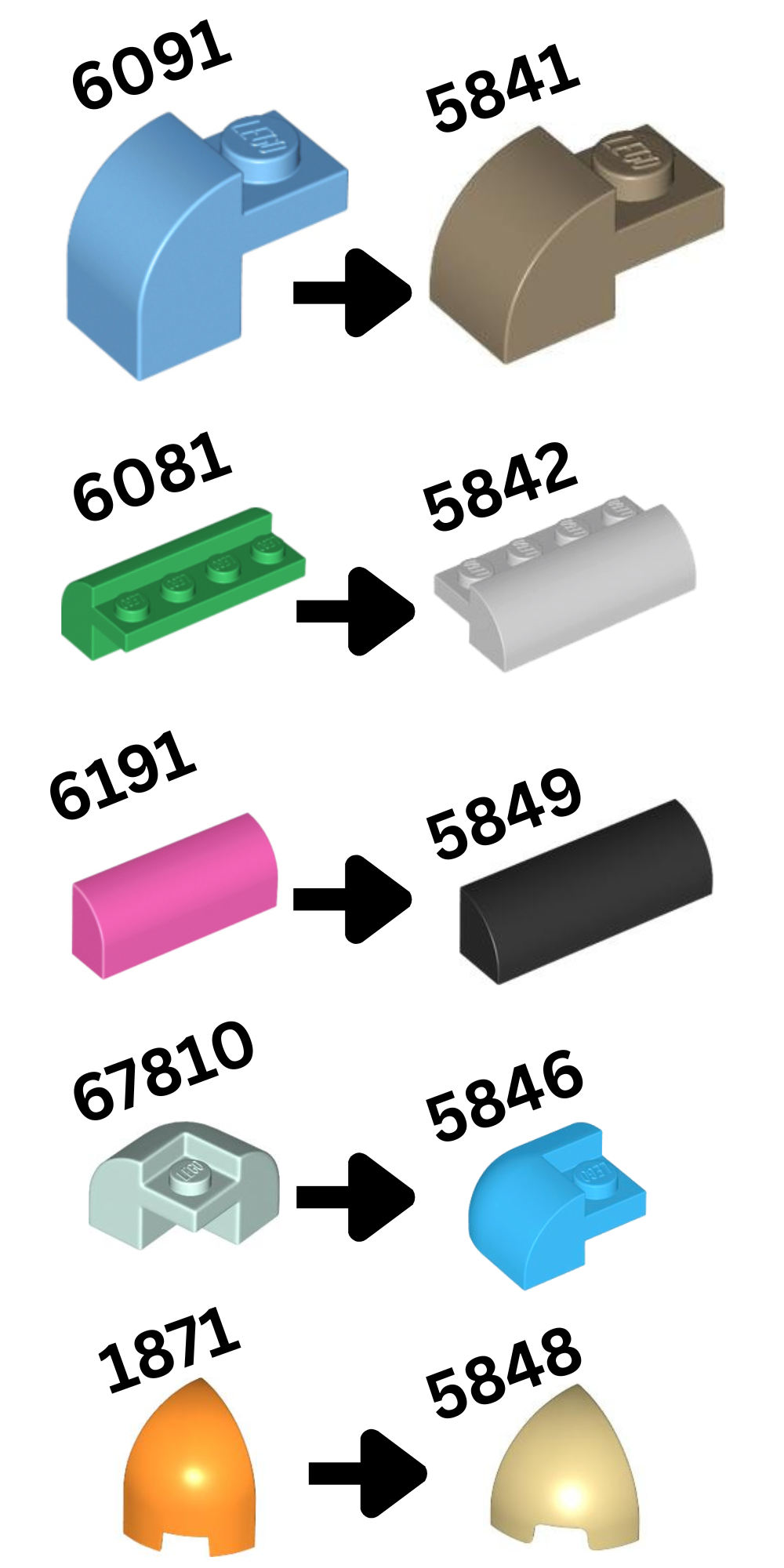
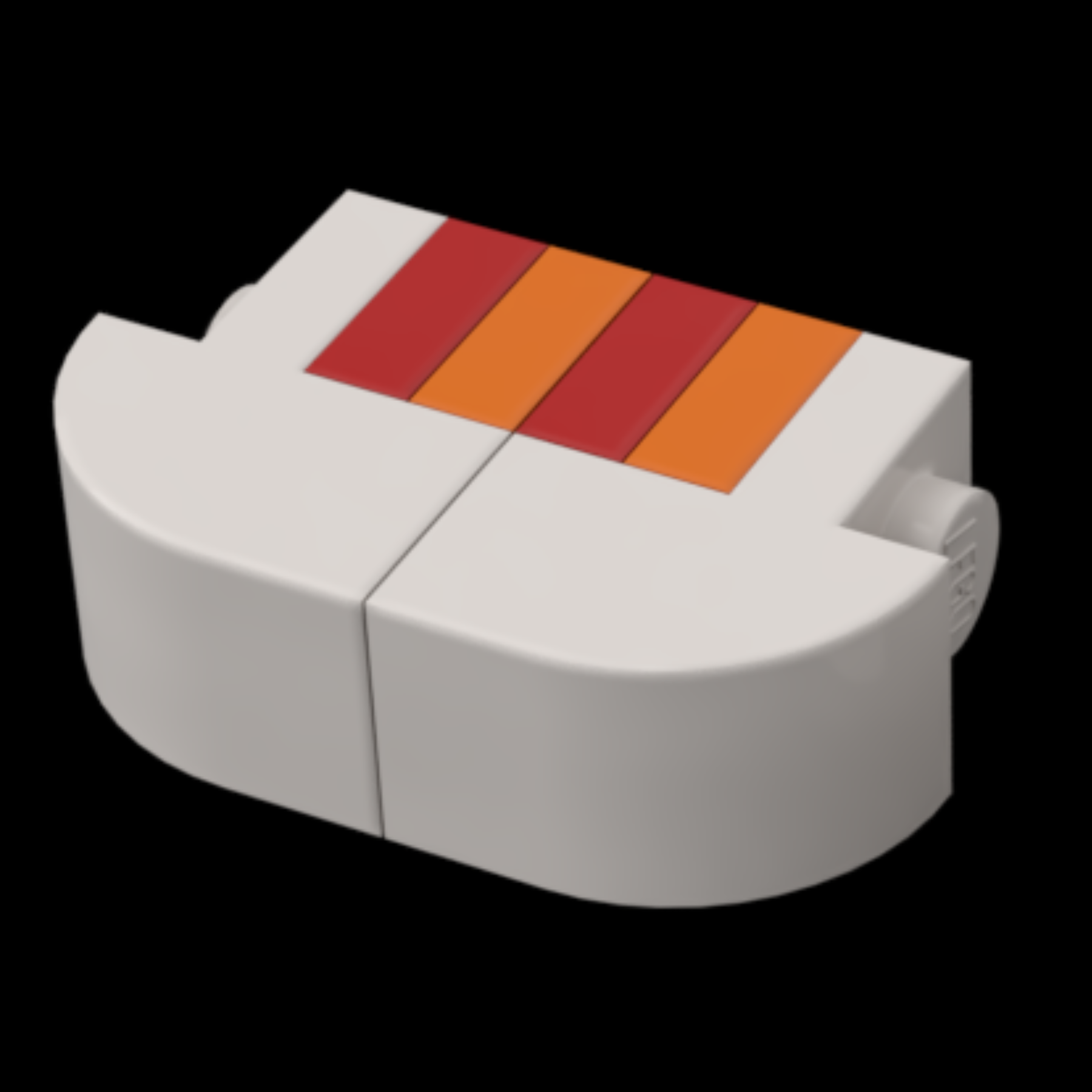
This issue was solved with a brand new part: the 1 x 2 x 1 Half Bow Slope. The part was nearly identical to its predecessor, but instead of being 4 plates tall, it was reduced to 3. Other parts quickly followed suit, and by the end of 2025, nearly every part in the family was standardized to 3 plates tall.
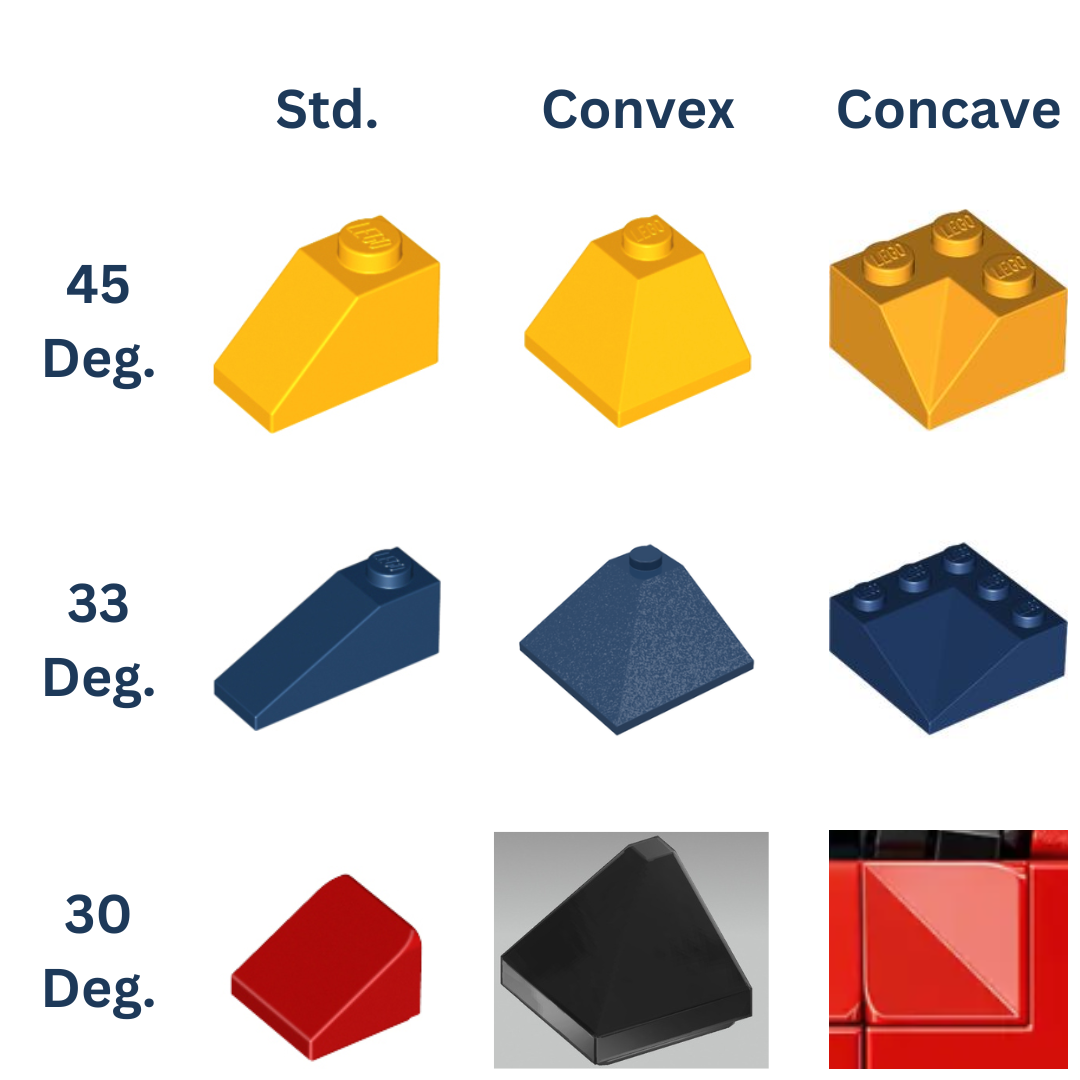
Not all new parts designed to “fix” the system address an inconsistency within a family of parts; rather, they fill a gap. Adjacent to our curved slopes, we have our good ol’ classic family of slopes in the form of 45, 33, and 30-degree slopes. The 45 deg. and 33 deg. family of slopes both include convex versions of the part (3045 at 45 deg. and 3675 at 33 deg.) and concave (3046 at 45 deg. and 99301 at 33 deg.).
Unfortunately, our friend the 30-degree “Cheese” slope (part 54200) remained alone since 2004, save for the 1 x 2 variant. While the 45 deg. and 33 deg. slopes and their convex/concave versions are more part-efficient for building large slope structures, their 1/2 plate lip can cause a jagged look.
As the cheese slope has no flat top, it is much better suited to getting clean edges using basic 1/2 plate offsets, but the lack of concave and convex versions of the part can limit or ruin the corners of otherwise perfect sloped surfaces. LEGO has also seen this gap in the system, and 2026 is bringing us concave versions of the cheese slope in set 77254 Ferrari SF90 XX Stradale Sports Car as well as a convex version in set 77257 McLaren W1.
Simplifying the System
The third justification for many new parts is that they are a way of “simplifying” the LEGO system. Through simplification, parts can achieve the same function that can already be accomplished with current parts, but either require more complicated techniques or use more space/parts.
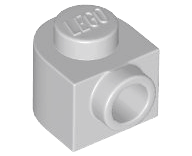
One of the most relevant examples of this is the good ol’ new-and-reliable D-SNOT (lovingly referred to as the swivel SNOT here on BrickNerd). Introduced in March 2023, this part has already been used in 300 sets over three years. While undoubtedly a game-changing part, one of its main functions has actually existed in the system through the sideways use of the classic Erling/headlight brick. However, to do this, one needs at least a 1/2 plate of space behind the brick. This technique was used in the 76917 Nissan Skyline GT-R (R34), released in January of 2023, to attach the vehicle’s side panels. While this works, it requires some extra space, and though this particular model has the space to spare, not all do.
The 76921 Audi S1 e-tron quattro has a particular feature where the space required for a headlight brick simply wasn’t achievable. The D-SNOT – which arrived only three months later after the Nissan Skyline – eliminates the space requirement, allowing for tighter assemblies. While the assembly on the Audi, seen below, could have been designed using the Erling brick, the D-SNOT allows for a much simpler and sturdier construction.
In an interview with New Elementary, Speed Champions designer Christopher Stamp spoke of this purpose: “We checked in with many different projects, from LEGO Super Mario to LEGO Monkie Kid to ask, ‘Have you ever found yourself with a problem where this might help?’ And everybody said that yes, if they had this element, it could help them from having to add six pieces to do the job of one, and that it would really simplify things.”
All The Above and Beyond
Few LEGO pieces are designed to fit into a single category. An aspect of good design is that the design can achieve several goals. Take the half bow slope; while the updated molds fix an inconsistency with the system, they also look considerably more modern than the originals. New slopes modernize the system but also simplify it, allowing certain features to be created in a single part rather than through complex techniques…
… wait, isn’t part of the fun of building trying to find creative ways to solve problems? How far is “too far” for a mold to go? When do we start questioning whether a part is even truly LEGO?
This is arguably the largest source of controversy on the topic in the MOC sphere today. This ties into one final reason for a new mold we have yet to talk about: expanding the system. As we discussed earlier about the D-SNOT, there were simply some things that could not be achieved with an Erling brick. But is that really true? Set 76918’s McLaren Solus uses the D-SNOT and a Pneumatic T-Bar to attach a few side plates where a bracket or brick couldn't have worked. But was it actually the only option? With the right geometry, a clip connection could have worked just as well.
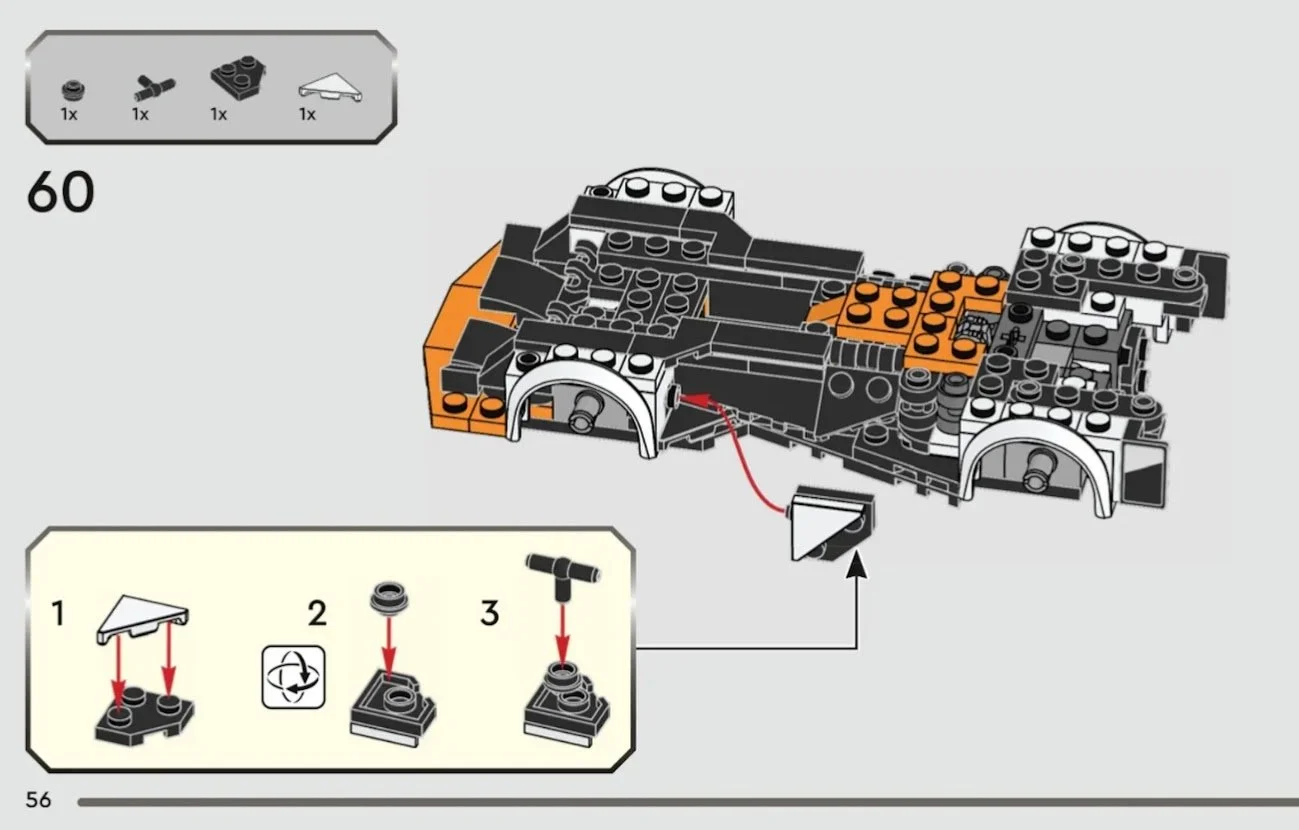
When does a part go too far, and instead of expanding the system, it breaks it? Given the artistic nature of the hobby, there can be no single true answer; each builder must set their own boundaries. But how does a builder evaluate new parts? How does one keep up to date with all the new parts? These are questions we seek to answer in a future article!
Written by Eann McCurdy in collaboration with Julian Collins.
Have a question for a future article in The Conversation Piece? Let us know in the comments below!
Do you want to help BrickNerd continue publishing articles like this one? Become a top patron like Marc & Liz Puleo, Paige Mueller, Rob Klingberg from Brickstuff, John & Joshua Hanlon from Beyond the Brick, Megan Lum, Andy Price, Lukas Kurth from StoneWars, Wayne Tyler, Dan Church, and Roxanne Baxter to show your support, get early access, exclusive swag and more.